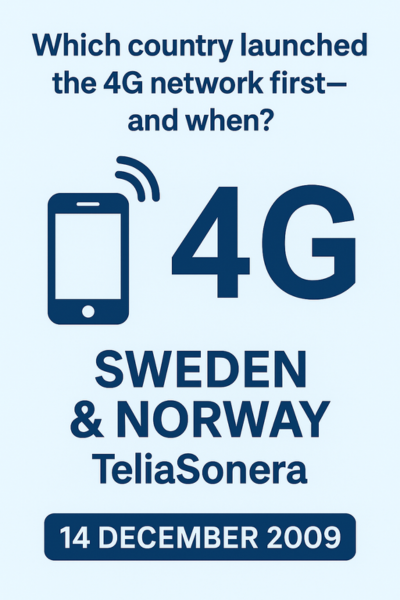
Who launched the 4G network first — and when?
Who launched the world’s first 4G network, and when did it happen?
Answer
The first widely recognized commercial LTE (Long Term Evolution) — commonly called “4G” — was launched by TeliaSonera in the Scandinavian capitals of Stockholm (Sweden) and Oslo (Norway) on 14 December 2009.
However, if you define “4G” more broadly to include earlier mobile broadband technologies marketed as 4G (for example, Mobile WiMAX, WiBro and early HSPA+), there were earlier commercial rollouts in several countries (notably South Korea and some operators in Asia and the US) before 2009. The answer therefore depends on the technology and the definition you use.
Why the question has more than one correct-looking answer
“4G” was originally defined by the ITU as a set of standards called IMT-Advanced — a strict technical benchmark that required very high peak speeds and other criteria. Early evolutions of 3G (like HSPA+) and the first releases of LTE and Mobile WiMAX did not always meet the literal IMT-Advanced spec, but the industry quickly began using “4G” as a marketing term for much faster mobile broadband services. In December 2010 the ITU acknowledged that evolved 3G technologies such as LTE and WiMAX (and their improvements) could legitimately be considered 4G in practice. That’s why timelines look different depending on whether you use a strict or practical definition.
The two main technologies people mean by “4G”
-
LTE (Long Term Evolution) — evolved from GSM/UMTS ecosystems and ultimately became the global 4G standard. The first commercial LTE deployment that many sources recognize was by TeliaSonera in Sweden and Norway on 14 Dec 2009.
-
Mobile WiMAX (IEEE 802.16e / 802.16m) — a competing technology that saw early commercial launches in several markets and was often marketed as “4G” in places where it was deployed (for example, certain Korean, Russian, U.S. and Asian deployments). These earlier WiMAX rollouts complicate claims about who was “first.”
A short timeline of early 4G-era launches
-
2006–2008 — Early Mobile WiMAX and WiBro trials and launches: Some nations and operators (notably in South Korea with WiBro and other markets testing Mobile WiMAX) started commercial services earlier than 2009 using WiMAX-based systems — and some marketed those services as “4G.”
-
2008–2009 — WiMAX devices and city-scale rollouts: Various operators launched WiMAX services and devices in selected cities and countries; in certain local markets these were the first “4G-like” commercial services.
-
14 December 2009 — TeliaSonera launches commercial LTE in Stockholm and Oslo: Widely reported and cited as the first commercial LTE (branded “4G” by the operator). This launch is the clearest milestone for the first commercial LTE deployment.
-
2010 onward — Broader LTE rollouts and devices: Throughout 2010 and into 2011 LTE networks and devices proliferated globally; many operators offered “4G” branded services, and in December 2010 the ITU effectively recognized evolved 3G tech such as LTE and WiMAX as 4G for practical purposes.
Country perspective: who to credit
-
Sweden and Norway (via operator TeliaSonera) — if your criterion is the first commercial LTE network marketed as 4G, the credit goes to TeliaSonera’s launch in Stockholm and Oslo on 14 December 2009. This is the commonly accepted “first commercial LTE” milestone.
-
South Korea and other early adopters of WiMAX/WiBro — if you consider earlier WiMAX/WiBro commercial deployments (which some called “4G”), then countries like South Korea had early commercial services as far back as 2006–2008 with mobile broadband technologies that significantly outpaced 3G. That’s why some local narratives call South Korea “first” in delivering 4G-like mobile broadband services.
What made TeliaSonera’s 14 December 2009 launch notable?
-
It was the first operator to offer a commercial LTE service to real customers in two capital cities (Stockholm and Oslo), with consumer devices (USB modem dongles) and carrier-grade infrastructure from major vendors. TeliaSonera marketed the service as “4G,” set practical expectations for speeds far higher than 3G, and triggered the rapid global push toward LTE.
If your question asks which country launched 4G first and you mean the first commercial LTE network — then the milestone points to Sweden and Norway (TeliaSonera) on 14 December 2009. If instead you use a broader marketing definition of “4G” that includes early Mobile WiMAX or WiBro deployments, then other countries (notably South Korea) had earlier commercial services that were marketed as 4G-like before 2009. The safest answer for most readers: TeliaSonera’s LTE launch on 14 December 2009 is the widely accepted “first” commercial 4G/LTE deployment, but the full story depends on how you define the term.
FAQ (fast answers)
Q: Was the first 4G in the US?
A: No — the commonly cited first commercial LTE launch was TeliaSonera in Sweden/Norway on 14 Dec 2009. The U.S. saw early WiMAX commercial services and later LTE rollouts, but not the first LTE commercial launch.
Q: Did any country have 4G before 2009?
A: Some operators launched WiMAX or WiBro services (marketed by some as “4G”) earlier (2006–2008), notably in South Korea and selective city deployments elsewhere. But those used different technology than LTE.
Q: When did ITU accept LTE and WiMAX as 4G?
A: In December 2010 the ITU recognized that evolved 3G technologies, including LTE and WiMAX improvements, could be considered 4G for practical purposes.