What is 4G Used For, and How Does 4G Work?
In today’s hyper-connected world, the term 4G is familiar to nearly everyone who owns a smartphone or uses the internet on the go. But while most people know that 4G provides fast mobile internet, few truly understand how it works and what makes it different from earlier technologies like 2G and 3G.
This detailed guide explains what 4G is, how it works, and what it’s used for in everyday life and industry. You’ll also learn about the technology behind 4G, its advantages, and why it remains one of the most significant leaps in mobile communication history.
What Is 4G?
4G stands for Fourth Generation of mobile communication technology. It’s the successor to 3G and a major upgrade in terms of speed, reliability, and capacity. The “G” in 4G refers to the generation of technology used for wireless communication between mobile devices and the internet.
4G was first launched commercially in 2009, marking a major shift from simple voice and text networks to high-speed data networks capable of supporting video streaming, online gaming, video calls, and more.
In simple terms, 4G provides broadband-like internet speeds over mobile networks, allowing users to browse websites, stream videos, and download files at lightning-fast rates.
A Brief History of 4G Development
Before 4G came along, mobile networks evolved through several stages:
-
1G (1980s): The first generation of mobile networks, based on analog signals. It allowed only voice calls.
-
2G (1990s): Introduced digital signals and text messaging (SMS).
-
3G (2000s): Added mobile internet access, video calling, and multimedia messaging.
-
4G (2009 onwards): Delivered true mobile broadband, enabling HD streaming, video conferencing, and real-time online gaming.
The first major 4G network was launched in Stockholm, Sweden, and Oslo, Norway by TeliaSonera in 2009. Soon, the technology spread globally, becoming the standard for mobile internet throughout the 2010s.
How Does 4G Work?
To understand how 4G works, it’s important to know that it relies on packet-switched data transmission rather than circuit-switched networks used in earlier generations. This means that instead of creating a dedicated line for communication, 4G breaks information into small packets and sends them across multiple paths to reach their destination faster and more efficiently.
Let’s explore the process step by step:
1. Radio Waves and Cell Towers
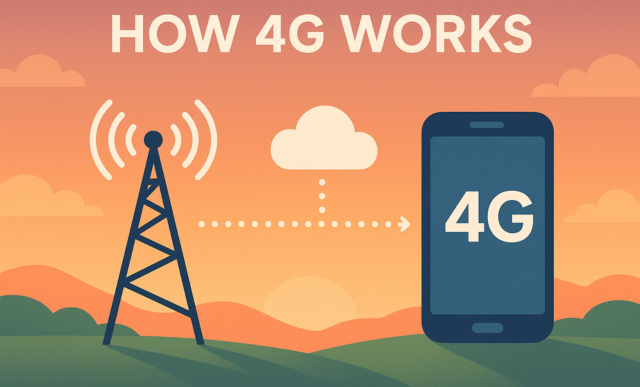
When you use your phone to connect to the internet, it communicates with the nearest cell tower using radio waves. These waves carry your data—such as a webpage request or a video stream—to the mobile network operator’s base station.
2. Base Stations and Core Network
Each tower has a base station that connects your signal to the operator’s core network. The base station translates your radio signal into digital data and forwards it to the internet backbone, which routes it to the destination server (for example, YouTube, Facebook, or Google).
3. LTE (Long Term Evolution) Technology
Most 4G networks use a standard called LTE (Long Term Evolution). LTE improves efficiency and increases data transfer rates by using advanced techniques like:
-
Orthogonal Frequency Division Multiplexing (OFDM): Splits data into multiple sub-signals that are transmitted simultaneously over different frequencies.
-
Multiple Input Multiple Output (MIMO): Uses multiple antennas on both the transmitter and receiver to send and receive more data at once.
-
IP-Based Communication: All 4G traffic (including voice and video) is transmitted as Internet Protocol (IP) data, ensuring smooth integration with the web.
4. Faster Data Transmission
Through these technologies, 4G achieves download speeds between 20 to 150 Mbps in real-world conditions and up to 1 Gbps under ideal scenarios. This is nearly 10 times faster than 3G.
The Main Uses of 4G
4G technology revolutionized the way people use mobile devices. It’s not just about browsing faster — it changed entertainment, communication, business, and industry. Let’s look at some of the most common and important uses of 4G.
1. High-Speed Internet Access
The most obvious use of 4G is to provide fast mobile internet. Whether you are checking your email, reading the news, or shopping online, 4G ensures that web pages load almost instantly. The average 4G user can enjoy seamless browsing, buffer-free streaming, and quick downloads even while moving.
2. Video Streaming and Entertainment
Before 4G, streaming HD videos on a mobile device was difficult due to low speeds and buffering. With 4G, services like YouTube, Netflix, Hulu, and Disney+ became easily accessible on smartphones and tablets. Users can now stream high-definition videos or live broadcasts anywhere with stable coverage.
3. Video Calls and Virtual Meetings
4G made video calls practical and reliable. Applications like Zoom, Skype, WhatsApp, and FaceTime depend heavily on 4G speeds for smooth, lag-free video communication. It also allowed businesses to adopt remote work and virtual meetings, setting the stage for today’s digital workplace.
4. Online Gaming and Cloud Gaming
Modern mobile games require real-time responses and fast data transfer. 4G networks reduced latency to around 30–50 milliseconds, allowing competitive online gaming on smartphones. Later, cloud gaming platforms like NVIDIA GeForce NOW and Xbox Cloud Gaming also benefited from 4G’s low-latency connections.
5. Navigation and Real-Time Location Services
4G supports GPS-based applications such as Google Maps, Uber, and food delivery services that require constant updates. The technology ensures accurate, real-time location tracking and smooth communication between drivers and customers.
6. Social Media and Live Streaming
Apps like Instagram, Facebook, TikTok, and X (Twitter) rely on 4G to deliver rich multimedia content. Users can upload high-quality photos and videos, go live, and interact instantly with followers without interruptions.
7. Smartphones and Mobile Hotspots
4G allows users to share their internet connection through mobile hotspots, enabling laptops and tablets to access high-speed internet. This feature is widely used by travelers and professionals who work remotely.
8. IoT (Internet of Things) Devices
Although 5G is better suited for IoT, 4G LTE laid the groundwork for smart devices such as connected cars, security cameras, smartwatches, and industrial sensors. These devices use 4G to communicate and send real-time data to the cloud.
9. E-commerce and Mobile Banking
4G made mobile transactions faster and more secure. Apps like PayPal, Google Pay, and Apple Pay rely on 4G connections for real-time verification, making online shopping and digital payments smooth and reliable.
10. Rural Internet Connectivity
In many regions where fiber-optic broadband is not available, 4G networks serve as the primary internet source. Fixed 4G routers and modems allow rural households and businesses to connect to the web without the need for wired infrastructure.
Advantages of 4G Technology
4G brought a wave of improvements that reshaped communication and technology:
-
Speed and Performance: 4G offers up to 10 times the speed of 3G, enabling instant data access.
-
Low Latency: Lower delay times allow real-time interaction, ideal for gaming and video calls.
-
Higher Capacity: Supports more users and devices simultaneously without congestion.
-
Better Multimedia Quality: Enables HD video streaming, high-quality audio, and crystal-clear video calls.
-
Enhanced Security: 4G uses advanced encryption and authentication protocols to protect user data.
-
Improved Mobility: Users can stay connected even when moving at high speeds, such as in trains or cars.
How 4G Differs from 3G and 5G
| Feature | 3G | 4G | 5G |
|---|---|---|---|
| Launch Year | Early 2000s | 2009 | 2019–2020 |
| Max Speed | ~2 Mbps | Up to 1 Gbps | Up to 10 Gbps |
| Latency | 100–500 ms | 30–50 ms | <10 ms |
| Main Use | Internet access, video calls | HD streaming, gaming, mobile broadband | Smart cities, IoT, autonomous systems |
| Technology | WCDMA, HSPA | LTE, OFDM, MIMO | mmWave, Massive MIMO, Beamforming |
While 5G is now expanding worldwide, 4G remains the backbone of mobile communication because of its wide availability and excellent performance.
Challenges and Limitations of 4G
Despite its many advantages, 4G isn’t perfect. Some challenges include:
-
Coverage Gaps: Rural or remote areas may still have limited 4G access.
-
Network Congestion: In crowded cities, performance may drop during peak hours.
-
Battery Consumption: Devices using 4G often consume more power than on 3G.
-
Infrastructure Costs: Building and maintaining 4G networks requires high investment.
Nonetheless, these challenges are gradually being reduced with better network optimization and the gradual integration of 5G.
The Future of 4G
Even though 5G is rolling out globally, 4G isn’t going away anytime soon. Experts predict that 4G will coexist with 5G for many years, serving as a fallback network when 5G coverage is unavailable.
Many industries and developing countries continue to rely on 4G as it provides a perfect balance of speed, stability, and affordability. Furthermore, 4G LTE continues to evolve through improvements like LTE-Advanced and LTE-Advanced Pro, offering speeds close to early 5G networks.
So, what is 4G used for, and how does 4G work?
In essence, 4G is the fourth generation of mobile communication technology that revolutionized how people access and use the internet. It works through high-speed digital data transmission using advanced technologies like LTE, MIMO, and OFDM, enabling a broad range of applications—from streaming and gaming to IoT and virtual meetings.
4G made it possible for billions of people to stay connected, work remotely, and enjoy high-quality digital experiences on mobile devices. While 5G promises even greater speed and lower latency, 4G remains a reliable global standard and continues to shape the digital world as we know it.