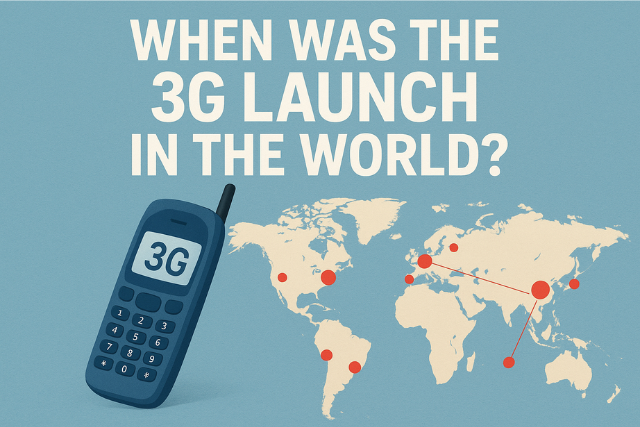
When Was the 3G Launch in the World?
An In-Depth Look at the Beginning of High-Speed Mobile Internet
The Dawn of Mobile Data Evolution
Before the arrival of 3G, mobile communication was limited primarily to voice calls and text messages. The introduction of third-generation mobile networks (3G) revolutionized the telecommunications industry by making mobile internet, video calls, and multimedia services accessible to millions around the world. This technological leap marked the beginning of a truly connected world — one where information could be exchanged instantly from a handheld device.
But when exactly did 3G launch globally? To answer that, we must look at the timeline, the countries that led the rollout, and the evolution of standards that defined this groundbreaking technology.
What Is 3G?
3G stands for Third Generation of mobile telecommunications technology. It succeeded 2G (second generation) networks, which were primarily designed for voice communication and simple SMS services. 3G, on the other hand, was built to handle data-intensive applications, enabling users to browse the internet, send emails, stream media, and make video calls from their mobile phones.
The key feature of 3G was high-speed data transmission. While 2G networks offered data speeds of about 30–50 Kbps, 3G networks could provide speeds ranging from 384 Kbps to several Mbps, depending on the specific standard implemented.
3G networks were based on technologies defined by the International Telecommunication Union (ITU) under the IMT-2000 (International Mobile Telecommunications-2000) framework. These standards ensured that 3G services could work globally across different operators and countries.
The Origin of 3G Development
The journey toward 3G began in the 1990s, when mobile data usage started increasing, and telecom companies realized that 2G networks were insufficient for the growing demand. The ITU, working with organizations such as the 3rd Generation Partnership Project (3GPP) and 3GPP2, began developing the technical specifications for 3G.
By the late 1990s, the foundations of 3G technology were established, based on several key standards:
-
WCDMA (Wideband Code Division Multiple Access) – adopted primarily in Europe and Asia.
-
CDMA2000 – used mainly in the United States, Japan, and parts of South Korea.
-
TD-SCDMA – a variant developed and deployed in China.
These standards allowed 3G to deliver mobile broadband experiences far beyond what 2G networks could offer.
When Was 3G Officially Launched?
The world’s first commercial 3G network was launched in Japan by NTT DoCoMo on October 1, 2001. The network was branded as FOMA (Freedom of Mobile Multimedia Access) and was based on WCDMA technology. This marked the beginning of the 3G era globally.
Japan’s launch was groundbreaking for several reasons:
-
It was the first time consumers could experience true mobile broadband.
-
It introduced video calling, mobile TV, and internet browsing on cell phones.
-
It set the stage for other countries to follow quickly with their own 3G rollouts.
However, the early version of 3G in Japan faced technical and adoption challenges. The network initially had limited coverage, and devices were bulky and power-hungry. Over time, with better infrastructure and improved handsets, 3G adoption grew rapidly across Asia and then the world.
Global Timeline of 3G Rollouts
Here’s a closer look at how 3G spread across the world following Japan’s pioneering launch:
| Year | Country/Region | Network/Operator | Notes |
|---|---|---|---|
| 2001 | Japan | NTT DoCoMo (FOMA) | First commercial 3G network in the world |
| 2002 | South Korea | SK Telecom, KTF | Early adopter, nationwide coverage soon after launch |
| 2003 | United Kingdom | Hutchison 3G (Three) | First commercial 3G in Europe |
| 2003 | Italy | Telecom Italia Mobile | Among Europe’s first major 3G markets |
| 2003–2004 | United States | Verizon, AT&T, Sprint | Began nationwide rollouts using CDMA2000 and UMTS |
| 2004 | Australia | Telstra, Optus | Introduced mobile broadband across major cities |
| 2005–2006 | China | China Mobile, China Unicom | Adopted TD-SCDMA and WCDMA standards |
| 2007 | India | BSNL, MTNL | Began testing and pilot programs; commercial launch in 2009 |
| 2008–2010 | Africa and Middle East | Various operators | Gradual adoption across developing regions |
By the mid-2000s, 3G had become the global standard for mobile connectivity. Within a decade, billions of users worldwide had access to the internet through their mobile phones.
How 3G Changed the World
The impact of 3G on communication and daily life was enormous. It served as the foundation of the modern mobile internet. Here are the key transformations it brought:
1. Mobile Internet Access
For the first time, users could browse websites, check emails, and download apps directly on their phones. This laid the groundwork for the smartphone revolution.
2. Video Calling and Multimedia
3G introduced the ability to make video calls and stream audio and video content. Platforms like YouTube, Skype, and early mobile TV services became possible due to 3G’s higher speeds.
3. Growth of Smartphones
Without 3G, smartphones as we know them today would not exist. The first iPhone (2007) and Android devices relied heavily on 3G to deliver seamless internet experiences.
4. Boost to E-commerce and Social Media
The rise of mobile e-commerce platforms, mobile banking, and early social media networks (like Facebook and Twitter) was directly linked to the connectivity 3G provided.
5. Economic and Social Development
In many developing countries, 3G helped bridge the digital divide by providing affordable internet access to rural and remote regions. This enabled education, healthcare, and business opportunities on a massive scale.
Technical Aspects of 3G
3G technology introduced several advanced features and improvements over 2G:
| Feature | 2G | 3G |
|---|---|---|
| Speed | 30–50 Kbps | 384 Kbps to 2 Mbps (and higher) |
| Network Type | GSM/CDMA | WCDMA/CDMA2000/TD-SCDMA |
| Main Services | Voice, SMS | Voice, Video Calls, Internet, Multimedia |
| Core Network | Circuit-switched | Circuit + Packet-switched |
| Applications | Basic communication | Mobile internet, apps, streaming, GPS |
3G also used more advanced packet-switching technology, which allowed data to be transmitted efficiently, reducing network congestion and improving reliability.
Challenges During Early 3G Deployment
Although revolutionary, the 3G rollout wasn’t without its difficulties. Some of the main challenges included:
-
High Costs: Building 3G networks required significant investment in new infrastructure, towers, and licenses.
-
Expensive Devices: Early 3G-compatible phones were costly, making adoption slow initially.
-
Battery Life: The first generation of 3G phones consumed large amounts of power, leading to shorter battery life.
-
Limited Coverage: In many countries, 3G coverage was initially restricted to urban areas.
-
Regulatory and Licensing Issues: Spectrum allocation and licensing fees varied by country, causing delays in rollout.
Despite these obstacles, the advantages of faster mobile internet and enhanced communication eventually made 3G a universal technology.
3G vs. 4G: The Next Evolution
By the late 2000s, as internet usage and smartphone applications exploded, 3G networks started reaching their limits. The need for even faster and more efficient data transmission led to the development of 4G (Fourth Generation) technology.
While 3G offered speeds of a few Mbps, 4G LTE (Long-Term Evolution) could deliver up to 100 Mbps or more. The jump from 3G to 4G was as significant as from 2G to 3G — enabling HD streaming, mobile gaming, and real-time communication on a scale never seen before.
When Did 3G Begin to Phase Out?
With the rise of 4G and 5G, many countries began phasing out 3G networks in the 2010s and early 2020s. Telecom companies redirected resources to newer technologies offering faster speeds and lower latency.
For instance:
-
Japan and South Korea shut down their 3G networks around 2022.
-
The United States began retiring 3G services in 2022–2023, with major carriers like AT&T and Verizon leading the transition.
-
Europe and other regions followed similar timelines, with gradual shutdowns continuing through 2024–2025.
Even as it phases out, 3G’s legacy remains powerful — it set the stage for the digital world we live in today.
The Lasting Legacy of 3G
3G will always be remembered as the technology that brought the internet to mobile phones. It connected people globally and enabled the rise of smartphones, apps, and digital services that define modern life.
Key milestones in 3G’s legacy include:
-
The first mobile video call in Japan (2001)
-
The global boom in mobile apps (2007–2010)
-
The rapid spread of mobile e-commerce and streaming
-
Its role in making internet access affordable and portable
Even though we now live in the 5G era, 3G’s contribution to communication, technology, and society remains monumental.
The launch of 3G in 2001 by NTT DoCoMo in Japan was one of the most important milestones in the history of mobile communication. It marked the transition from simple voice-based mobile phones to intelligent, connected devices capable of handling rich data and multimedia.
From Japan’s first network rollout to global adoption across continents, 3G changed how humanity communicates, learns, and does business. Though now being replaced by faster technologies, 3G laid the foundation for everything that followed — including 4G, 5G, and the upcoming 6G networks.
In essence, 3G was not just a technological upgrade — it was a revolution that turned mobile phones into gateways to the digital world, connecting billions of people and shaping the modern era of communication.