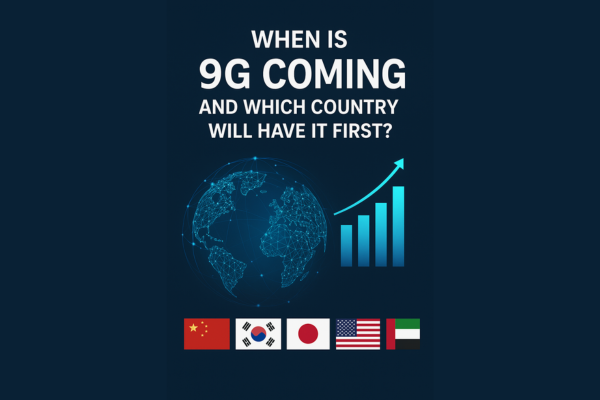
When Is 9G will come out and Which Country will have It First?
Curious about 9G? This in-depth SEO guide explains why “9G” is still speculative, how mobile generations evolve, realistic timelines (based on current 6G roadmaps), and which countries are best positioned to adopt ultra-next-gen networks first.
Introduction — the naming race vs. the technology race
Every time the telecom industry adds a new letter to “G” we expect faster speeds, lower latency, and a wave of new apps. Today the conversation is focused on 6G — a generation expected to deliver AI-native networks and terabit levels of throughput. But talk about 9G already appears in blogs and social posts. So: is 9G coming soon? And which country will see it first?
Short answer: 9G is purely speculative at this point. The industry is still formalizing 6G research and timelines; realistic public roadmaps only go as far as 6G (and sometimes 7G in very broad forecasts). Any definitive timeline for 9G would be guessing beyond available evidence. What we can do is look at the pattern of past generation rollouts, current 6G plans, and national readiness to infer who would likely lead future leaps.
Why “9G” is speculative (and what that actually means)
Mobile “G” generations are defined by waves of global research, standards work (3GPP, ITU), vendor roadmaps (Nokia, Ericsson, Huawei, Qualcomm), and commercial trials. Right now:
-
6G: active research and early standardization activity; many organizations project commercial services around 2030 or early 2030s. Major vendors and consortiums have public roadmaps for 6G research, trials, and pre-commercial devices.
-
7G–9G: no formal standards, no timelines, no agreed technical definition. These are hypothetical labels for later evolutionary steps in wireless technology.
Because the industry follows a roughly decadal rhythm (e.g., 3G in early 2000s, 4G in late 2000s, 5G commercial from ~2019), projecting from 6G to 9G would push forecasts many decades into the future — a period when many social, economic, and physical constraints (spectrum, power consumption, backhaul capacity, device design, regulation) could change unpredictably. In short: 9G = interesting speculation, not an imminent product.
Reading the tea leaves: how to infer a 9G timeline
If you want a plausible upper-level approach for when “9G” might appear, use this method:
-
Follow the current cycle. If 6G commercial rollouts happen around 2030, then 7G might appear in the 2040s, 8G in the 2050s, and 9G in the 2060s — if the same ~10- to 12-year rhythm continues. That places 9G several decades away in any realistic scenario.
-
Watch standardization. The ITU and 3GPP sequence and naming conventions ultimately determine when a new generation is recognized. There is no signal today that either body is preparing “9G” work items.
-
Monitor vendor R&D. Companies like Qualcomm, Ericsson, Nokia, Samsung and major nation labs set the tone. Qualcomm’s recent public moves around 6G indicate the more immediate focus is on building 6G devices and trials first.
So — if current patterns hold, 9G is a multi-decade conversation, not a product of the next 5–10 years.
Which countries would be best placed to get 9G first?
While 9G itself is speculative, we can identify countries that historically and structurally lead in adopting next-gen networks. These are the nations most likely to host early long-term successors to 6G — whenever those successors emerge.
Top candidates (why they matter)
-
China — huge domestic market, strong state coordination, fast spectrum work and vendor ecosystem. China led aggressive 5G expansion and invests heavily in research.
-
South Korea — early 5G adopter and consistent leader in penetration, infrastructure density, and consumer demand for high-speed services. South Korea often appears at the front of adoption lists.
-
Japan — strong vendor base (NEC, NTT, etc.), consistent research funding, and a history of early trials for new mobile tech.
-
United States — large vendor and research ecosystem (Qualcomm, Verizon/AT&T trials), deep capital markets for rollouts, though regulatory fragmentation can slow uniform nationwide launches.
-
Singapore, UAE, and small high-income European states (Sweden, Netherlands, Switzerland, Denmark) — small size, high GDP per capita, dense urban centers, progressive digital policy and fiber backhaul make them ideal testing grounds for bleeding-edge networks. These countries were already called out as prime candidates for ultra-high-speed adoption beyond 6G.
Bottom line: countries that lead 9G (when it exists) will likely be the same group that leads 6G: nations with strong industry ecosystems, ample spectrum planning, fiber-rich backhaul, and public/private coordination.
What would “9G” even mean? Possible technical directions
Speculation about 9G centers on several technical themes that could follow 6G:
-
AI-native, context-aware networks: building on 6G’s expected intelligent networking, later generations could embed sensing/perception at scale and enable networks that anticipate demand.
-
Terabit and beyond: higher mmWave and THz spectrum exploitation (with new propagation and energy solutions) might push peak rates far beyond 6G.
-
Native holographic and immersive services: ultra-high fidelity AR/VR and remote presence that demand orders-of-magnitude throughput and near-perfect latency.
-
Quantum and photonic interconnects: longer term infrastructure shifts could alter how data is carried between nodes (speculative).
-
Sustainability & energy efficiency: any future generation must significantly reduce per-bit energy use to be practical at scale.
These are research directions rather than agreed specifications; they show where innovation pressure will concentrate as generations progress.
What businesses and policymakers should do now
Even if 9G is a distant prospect, planning can start today:
-
Invest in fiber and edge compute: Future wireless depends on dense fiber and edge clouds. Strengthen backhaul to avoid being the bottleneck when new air interfaces arrive.
-
Support standards participation: National labs and carriers that join 3GPP/ITU working groups gain influence and early access to trials.
-
Spectrum strategy: long-term spectrum planning for mmWave and THz bands will be critical. Policymakers should coordinate auctions and research trials.
-
R&D partnerships: vendors, universities, and governments should fund long-horizon research around sensing, AI networking, and energy-efficient PHY layers.
These actions position countries and companies to lead whenever “next-next-gen” technology appears.
Curiosity vs. certainty
Speculation about 9G tells us more about human optimism for speed and capability than about concrete engineering timelines. Based on today’s evidence, 9G is many years — likely decades — away, and the countries best positioned to host it will almost certainly be those already leading in 5G/6G research and deployment: China, South Korea, Japan, the U.S., plus well-wired small states and Gulf cities. Keep an eye on 6G milestones (standards, trials, vendor announcements) — they’re the best early signal for the long road ahead toward whatever we eventually call “9G.”
FAQ
Q: Is there an official 9G standard?
No. There is no official 9G work item at major standards bodies yet — discussions today are focused on 6G.
Q: Could a country “skip” to 9G?
Practically no — each generation builds on prior infrastructure, vendor ecosystems, and device support. Early adopters of 6G are most likely to lead later generations too.
Q: When will 6G arrive (as a reference point)?
Most expert roadmaps place commercial 6G around 2030–2035, with trials starting in the late 2020s. That makes 9G a multi-decade prospect if generational cadence remains similar.