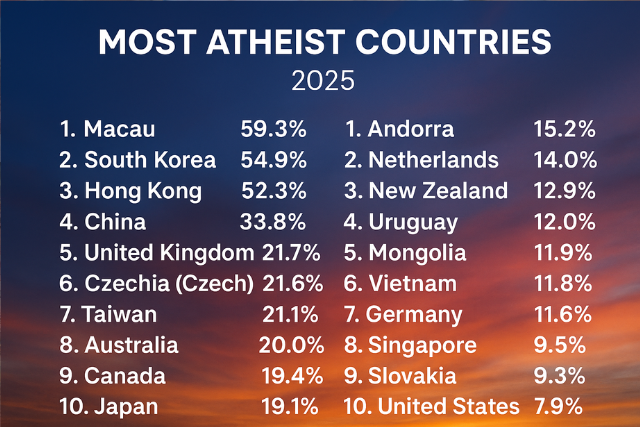
Most atheist countries in the world in 2025 — full guide, top list & percentages
Discover the most atheist countries in the world in 2025 — a data-driven list with percentages, explanations of methodology, regional patterns, and what “atheist” actually means in surveys. Sources: World Values Survey, WIN-Gallup and major research centers.
Religion, belief and non-belief are complex and culturally embedded topics — and in 2025 we continue to see important geographic patterns. Large parts of East Asia, several high-income European countries, and some Pacific and Latin American states report unusually high shares of people who identify as atheist or non-religious. Below you’ll find a clear, sourced top-20 list (with percentages) and an evidence-based explanation of what the numbers mean and how to use them.
Top 20 most atheist countries (2025) — with percentages
Note: the percentages below are taken from the most recent public compilations based primarily on the World Values Survey (WVS, Wave 7, 2017–2022) together with older WIN-Gallup items compiled by aggregators. These figures report the share of respondents who self-identified as “atheist” (not simply “no religion”), as listed by WorldPopulationReview’s 2025 compilation. See methodology and caveats after the list.
-
Macau — 59.3% identify as atheists.
-
South Korea — 54.9% identify as atheist.
-
Hong Kong — 52.3% identify as atheist.
-
China — 33.8% identify as atheist.
-
United Kingdom — 21.7% identify as atheist.
-
Czechia (Czech Republic) — 21.6% identify as atheist.
-
Taiwan — 21.1% identify as atheist.
-
Australia — 20.0% identify as atheist.
-
Canada — 19.4% identify as atheist.
-
Japan — 19.1% identify as atheist.
-
Andorra — 15.2% identify as atheist.
-
Netherlands — 14.0% identify as atheist.
-
New Zealand — 12.9% identify as atheist.
-
Uruguay — 12.0% identify as atheist.
-
Mongolia — 11.9% identify as atheist.
-
Vietnam — 11.8% identify as atheist.
-
Germany — 11.6% identify as atheist.
-
Singapore — 9.5% identify as atheist.
-
Slovakia — 9.3% identify as atheist.
-
United States — 7.9% identify as atheist.
What these percentages mean (and don’t mean)
Atheist vs non-religious: surveys distinguish between people who say “I am an atheist” and those who say “I have no religion” or “not religious.” The list above uses the WVS category for people who self-identify as atheist (a narrower label). Many countries show substantially larger shares of non-religious people than of declared atheists — for example, China and some European countries report much higher “non-religious” shares than strict atheist shares. Always check whether a data source reports atheist, non-religious/irreligious, or convinced atheist categories because they can differ a lot.
Survey wording matters. Cultural context affects how people interpret questions about belief. In some East Asian countries (e.g., China, Japan), religious identity is often expressed in cultural or ritual terms rather than belief in a personal god — so many respondents report “no religion” or “atheist” even while practicing ancestor rituals, folk traditions, or forms of Buddhism/Confucian practice that don’t center a theistic god. This is why cross-country comparisons require careful reading of the survey instrument.
Multiple sources & dates. The WVS Wave 7 (2017–2022) is a major basis for current country comparisons and was compiled into public lists in 2024–2025. Other large surveys (WIN-Gallup, Pew Research, national panels) sometimes give different numbers depending on question wording and sampling year. Aggregators like WorldPopulationReview combine WVS results with earlier WIN-Gallup items to present the current picture. Always check the original survey date when you need absolute precision.
Regional patterns and why they matter
-
East Asia & Greater China: Macau, Hong Kong, South Korea and China stand out with very high atheist or non-religious shares. Rapid modernization, urbanization, and cultural understandings of “religion” (less emphasis on theistic belief) help explain these patterns. Political and educational factors in the PRC also influence reported religiosity.
-
Europe (select countries): Several high-income European states show sizable atheist or non-religious populations (Czechia, UK, Netherlands, Germany). Historic secularization, declining formal church affiliation among younger generations, and strong separation of church and state have all contributed.
-
Oceania & Americas: Australia, New Zealand, Canada and Uruguay appear in the top-20 lists for declared atheists or non-religious people — reflecting generational shifts and growing numbers who choose no religious label. Pew and other studies document rising “religiously unaffiliated” shares across many high-income democracies.
-
Important exceptions: High shares of non-religion in national statistics don’t mean religion has disappeared. In some places a strong cultural Christianity or Islam continues even where many report “no religion.” Local practice and belief are nuanced.
Recent trends — are atheism and non-religion increasing?
Short answer: yes — but unevenly. Global surveys and trend analyses show an increase in the religiously unaffiliated and in people willing to identify as atheists in some countries, especially among younger cohorts and in wealthier, more urbanized societies. Gallup-style global indices and Pew Research analysis both point to rising shares of the unaffiliated and of self-described atheists over the last two decades, though growth is uneven by region.
Key points:
-
Pew found that the religiously unaffiliated grew as a share of the world population between 2010 and 2020.
-
Gallup/WIN releases indicate long-term declines in self-reported religiosity in many nations and rising numbers identifying as “convinced atheists” in some samples.
-
In 2025, East Asian territories (Macau, South Korea, Hong Kong) and several Western countries show the highest shares of people calling themselves atheist in comparable surveys. The top-20 list above gives a clear snapshot with country-level percentages drawn from WVS-based compilations.
-
Trends show an overall global increase in the religiously unaffiliated and a rising share of people who will identify as atheists in many parts of the world — especially among younger, urban populations. But definitions and survey phrasing matter a lot, so always include source and methodology when publishing.