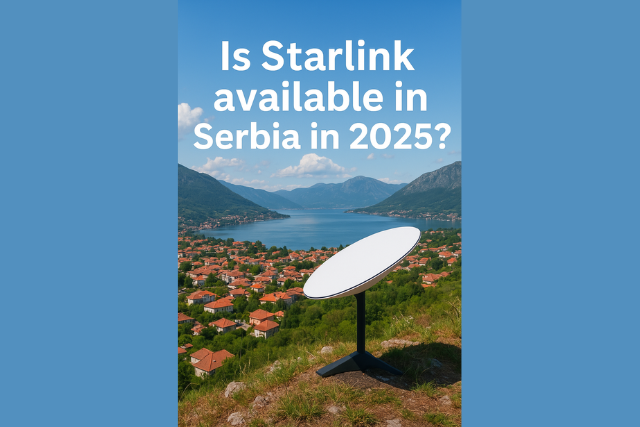
Is Starlink available in Serbia in 2025?
Is Starlink available in Serbia in 2025? Learn the current availability status, expected launch timing, how to reserve service, likely equipment and monthly costs, and what to expect for speeds and coverage. Updated with official availability map notes and regional reports.
As of 2025 Starlink’s official coverage map and several regional reports show Serbia listed as a country scheduled for service in 2025 — meaning the network is expected to become available once local regulatory approvals and rollout logistics are completed. You can register interest or reserve a spot on Starlink’s official site; exact Serbia-specific monthly prices and local currency equipment offers may only appear once the service is fully activated and the Starlink regional page goes live.
Why this matters?
Starlink (SpaceX’s low-earth-orbit satellite internet) can bring high-speed broadband to rural and underserved areas where fixed-line or mobile networks are weak. For Serbia — with mountainous and rural regions — Starlink’s arrival could meaningfully improve connectivity for homes, farms, businesses and emergency services. Several local outlets and community threads have reported that Serbia appears on Starlink’s roadmap for 2025, but the final rollout depends on regulatory approvals and commercial decisions.
Official availability: what Starlink’s map shows
The single most authoritative public source for Starlink availability is the company’s own coverage map and availability pages. Those pages are interactive and show per-country / per-area status: “Available,” “Area is pending service/approval,” or “Area is available but at capacity — order to reserve your place.” For countries that are not yet open, Starlink typically provides an e-mail sign-up / reservation process so early adopters can be notified when ordering is possible. If you want to check for an exact address or municipality in Serbia, enter it on Starlink’s availability map.
What reporters and local sources say about Serbia
Local and regional technology/news sources have tracked the Starlink map updates and reported that Serbia (and neighboring Montenegro and Bosnia & Herzegovina) were added to Starlink’s expected coverage for 2025. These reports repeatedly note the caveat that public rollout requires local licensing/approval and that timelines may shift. In practical terms this means Starlink is expected to be available to Serbian users in 2025, but the exact date and local pricing will be confirmed when the company launches service for Serbian addresses.
How to reserve or register interest now
If you want to be among the first to sign up:
1. Visit the Starlink availability page and enter your Serbian address (or nearest city).
2. If Serbia area is not yet “open,” the site typically gives an option to “order to reserve your place” or sign up for updates. Some regions also request a small refundable deposit (historically small deposits have appeared for some regions). The registration places you in a queue for early access once the service becomes operational for your area.
Likely costs — what we can reasonably expect for Serbia in 2025
Starlink pricing has varied by country and product tier (Residential, Residential Lite, Business, Roam / RV / On-the-Go). Because Starlink often localizes pricing in the local currency when they go live in a country, official Serbia-specific tariffs were not yet published on the Starlink regional pages at the time of writing.
However, you can estimate Serbia pricing from two inputs:
1. Starlink global tiers and examples: Starlink lists multiple service plans (Residential / Residential Lite / Business / Roam / On-The-Go) and the global page shows typical monthly prices and hardware models — but local prices vary by market and taxes. Typical European residential prices (for countries where service is active) have ranged from roughly €29–€80+ per month for lower-tier or lite options up to higher unlimited-home plans (and business plans cost more). Hardware (the user terminal / dish) in Europe has commonly been in the €299–€449 range depending on kit and promotions, though offers sometimes waive an upfront hardware charge with a 12-month commitment in selected markets.
2. Regional clues & community reports: Community discussions and local retailers in nearby countries have speculated that when Starlink opens service in Serbia the initial costs could be similar to neighboring Croatia and other Central-European markets — with hardware ~€349 and monthly ~€40–€80 depending on the plan. Some community threads also mentioned a small reservation deposit (for some unreleased regions a $9 deposit was referenced historically). Treat these numbers only as an informed estimate until Starlink publishes Serbia pricing on its official regional page.
Bottom line on price: expect hardware in the low hundreds of euros and monthly plans anywhere from a budget “lite” tier to full unlimited plans costing more. Once Starlink activates the Serbian region, the company will show exact RSD/€ prices and local VAT/tax details on the official ordering page.
What to expect for speeds and limits
Starlink consumer plans widely advertise typical download speeds in the tens to low hundreds of Mbps and low-latency performance suitable for video streaming, calls and many real-time applications. Business plans deliver higher throughput and service-level guarantees at a premium. Exact speeds in Serbia will depend on local satellite geometry, ground station density, user load, and the specific terminal model you order. Starlink also periodically updates hardware and firmware which can affect performance.
Regulatory & legal notes (why rollout timing varies)
Starlink must often secure local licensing and spectrum approvals, and coordinate with national regulators before commercial service can fully launch. Even when a country appears on the coverage map as “coming soon,” that’s not a guarantee of immediate service — it signals that SpaceX intends to operate once administrative steps are cleared. This is why media coverage often uses “expected in 2025” language instead of a firm launch date.
Practical tips for Serbian users who want Starlink
-
Register your address on Starlink’s map so you’ll be notified when service opens. The map is the primary official channel for updates.
-
Decide which plan you’ll need: residential for a home, business for guaranteed bandwidth, or Roam/On-the-Go if you need mobile coverage across borders. Compare typical European plan tiers as a baseline.
-
Watch for promotions: Starlink has in some countries offered promotions (like waived upfront hardware with a subscription commitment). If you’re flexible, wait for the official Serbia product page to see local offers.
-
Join local communities (forums, subreddits, local tech groups): early adopters often share hands-on experiences and hints about installation, local suppliers, and real-world speeds. Community posts have been useful where official information is still pending.
Starlink’s public coverage materials and multiple regional reports indicate Serbia is on the company’s roadmap for 2025. That means there is a reasonable expectation that Serbian home and business users will gain access in 2025, but precise launch dates and local prices will be confirmed only when Starlink activates service for Serbia on its website. If you want to be ready, sign up on Starlink’s availability page for your address and monitor the official regional page for pricing, hardware options and local terms.
Frequently asked questions
Q: Can I use a Starlink terminal bought in another EU country while in Serbia?
A: Starlink terms and roaming allowances depend on the plan. Some kits allow limited roaming; others are region-locked. Using equipment bought in one country in another may work temporarily (roaming) but long-term operation usually requires service activation for the country of use. Check Starlink’s roaming/terms prior to purchase.
Q: When will exact RSD prices be shown?
A: As soon as Starlink opens the Serbian ordering page (after regulatory steps) the company will publish localized prices and currency. Until then, only global-tier examples and regional estimates are available.