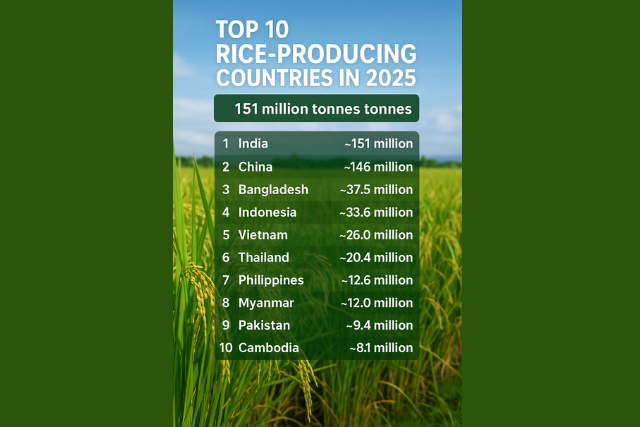
What are The Top 10 Rice-Producing Countries in the World in 2025?
Discover the top 10 rice-producing countries in 2025, their estimated production volumes, why they lead the world market, and what this means for global rice supply and trade.
Rice remains one of the world’s most important staple foods — feeding billions and shaping rural economies across Asia, Africa and Latin America. In 2025 global rice production continued to expand, driven by larger harvests in South and Southeast Asia and improved agronomy and seed varieties. Below we list the top 10 rice-producing countries for 2025, provide current production estimates, explain why each country ranks where it does, and offer context about how these numbers affect markets and food security. (Production figures cited are in metric tonnes of milled rice or paddy as stated by the data sources and represent the 2024/25–2025 marketing-year estimates.)
The 2025 top 10 rice-producing countries (headline list)
1. India — ~151 million tonnes
2. China — ~146 million tonnes
3. Bangladesh — ~37.5 million tonnes
4. Indonesia — ~33.6 million tonnes
5. Vietnam — ~26.0 million tonnes
6. Thailand — ~20.4 million tonnes
7. Philippines — ~12.6 million tonnes
8. Myanmar — ~12.0 million tonnes
9. Pakistan — ~9.4 million tonnes
10. Cambodia — ~8.1 million tonnes.
Why these countries top the list
India and China — the giants
India and China together produce more than half of the world’s rice. In recent years, India’s rice area and yields have expanded thanks to government procurement programs, higher support prices for farmers, and adoption of improved varieties — pushing India to the top of the 2025 rice production rankings at roughly 151 million tonnes. China remains a close second with approximately 146 million tonnes, driven by large planted area and relatively high yields in its major rice provinces. These two countries dominate global supply and therefore have an oversized influence on world prices and trade flows.
Large ASEAN producers: Bangladesh, Indonesia, Vietnam, Thailand, Myanmar
The next tier of top producers are mostly Southeast and South Asian countries where rice is both a staple food and a major agricultural employer. Bangladesh (≈37.5 Mt) benefits from intensive double-cropping in many regions; Indonesia (≈33.6 Mt) has a vast planted area despite lower per-hectare yields; Vietnam (≈26.0 Mt) focuses on Mekong Delta production and remains a major exporter; Thailand (≈20.4 Mt) is known for higher-value export rice; and Myanmar (≈12.0 Mt) has large traditional paddy areas that contribute substantially to regional output. These countries’ performance is highly sensitive to monsoon timing, flooding and water management.
The Philippines, Pakistan and Cambodia
The Philippines (≈12.6 Mt) and Pakistan (≈9.4 Mt) also rank within the top ten, with the Philippines increasing output through irrigation investment and high-yield rice seed programs. Cambodia (≈8.1 Mt) has invested in irrigation expansion and mechanisation, enabling steady growth from a smaller base. Political stability, trade policy and access to fertilizer and fuel directly affect harvest sizes in these countries.
What the numbers mean for global supply (short analysis)
Global rice production estimates for 2024/25–2025 have been reported at historically high levels, reflecting both area and yield gains in Asia and improvements in some Latin American producers. Higher aggregate output reduces pressure on world prices, but local supply constraints, export restrictions, or extreme weather can still create price shocks in the short term. Since India and China produce such large shares of global rice, any significant policy shift (for instance export curbs, minimum support price changes, or large domestic stock releases) from either country can ripple through global markets.
A deeper look at each country (what drives production and future outlook)
1. India — ~151 million tonnes
Drivers: large planted area, government procurement and price support, widespread adoption of high-yield varieties and expansion in irrigation. Outlook: India’s role as the world’s largest producer and one of the largest exporters is expected to continue, though exports can be influenced by domestic policy choices.
2. China — ~146 million tonnes
Drivers: high yields in major rice provinces, continued focus on food self-sufficiency and investment in agricultural technology. Outlook: China will likely continue to prioritise stable production to meet domestic demand.
3. Bangladesh — ~37.5 million tonnes
Drivers: multiple cropping seasons, improved varieties and targeted subsidies. Outlook: Gains possible through better irrigation and flood-resilient rice varieties.
4. Indonesia — ~33.6 million tonnes
Drivers: wide cultivation area and national programs to increase self-sufficiency. Outlook: Production growth depends on mechanisation and fertilizer availability.
5. Vietnam — ~26.0 million tonnes
Drivers: productive Mekong Delta, strong export base (non-basmati varieties). Outlook: Vulnerable to salinity intrusion and upstream water management in the Mekong basin — adaptation is critical.
6. Thailand — ~20.4 million tonnes
Drivers: specialised varieties (jasmine, premium grades), strong irrigation in central plains. Outlook: Thailand remains a major exporter of premium rice even if production is behind giants like India and China.
7. Philippines — ~12.6 million tonnes
Drivers: government support for hybrid seeds, irrigation, and mechanisation. Outlook: The Philippines continues to strive for self-sufficiency but still depends on imports in some years.
8. Myanmar — ~12.0 million tonnes
Drivers: large paddy area and traditional rice systems. Outlook: Political instability, access to inputs, and infrastructure issues affect output variability.
9. Pakistan — ~9.4 million tonnes
Drivers: well-established rice varieties including high-value Basmati, irrigation systems in Punjab and Sindh. Outlook: Water availability and salinity are medium-term concerns.
10. Cambodia — ~8.1 million tonnes
Drivers: irrigation expansion and yield improvements. Outlook: Further mechanisation and export market development could boost output.
(Production figures above are taken from 2025 crop assessments and USDA/IPAD country rankings.)
Trends to watch (2025 and beyond)
-
Climate risks and water stress: Rice is water-intensive. Shifts in rainfall patterns, droughts or flooding can quickly change year-to-year production.
-
Seed & yield gains: Improved varieties and better extension services can raise yields without expanding area.
-
Policy volatility: Export restrictions and domestic price support programs—especially in major producers—remain the fastest way to tighten global supplies.
-
Mechanisation and input access: For many developing producers, access to fertilizer, mechanisation and finance are the limiting steps to higher output.
-
Diet and demand evolution: Urbanisation changes diets in some regions, but rice remains central for billions — keeping demand stable.
FAO and USDA outlooks for 2025 expected broadly stable-to-higher global rice output compared with previous years, but with regional variation.
In 2025 rice production remained concentrated in Asia, with India and China accounting for the lion’s share of global output. The top ten producers listed here reflect long-standing patterns of cultivation, investment in irrigation and seeds, and population dietary preferences. While aggregate world production is at historically high levels, short-term risks from weather and policy can still affect prices and trade. For readers and site owners, using authoritative 2025 data (USDA, FAO and national statistics) and clear keyword structure will make content both credible and search-friendly.
Frequently asked questions
Q: Who produces the most rice in 2025?
A: India leads the 2025 rankings at roughly 151 million tonnes, followed closely by China at about 146 million tonnes.
Q: Are the top producers the same every year?
A: The leading countries are fairly consistent (India, China, Indonesia, Bangladesh, Vietnam, Thailand), but exact rankings and volumes shift with weather, policy and input availability.
Q: Does high production mean a country will export a lot?
A: Not necessarily. Domestic policies, food security concerns and consumption levels determine exportable surpluses. India and Vietnam are big exporters; China and Indonesia consume most of their production domestically.