When Is the Jewish New Year (Rosh Hashanah)? — A Complete Guide to Date, Meaning & Celebrations
When Is the Jewish New Year (Rosh Hashanah)? Date, Meaning & How It’s Celebrated
Learn when the Jewish New Year (Rosh Hashanah) takes place, what it means, traditional customs and foods, modern observances, and helpful FAQs for travelers and newcomers. 100% original, SEO-friendly guide.
Jewish New Year Introduction
Rosh Hashanah — literally “Head of the Year” in Hebrew — is the Jewish New Year. It’s not just a calendar marker; it’s a spiritual season that begins a 10-day period of reflection known as the High Holy Days (or Yamim Noraim, “Days of Awe”), culminating in Yom Kippur, the Day of Atonement. Rosh Hashanah combines ancient ritual, communal prayer, symbolic foods, and personal introspection. If you’re wondering when it falls, how people celebrate, and what to expect whether you’re attending services or hosting a holiday meal, this guide covers the essential dates, traditions, and modern practices.
When Is Rosh Hashanah?
Rosh Hashanah is observed on the 1st and 2nd days of Tishrei, the seventh month of the Hebrew lunar calendar. Because the Hebrew calendar is lunisolar, Rosh Hashanah falls on different Gregorian dates each year, typically in September or early October.
Key points:
-
Observed for two days by most Jewish communities (some Reform communities observe one day).
-
Its timing is set by the Hebrew month of Tishrei, so the Gregorian date changes annually.
-
The holiday officially begins at sunset on the evening before the first day and continues until nightfall at the end of the final day.
What Does Rosh Hashanah Mean?
Rosh Hashanah marks the creation of the world (according to Jewish tradition) and serves as an annual reminder that each person is accountable for their actions. It’s a time for:
-
Teshuvah (repentance/return) — reflecting on mistakes and resolving to improve.
-
Tefillah (prayer) — communal worship in the synagogue with special liturgy.
-
Tzedakah (charity) — giving to those in need as part of moral renewal.
While it’s called the New Year, the mood is contemplative rather than celebratory in the secular sense. Joy and seriousness intertwine: there are festive meals and sweet foods to wish for a good year, paired with solemn prayers asking for forgiveness and divine compassion.
Core Rituals and Customs
1. Blowing the Shofar
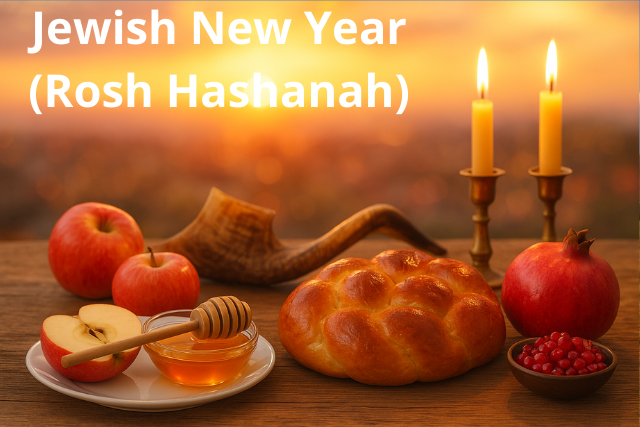
The shofar — a ram’s horn — is central to Rosh Hashanah. Its piercing blasts occur during synagogue services and serve as a spiritual wake-up call. Traditional sequences of sounds include:
-
Tekiah (a long blast),
-
Shevarim (three short broken sounds),
-
Teruah (a series of staccato blasts),
-
and combinations thereof.
Hearing the shofar is a mitzvah (commandment) for those who are able; it prompts reflection, repentance, and renewed attention to ethical living.
2. Special Prayer Services
Synagogue services during Rosh Hashanah are longer than usual and include:
-
The Machzor, a special High Holiday prayer book.
-
Recitations of Unetaneh Tokef, a powerful liturgical poem that emphasizes divine judgment.
-
Extensive communal prayers and chanting by the cantor (chazzan).
Many people attend multiple services across the two days; synagogue attendance is traditionally high.
3. Tashlich: Casting Away Sins
On the first day in the afternoon (or another suitable time), some Jews perform Tashlich — a symbolic ritual of casting breadcrumbs or small pieces of bread into flowing water while reciting prayers. Tashlich symbolizes letting go of sins and starting the year with a clean slate.
4. Festive Meals & Symbolic Foods
Food plays a major role in Rosh Hashanah customs. Typical items and their meanings:
-
Apples dipped in honey — for a sweet new year.
-
Round challah — symbolizing the cycle of the year and continuity; often baked with raisins or a glaze.
-
Pomegranates — their many seeds represent abundant merits and good deeds.
-
Fish head or ram’s head (symbolically) — “be a head, not a tail”; leadership and forward motion.
-
New fruits — foods not yet eaten that season, often blessed as Shehecheyanu: “Who has kept us alive, sustained us, and brought us to this season.”
Meals are occasions for family, stories, and blessings. Traditional songs (zemirot) may be sung, and blessings are offered before and after each course.
How Do Different Communities Observe Rosh Hashanah?
Observance varies by denomination, culture, and custom:
-
Orthodox Jews: Typically observe two full days, attend extended synagogue services, and observe traditional laws stringently.
-
Conservative Jews: Observe two days and maintain many traditional practices while sometimes adapting community norms.
-
Reform Jews: Some Reform communities observe one day, while others observe two; liturgy may be modernized.
-
Sephardic and Ashkenazi traditions: Both include unique tunes, foods, and liturgical variations. For example, some Sephardic communities emphasize particular piyutim (liturgical poems).
Cultural customs — like specific songs, foods, or melodies — differ widely across Iraqi, Moroccan, Polish, Russian, Greek, and American Jewish communities.
Practical Tips for Visitors & Newcomers
-
Expect longer services: Rosh Hashanah services can last several hours. If you’re a visitor, arrive early and plan to stay for parts of the service.
-
Dress respectfully: Festive, modest attire is recommended; many men wear kippot (skullcaps) and some may wear tallit (prayer shawls).
-
Bring a gift: If you’re joining someone’s home for a meal, consider bringing kosher wine, honey, or fruit.
-
Respect the customs: If you’re unsure, follow the lead of the host or ask softly. Most congregations welcome questions after services.
-
Food rules: If the household keeps kosher, do not bring or consume non-kosher items without permission.
Modern Expressions & Community Life
Rosh Hashanah today blends ancient ritual with contemporary life. Many synagogues livestream services; interfaith families participate in inclusive programs; community centers host family-friendly services with storytelling and children’s activities. Civic leaders sometimes attend public services in cities with substantial Jewish populations, and cultural events — concerts, lectures, and charity drives — are common during the High Holy Days.
Rosh Hashanah is both an ancient observance and a living, evolving holiday. It marks a time of renewal: communities gather to pray, families share symbolic meals, and individuals commit to moral growth. Whether you’re observing Rosh Hashanah as part of a Jewish tradition, attending a service as a visitor, or simply curious about its meaning, the holiday offers a rich blend of reflection, ritual, and hope for a sweet and meaningful year ahead.
Friendly FAQs
Q: Is Rosh Hashanah the same date every year?
No. It follows the Hebrew month of Tishrei, so Gregorian dates change yearly (usually September/October).
Q: How long does Rosh Hashanah last?
Traditionally it is observed for two days. Some Reform communities observe one day.
Q: What is the difference between Rosh Hashanah and Yom Kippur?
Rosh Hashanah marks the start of the Jewish year and a time of judgment; Yom Kippur, ten days later, is the Day of Atonement — the holiest, most solemn day, focused on fasting and repentance.
Q: Can non-Jews attend Rosh Hashanah services?
Yes—many congregations welcome visitors. It’s polite to check with the synagogue first, especially for High Holiday seating and access.
Q: Do people fast on Rosh Hashanah?
No. Fasting is not observed on Rosh Hashanah. Instead, it’s a time for festive meals and symbolic foods. Fasting occurs on Yom Kippur.