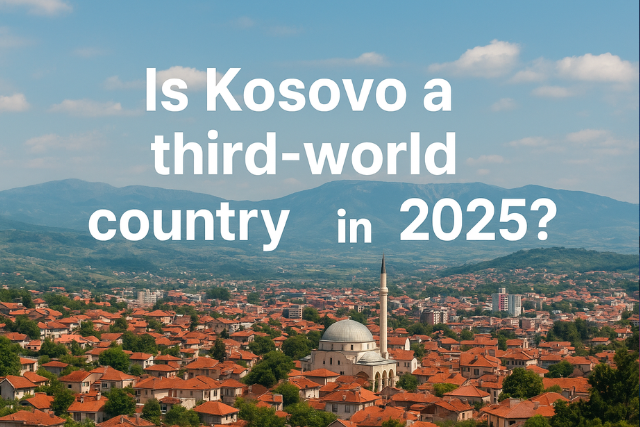
Does Kosovo a “third-world” country in 2025?
The phrase “third-world country” still appears in everyday speech, but it’s an outdated and imprecise label for describing a state’s economic or social development. If you’re asking “Is Kosovo a third-world country in 2025?” the short answer is: No — by modern statistical measures Kosovo is not classified as a “third-world” country. Below we unpack why, explain the modern indicators used to assess development, and present the main facts you should use when writing, researching, or optimizing content about Kosovo in 2025.
What “third-world” originally meant — and why it’s misleading today
The term “third world” originated during the Cold War as a political label for countries that were neither aligned with NATO/Western bloc (the “first world”) nor the Soviet bloc (the “second world”). Over time, people began using it to mean “poor” or “under-developed.” Today scholars, development agencies, and professional media avoid the phrase because it’s vague, historically loaded, and imprecise. Instead, organizations use measurable categories such as World Bank income groups and the UNDP Human Development Index (HDI) to describe development levels.
How modern institutions categorize countries (the better alternatives)
Two widely used, objective ways to describe a country’s development are:
-
World Bank income classification — uses GNI per capita thresholds to group economies into low, lower-middle, upper-middle, and high income. These thresholds are updated yearly and are used for lending and analytical purposes.
-
Human Development Index (HDI) — produced by UNDP, the HDI combines life expectancy, education, and per-capita income to produce a single index, dividing countries into “low”, “medium”, “high”, and “very high” human development categories. HDI captures multiple dimensions beyond purely economic measures.
Kosovo’s economic snapshot (2024–2025): GDP, GDP per capita and growth
Kosovo’s economy has been growing in recent years. According to World Bank data, Kosovo’s GDP per capita (current US$) is in the range of roughly $6–7k in recent reporting (2023–2024 data), and the country saw positive GDP growth into 2024. These figures place Kosovo well above low-income thresholds and into the middle-income range by standard measures.
The World Bank and regional analyses also project continued, though modest, growth for Western Balkan economies including Kosovo into 2025 — underscoring steady convergence pressures with European peers, even if structural challenges (jobs, investment, governance) remain.
Where Kosovo sits in World Bank income classifications (2024/2025)
The World Bank’s country income classifications are based on GNI per capita. By the 2024–2025 classification round, Kosovo’s income indicators place it within the middle-income group (i.e., above lower-middle thresholds and below the high-income threshold). In plain language: Kosovo is not a low-income country and therefore does not match the common modern meaning of “third-world” as “extremely poor.” Use the World Bank classification when you need an authoritative, up-to-date label.
Human development in Kosovo: HDI and social indicators
Economic numbers tell one part of the story. Looking at human development gives a fuller picture:
-
Kosovo’s HDI and subnational HDI data show improving outcomes in health, education, and income over the past decade — with regional differences between districts (Pristina and Mitrovica typically scoring higher than some other districts). Aggregate HDI estimates put Kosovo solidly in the medium–high human development range, showing real progress since the early 2000s.
-
Poverty indicators (for example, poverty headcount ratios measured at an international poverty line) and life expectancy have shown improvement, though pockets of vulnerability and youth unemployment remain important policy concerns. Development partners like the World Bank and UNDP actively fund programs aimed at jobs, governance, and competitiveness.
Political and institutional context — why labels don’t tell the full story
Kosovo’s international status is politically complex: many countries recognize Kosovo as an independent state, while some others do not. That geopolitical situation has implications for diplomacy, trade, and EU accession discussions — but it doesn’t determine whether Kosovo is “developed” or “developing.” Development is measured by concrete indicators (income, education, health, institutions), and by those measures Kosovo is progressing as a middle-income economy with improving human development outcomes. For authoritative writing, avoid sloppy labels and instead cite the exact measure you mean (e.g., “upper-middle-income” or “HDI = 0.7xx”).
So — is Kosovo a “third-world” country in 2025?
No. Using modern, objective measures used by development agencies and economists, Kosovo is not a “third-world” country in the historical or colloquial sense that implies extreme poverty or complete underdevelopment. Instead:
-
Kosovo is best described as a middle-income country by World Bank income thresholds (well above low-income levels).
-
Kosovo’s HDI and social indicators show sustained improvement, consistent with countries on a path of development rather than collapse.
Outlook: challenges and opportunities for Kosovo (2025 and beyond)
Kosovo faces typical challenges for a transitioning economy: raising private investment, improving the business climate, creating quality jobs (especially for youth), and converging regulatory and infrastructure standards toward EU markets. At the same time, positive trends—steady GDP growth, falling poverty rates in recent years, and international development support—suggest gradual convergence with higher-income neighbors if reforms and investment continue. Development is a process, not an instant reclassification. Reuters+1
SEO keywords: Kosovo reforms 2025, Kosovo investment opportunities, Kosovo job market 2025.
How to cite reliable sources when you publish
When you assert facts in your article, link to reputable sources:
-
World Bank country pages and data (for GDP per capita and income classification).
-
UNDP Human Development Reports or Our World in Data (for HDI and multi-dimensional progress).
-
Reputable news agencies (Reuters, World Bank press releases) for growth projections and regional context.
In 2025, calling Kosovo a “third-world” country is inaccurate and unhelpful. By modern standards — World Bank income classification, GDP per capita, and HDI — Kosovo is a middle-income country with improving social indicators and steady growth prospects. For SEO and journalistic precision use specific measurements (GNI, GDP per capita, HDI) and avoid the antiquated “third-world” label.