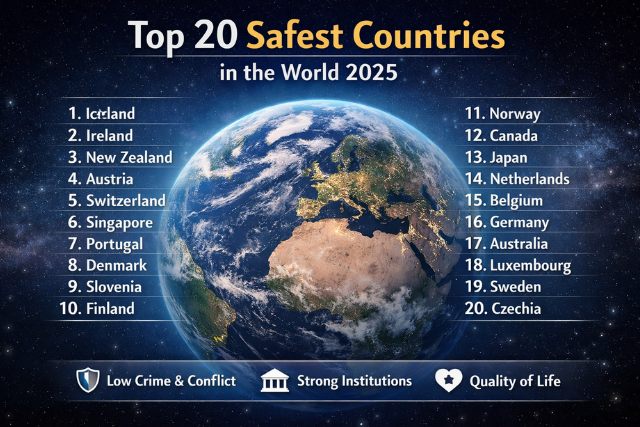
Top 20 Safest Countries in the World — 2025
Explore the top 20 safest countries in the world in 2025 — data-driven ranking, what makes each country safe, travel tips, and what safety means in practice. Based on the Global Peace Index and global safety indicators.
Safety matters to travelers, expats, investors and families. In 2025, international measures of peace and safety show a clear pattern: small-to-medium population countries with strong institutions, low violent crime, and well-resourced public services dominate the top ranks. This article summarizes the top 20 safest countries in the world in 2025, explains the main reasons they score so well, and gives practical advice for visitors and people thinking about relocation. The ranking below is based on the Global Peace Index (GPI) / Global Safety assessments for 2025 — the most widely used cross-national measure of peacefulness and safety.
Quick snapshot — top five (short)
Iceland, Ireland, New Zealand, Austria and Switzerland lead the 2025 safety rankings — repeatedly scoring highest on measures of societal safety and security, low levels of internal or external conflict, and limited militarisation. These nations pair strong rule of law with robust social safety nets and high institutional trust.
Top 20 safest countries in the world — 2025 (ranked)
1. Iceland — A long-standing leader on peace and safety indices. Extremely low violent crime, minimal internal conflict, and consistently high positive-peace indicators (social cohesion, functioning government) place it at #1. Its small, tightly knit population and strong social norms against violence are major factors. Vision of Humanity
2. Ireland — High rule-of-law scores, low homicide rates, and strong civic institutions help Ireland rank near the top. Growth in urban safety initiatives and community policing has reinforced perceptions of safety. Vision of Humanity
3. New Zealand — Very low levels of internal and external conflict, excellent emergency preparedness and police transparency, and high scores on social welfare metrics. The nation’s geography and cohesive public health systems also boost safety. Vision of Humanity
4. Austria — Stable politics, low violent crime, and strong public services. Austria benefits from central European cooperation, reliable law enforcement and high standards of living.
5. Switzerland — Neutral foreign policy, low crime, and robust civil institutions. High public trust in policing and an advanced welfare system underpin safety rankings.
6. Singapore — Exceptionally low street-crime statistics, strict law enforcement, and strong urban governance. Singapore’s dense city-state model pairs surveillance and enforcement with high service standards.
7. Portugal — Rapidly improved safety indicators over recent years; low violent crime and increasing political stability make Portugal a safe destination and relocation option.
8. Denmark — Consistent social equality, strong social services and effective policing contribute to Denmark’s high safety standing.
9. Slovenia — A smaller European nation with low crime rates, good governance and a strong safety net. It ranks highly in regional safety comparisons.
10. Finland — Low violent crime, transparent institutions, and strong social cohesion — Finland ranks in regional top tiers for safety and civil liberties.
11. Norway — Excellent safety in everyday life, high welfare spending, and strong emergency response capabilities help keep Norway among the world’s safest.
12. Canada — Low homicide rate relative to global averages, effective policing, and strong institutional stability. Canada’s multicultural social fabric and rule of law remain safety assets.
13. Japan — Very low violent crime, high public order and strong disaster preparedness infrastructure (earthquakes, typhoons) contribute to Japan’s consistent safety ranking.
14. Netherlands — Strong legal systems, effective policing, and high-quality public services, combined with social programs that reduce inequality and social stressors.
15. Belgium — Despite being a transit hub in Europe, Belgium ranks strongly due to law enforcement capacity, health services and steady institutional structures.
16. Germany — Large, well-resourced police and emergency services, solid legal institutions and strong social supports keep Germany high on safety lists.
17. Australia — Good emergency response capacity, stable institutions, and low levels of violent civil unrest (though some urban areas report localized crime upticks).
18. Luxembourg — Small population, high GDP per capita, and a strong social safety net support very low crime and high institutional trust.
19. Sweden — High standards of living, robust welfare systems and well-resourced public safety institutions contribute to Sweden’s placement (note: urban crime trends are monitored closely).
20. Czechia (Czech Republic) — Low levels of violent crime, solid public infrastructure and improving perceptions of safety in urban centers secure Czechia a top-20 spot.
Note: different safety indexes sometimes shuffle a few places (e.g., Canada, Japan, Norway and Sweden move slightly between sources), but the GPI and related safety indices show strong agreement across these high-ranking countries for 2025.
What “safest” means in 2025
“Safest” is multi-dimensional. The Global Peace Index and similar measures combine factors in three broad domains:
-
Safety & Security — violent crime, perceptions of criminality, homicide rates, and levels of organised crime.
-
Ongoing Domestic & International Conflict — whether a country is involved in armed conflict or suffering internal disturbances.
-
Militarisation — extent of military expenditure, weapons imports/exports and armed forces presence.
These domains are assessed using dozens of indicators (police presence, political stability, terror incidents, deaths from conflict, weapon availability, etc.) to produce a composite ranking. When you read lists like “top safest countries,” they primarily reflect these composite scores rather than any single indicator.
Why do these 20 dominate the list
Several recurring features explain why these nations top safety indexes:
-
Strong institutions and rule of law: Independent judiciaries, accountable police, and low corruption reduce violent crime and increase trust.
-
Social cohesion & welfare: Broad access to healthcare, education and social support lowers stressors that can drive crime.
-
Low geopolitical exposure: Countries with neutral foreign policies or limited external involvement tend to avoid spillover effects from wars and regional conflicts.
-
Effective emergency systems: Preparedness for natural disasters and public health emergencies reduces fatalities and preserves social order.
-
High human development: Higher GDP per capita and better human development indicators correlate with lower crime.
Practical travel & relocation tips (for these countries)
-
Carry ID and follow local laws. Even very safe countries enforce laws strictly; small infractions (e.g., jaywalking, alcohol in public) may carry fines.
-
Use common-sense urban safety habits. Stay in well-lit areas at night, watch belongings in crowded places, and register travel plans with your embassy if you’re staying long-term.
-
Understand local services. Familiarize yourself with emergency numbers (e.g., 112 in much of Europe) and local healthcare access.
-
Be mindful of natural hazards. Safety rankings emphasize low conflict but don’t remove natural risks — Japan, Iceland and New Zealand, for example, have advanced disaster systems you should respect.
-
Research neighbourhoods. Even the safest countries have neighbourhoods with higher petty crime; read local advice and use community resources.
How businesses and investors use the list
Companies and investors use safety rankings to assess political risk, supply chain resilience and staff relocation decisions. Nations higher on the safety index generally mean lower security costs, reduced insurance premiums, and simplified operational planning. That said, market-specific risks (sector regulation, taxation, labour) still require separate analysis.
Limitations & caveats
-
Index footprint: The GPI and similar indices use available international data; underreporting in some countries can skew scores.
-
Temporal change: Safety can shift rapidly due to political events, economic stress or sudden conflict — rankings show a snapshot, not a permanent guarantee.
-
Local variance: National averages hide regional differences. A top-ranked country can still have localised safety issues.
For readers who need the most up-to-date, granular guidance (city-level safety, real-time travel advisories, or security for high-value operations), use official government travel advice and local sources in addition to global rankings.
Final thoughts
In 2025, the world’s safest countries continue to be those that invest in robust institutions, social welfare and emergency preparedness. Iceland, Ireland and New Zealand top that list — but whether you’re a tourist, student or company, safety is a compound of community norms, effective governance and on-the-ground preparedness. Use global rankings as a starting point, then drill down into city-level data and up-to-date advisories before making travel or relocation decisions.