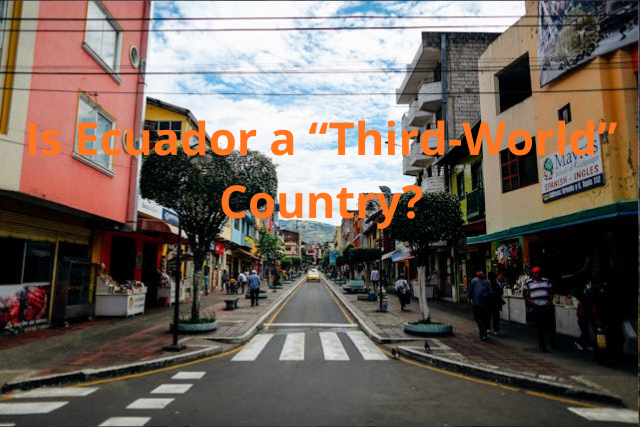
Is Ecuador a “Third-World” Country?
Is Ecuador a Third-World Country in 2025? — Facts, Data & Explanation
Curious whether Ecuador is a “third-world” country in 2025? This clear, data-driven guide explains the term’s history, modern measures (World Bank, IMF, UNDP), and where Ecuador stands today.
Answer
No — calling Ecuador a “third-world” country in 2025 is inaccurate and misleading. The phrase “third-world” is an outdated Cold War label and is rarely used by economists or international institutions. Modern indicators classify Ecuador as an upper-middle-income country with medium human development; it faces important development challenges (poverty pockets, infrastructure gaps, security), but it is not part of the historical “third-world” grouping nor the lowest economic tier.
Why this question matters
People often use “third-world” casually to mean “poor” or “developing,” but that usage can hide important nuance. Accurate terms (e.g., low-income, lower-middle, upper-middle, high-income, developing, least developed, emerging market, human development level) come from organizations that track welfare, growth, and structural change. Using the right classification helps when comparing living standards, investment risk, travel safety, or development policy.
What “third-world” originally meant
The term “Third World” originated during the Cold War to describe countries that were not aligned with either the capitalist “First World” or the communist “Second World.” Over time it became a shorthand for economically poorer, less industrialized countries, but scholars and practitioners now consider it imprecise and politically loaded. Most analysts and major organizations no longer use the label.
How modern institutions classify countries (the useful alternatives)
Instead of “third-world,” international institutions use measurable classifications:
-
World Bank income groups (low, lower-middle, upper-middle, high) based on GNI per capita.
-
UNDP Human Development Index (HDI) ranks countries by health, education, and standard of living.
-
IMF and World Bank economic reports track growth, inflation, debt, and structural reforms — useful for assessing near-term economic health.
These measures give objective, comparable information that helps answer whether a country is economically poor, middle income, or relatively prosperous.
Where Ecuador stands in 2025 — key facts and figures
1. World Bank income classification
As of the World Bank’s latest classifications, Ecuador is listed in the upper-middle-income group. That classification is determined by GNI per capita thresholds and is updated periodically; being upper-middle income places Ecuador above lower-middle and low-income countries, though below high-income economies.
2. GDP per capita and macro trends
Ecuador’s GDP per capita (current USD) has grown over recent years but remains modest compared with wealthy economies. World Bank series show GDP per capita in the low-to-mid thousands of US dollars (current USD) — consistent with an upper-middle-income profile rather than a low-income country. The IMF and World Bank also document cyclical growth, exposure to oil prices (Ecuador is an oil exporter), and recovery dynamics after recent shocks.
3. Human Development Index (HDI)
UNDP reporting places Ecuador in the medium to high human development range depending on the year-on-year change in indicators. HDI captures life expectancy, schooling, and GNI per capita (purchasing-power adjusted), providing a broader view of citizen well-being than GDP alone. Ecuador’s HDI performance shows progress in some social indicators, while gaps remain in others.
4. Recent policy context (2024–2025)
In recent years Ecuador has negotiated IMF programs and taken fiscal steps to stabilize finances; the IMF and news coverage in 2024–2025 reflect program support, fiscal measures, and efforts to protect vulnerable groups while shrinking fiscal imbalances. These policy actions are characteristic of emerging-market middle-income countries managing structural vulnerabilities.
So — why some people might still call Ecuador “third-world”
There are several reasons the label persists in casual speech:
-
Historical echo: Many people learned the term decades ago and use it to mean “poor” or “underdeveloped.”
-
Visible inequalities: Ecuador has regions and communities with limited access to services, higher poverty rates, and infrastructure deficits — realities that can look “third-world” in local areas even if national averages are higher.
-
Media shortcuts: Headlines or travel anecdotes sometimes use blunt labels, which stick in popular imagination.
These reasons explain the label’s persistence, but they do not make it accurate in technical terms.
Strengths and challenges for Ecuador in 2025
A balanced picture helps explain why Ecuador does not fit a blunt “third-world” label:
Strengths
-
Upper-middle-income classification and increasing social investments.
-
Macroeconomic engagement with lenders and institutions (IMF programs, international markets).
-
Diverse geography supporting agriculture, tourism, and energy sectors (including oil and renewables potential).
Challenges
-
Regional inequality — the Amazon, rural highlands, and some coastal areas lag in services and infrastructure.
-
Security & governance issues in parts of the country that affect investment and daily life.
-
Exposure to external shocks like oil price swings, climate events, and migration pressures.
-
Need for structural reforms to raise productivity, formal employment, and public service quality.
These characteristics are typical for many emerging-market, upper-middle-income countries: neither rich nor among the poorest.
How to talk about Ecuador accurately (recommended language)
Instead of “third-world,” use clearer terms:
-
“Upper-middle-income country (World Bank).”
-
“Emerging market” or “developing country” when discussing growth and investment context.
-
Refer to specific indicators (e.g., GDP per capita, HDI rank, poverty rate) to avoid vague judgments.
This approach avoids outdated Cold War language and gives readers measurable context.
What this means for travelers, investors, and researchers
-
Travelers: Ecuador offers modern cities, developed tourism infrastructure (Galápagos, Quito, Cuenca), and some regions with limited services. Use up-to-date travel advisories for security information.
-
Investors: Ecuador’s classification, macro programs, and natural resources make it potentially attractive, but country risk (policy uncertainty, governance) should be assessed. IMF and World Bank reports are good starting points.
By 2025, Ecuador is not accurately described as a “third-world” country. The term is obsolete and imprecise. Objective measures — World Bank income groupings and UNDP human development indicators — place Ecuador in the upper-middle-income and medium/upper human-development brackets, respectively. Ecuador faces real development challenges (inequality, security, vulnerability to external shocks), but its economic and social profile is better captured by modern classifications than by a Cold War label.
FAQ (quick, shareable answers)
Q: What do experts call Ecuador now?
A: Experts call Ecuador an upper-middle-income country (World Bank) and assess it using indicators like HDI, GDP per capita, and poverty rates.
Q: Is “third-world” offensive?
A: Many consider the term outdated and politically loaded. Better alternatives are “developing country,” “upper-middle income,” or specific statistical labels.
Q: Where can I find the official data?
A: Consult the World Bank country pages, IMF country reports, and UNDP Human Development Reports for the latest statistics and classifications.