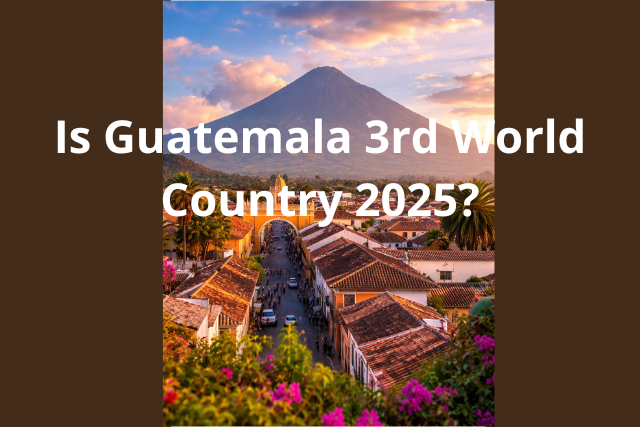
Is Guatemala considered a 3rd world country?
Is Guatemala a third-world country in 2025? This clear, up-to-date guide explains what “third-world” means, how Guatemala ranks on income, development and safety indicators, and why modern terms like “developing” or “lower-middle income” are more accurate.
Short answer first
No — calling Guatemala a third-world country is misleading in 2025. The phrase “third-world” is an outdated Cold War label that doesn’t reflect modern economic and human development classifications. That said, Guatemala faces serious challenges: widespread poverty, high inequality, health and malnutrition problems, and security concerns. To understand whether people call Guatemala “third-world,” we need to explain the term, show where Guatemala stands on current development metrics, and describe the social and structural reasons behind the label.
What “third-world” originally meant — and why it’s a bad label now
The term “third-world” originated during the Cold War to identify countries that were not aligned with NATO (the “First World”) or the Soviet bloc (the “Second World”). Over time the phrase shifted in popular speech to mean “poor” or “underdeveloped,” but it retains political and imprecise baggage. Today, development experts prefer specific, measurable classifications — for example, World Bank income groups, the UN Human Development Index, or poverty and inequality metrics — because they are transparent and comparable. Using those modern metrics gives a fairer picture than the vague “third-world” tag.
Guatemala’s economic standing in 2025
By World Bank income classifications, Guatemala is not among the poorest countries in the world; it sits in the lower-middle to middle-income band when measured by gross national income per capita (Atlas method). Guatemala’s GNI per capita and purchasing-power measures are substantially higher than low-income states, which places it outside the narrowest sense of “extreme poverty” countries — yet below high-income peers. These income numbers tell us Guatemala has a functioning, diverse economy (agriculture, remittances, manufacturing, services), but still struggles with low average incomes for large portions of the population.
Human development and well-being: the UNDP picture
The Human Development Index (HDI) measures health, education and income together. Guatemala’s HDI sits in the medium-human-development range rather than the “very high” or “high” categories. That means many Guatemalans have limited access to quality healthcare, education, and a decent standard of living compared with higher-scoring countries. The HDI helps explain why people sometimes casually describe Guatemala as “third-world”: the country’s human development scores reveal persistent deficits even when national income statistics look better on paper.
Poverty, informality and inequality — the real drivers of the label
Two statistical features explain most of the “third-world” perception:
-
High poverty rates. Recent World Bank briefs and national estimates show that a large share of the population still lives below Guatemala’s national poverty line — tens of percent of Guatemalans, with rural and indigenous regions much worse-off than urban centers. That concentrated, multi-dimensional poverty fuels perceptions of underdevelopment.
-
Large informal economy and inequality. Guatemala’s labor market is heavily informal: many people work without formal contracts, social protection, or guaranteed wages. And income distribution is uneven: economic growth has often lifted averages while leaving many households behind. This combination means visible poverty exists alongside pockets of relative wealth, which reinforces the “developing/third-world” image despite national GDP growth.
Health, nutrition and the climate factor
Guatemala faces public-health challenges that signal development gaps: chronic child malnutrition (stunting) in many rural and indigenous communities, food insecurity in climate-vulnerable areas, and limited access to comprehensive health services. Recurrent droughts in parts of Guatemala’s “dry corridor” have worsened food shortages for smallholder farmers, and international agencies have highlighted these hunger and malnutrition hotspots. These human costs shape perceptions: a country can be middle-income in headline statistics yet suffer serious human development deficits on the ground.
Security and governance: why safety matters for perceptions
Crime and public-security problems also feed the “third-world” narrative. Guatemala’s homicide and violence indicators have been comparatively high in the region, and weak rule-of-law or corruption episodes can erode trust in institutions. High levels of violence, coupled with limited access to justice for some groups, worsen everyday insecurity and hinder economic opportunity — reinforcing the impression of underdevelopment even as some macro indicators improve.
Why some people still call Guatemala “third-world”
When someone calls Guatemala “third-world,” they usually mean one or more of the following, in plain terms:
-
Rural poverty and malnutrition are still widespread.
-
Public services (health, sanitation, education) are unevenly available.
-
Many workers operate in the informal sector without protections.
-
Violence, weak public institutions, and corruption limit progress.
-
Indigenous communities suffer systematic exclusion and worse outcomes.
All of these are real challenges — but lumping them into the ambiguous Cold War term “third-world” hides nuance. Guatemala is a developing country with mixed progress: pockets of modern economic activity and serious areas needing investment and policy change.
For clarity and search relevance, use modern, specific phrases instead of “third-world”:
-
Developing country — broad and common.
-
Lower-middle income (World Bank) — precise, tied to GNI thresholds.
-
Medium human development (UNDP) — indicates relative performance on health/education.
-
Countries with high poverty / unequal income distribution — emphasizes the social dimension.
These terms are defensible, searchable, and map directly to recognized datasets — which makes your content more credible and discoverable.
What’s changing — trends to watch in 2025
Several trends will shape how Guatemala is discussed in the near term:
-
Remittances and migration: Remittances from Guatemalans abroad remain a big part of household incomes and can stabilise consumption even when domestic growth is slow.
-
Climate shocks: Droughts and extreme weather threaten rural livelihoods and food security; climate-smart agriculture and social programs will be critical.
-
Policy reforms and anti-poverty programs: Government and multilateral initiatives can reduce extreme deprivation, but progress depends on governance, funding and targeting.
Tracking these indicators (GNI per capita, poverty headcounts, HDI, homicide rates, malnutrition prevalence) helps explain whether Guatemala’s situation improves or worsens — far better than relying on the ambiguous “third-world” label.
In 2025, Guatemala is better described as a developing country with persistent poverty, inequality, and governance challenges, rather than using the outdated term “third-world.” Official metrics place the country in the lower-middle income and medium human development categories, but the lived reality for many Guatemalans — particularly rural and indigenous communities — includes high poverty, malnutrition, and insecurity. Using precise, sourced language helps readers and search engines understand the real strengths and challenges facing Guatemala today.