What Religions Are in China in 2025? Complete List
China is often described as an officially atheist country, yet religious belief and spiritual practice continue to shape daily life for hundreds of millions of people. In 2025, China remains one of the most complex religious landscapes in the world, where ancient traditions, modern belief systems, and state regulation coexist.
Unlike many countries where individuals identify with one clear faith, religious identity in China is often fluid and overlapping. Many people practice rituals from multiple traditions while still describing themselves as “non-religious.” Understanding religion in China therefore requires looking beyond labels and focusing on beliefs, customs, and cultural behavior.
Overview: Religion and Belief in China
China’s constitution guarantees freedom of religious belief, but the country officially recognizes only five religions:
1. Buddhism
2. Taoism
3. Islam
4. Protestant Christianity
5. Catholic Christianity
At the same time, the Chinese government identifies the nation as secular and atheist, and religious institutions operate under strict regulatory oversight.
Surveys conducted over the past decade consistently show that a large majority of Chinese citizens do not formally affiliate with a religion, even though many still engage in spiritual or ritual practices
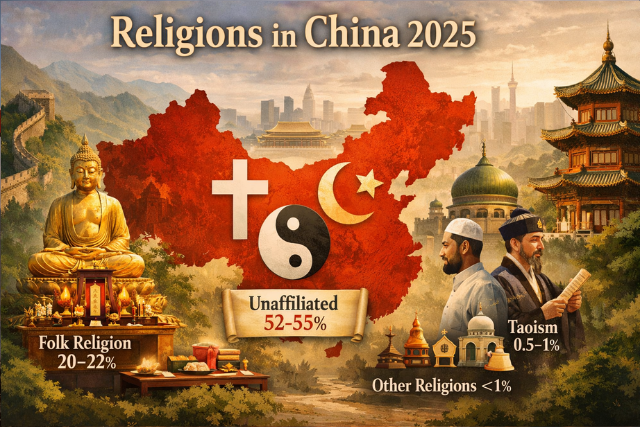
Religion in China 2025: Estimated Breakdown by Percentage
Based on the most widely cited demographic models adjusted for 2025 population trends, China’s religious composition can be summarized as follows:
| Religion / Belief System | Estimated Percentage (2025) |
|---|---|
| Unaffiliated / No formal religion | ~52–55% |
| Chinese Folk Religion | ~20–22% |
| Buddhism | ~17–19% |
| Christianity (Total) | ~5–6% |
| Islam | ~1.5–2% |
| Taoism (formal identification) | ~0.5–1% |
| Other religions | <1% |
These figures reflect formal identification, not cultural or occasional practices, which are far more widespread
Unaffiliated and Secular Population (≈ 52–55%)
The largest group in China consists of people who do not officially identify with any religion. This does not necessarily mean disbelief in spirituality.
Many individuals:
-
Observe ancestral rituals
-
Visit temples during festivals
-
Believe in concepts such as fate, harmony, or feng shui
Surveys show that China has the world’s largest unaffiliated population, making it unique among major civilizations
This category includes:
-
Self-identified atheists
-
People who view religion as cultural rather than spiritual
-
Citizens who avoid formal religious registration
Chinese Folk Religion (≈ 20–22%)
Chinese folk religion is not a single organized faith but a blend of ancient beliefs, including:
-
Ancestor worship
-
Local deities
-
Seasonal rituals
-
Spirit veneration
It is deeply rooted in Chinese history and often practiced at home rather than in formal temples.
Despite millions participating in these traditions, few formally label themselves as followers, which explains why official statistics often understate its influence
Buddhism (≈ 17–19%)
Buddhism is the largest institutionalized religion in China and has been present for nearly two thousand years.
Key Characteristics:
-
Mahayana Buddhism is dominant
-
Strong presence in eastern and southwestern provinces
-
Influential in philosophy, ethics, and art
China has more Buddhists than any other country in the world by absolute numbers, even though many practitioners engage at a cultural rather than devotional level
Christianity in China (≈ 5–6%)
Christianity in China includes both Protestants and Catholics, with Protestants forming the majority.
Estimated Breakdown:
-
Protestant Christianity: ~4–4.5%
-
Catholic Christianity: ~0.5–1%
Christian communities exist in both registered churches and unregistered house churches. While growth has slowed due to regulation, Christianity remains one of the most dynamic religions in the country
Islam (≈ 1.5–2%)
Islam has a long history in China and is primarily practiced among ethnic minorities such as:
-
Hui
-
Uyghur
-
Kazakh
-
Dongxiang
Muslim populations are concentrated in western and northwestern regions, including Xinjiang, Ningxia, and Gansu.
Islam remains one of China’s officially recognized religions and plays a significant cultural role in these regions
Taoism (≈ 0.5–1%)
Taoism originated in China and is deeply embedded in traditional philosophy, medicine, and cosmology.
Although millions follow Taoist principles informally, very few people officially register as Taoists, resulting in a relatively low percentage in surveys.
Taoist ideas such as balance, natural flow, and harmony strongly influence Chinese culture beyond religious boundaries
Other Religions (< 1%)
Smaller religious communities in China include:
-
Tibetan Buddhism (classified separately in some regions)
-
Confucian revival movements
-
Russian Orthodoxy
-
Judaism (very small communities)
-
New religious movements
Together, these groups make up less than 1% of the population but contribute to China’s overall religious diversity
Religious Practice vs. Religious Identity
One of the most important aspects of religion in China is the gap between belief and identification.
For example:
-
Many people believe in Buddha but do not call themselves Buddhist
-
Ancestral rituals are practiced without religious labels
-
Multiple belief systems coexist within families
This layered approach to faith makes China fundamentally different from Western religious models
Trends Shaping Religion in China in 2025
Several trends define the current religious environment:
-
Continued state regulation of religious institutions
-
Growth of digital religious expression under supervision
-
Cultural revival of traditional practices
-
Stable but cautious growth of Christianity
-
Strong persistence of folk beliefs
Religion in China is not disappearing—it is adapting.
In 2025, China remains a country where ancient spirituality and modern secularism coexist. While more than half the population identifies as unaffiliated, religious belief and ritual continue to influence daily life in powerful ways.
Key Takeaway:
China’s religious landscape is not defined by numbers alone, but by history, culture, and lived tradition.