Which Religion Is Practiced in Ghana in 2025?
Religious Composition of Ghana with Percentage Breakdown
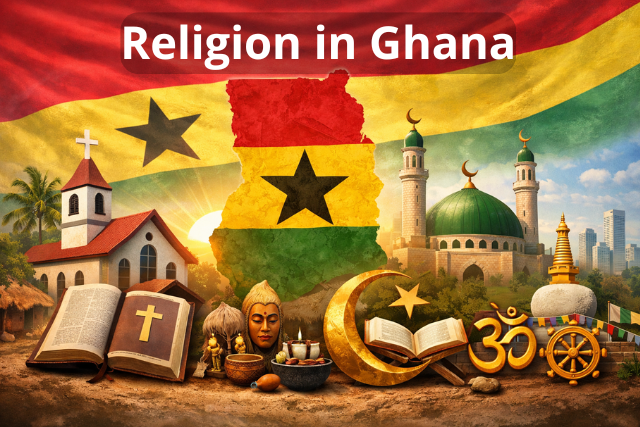
Ghana is widely recognized as one of Africa’s most peaceful and religiously tolerant nations. In 2025, religion continues to play a central role in Ghanaian identity, social structure, and daily life. From Christianity and Islam to indigenous belief systems and minority faiths, Ghana’s religious landscape reflects centuries of history, migration, trade, and cultural interaction.
This article provides a clear, updated overview of religions in Ghana in 2025, including percentage distribution, historical background, regional influence, and the social impact of religion in the country.
Overview of Religion in Ghana (2025)
As of 2025, Ghana remains a religiously pluralistic country, with Christianity as the dominant faith, followed by Islam, traditional African religions, and a small share of other belief systems and non-religious citizens.
Because Ghana’s most recent national census was conducted in 2021, the religious percentages used in 2025 are projected forward using population growth trends and stable affiliation patterns, which historically change very slowly in Ghana Wikipedia+1.
Religious Breakdown in Ghana (2025)
Percentage of Religions in Ghana
| Religion | Estimated Percentage (2025) |
|---|---|
| Christianity | 71.0% – 72.0% |
| Islam | 19.5% – 20.0% |
| Traditional African Religions | 3.0% – 3.5% |
| Other Religions (Hinduism, Buddhism, etc.) | 4.0% – 4.5% |
| No Religion / Irreligion | 1.0% – 1.5% |
These estimates are consistent with the Ghana Statistical Service census data (2021) and subsequent international religious freedom reports.
Christianity in Ghana (2025)
Christianity: The Largest Religion
Christianity is the dominant religion in Ghana, practiced by roughly seven out of every ten Ghanaians in 2025.
Christian Population Share
-
Approximate Percentage: 71–72%
-
Estimated Adherents (2025): Over 25 million people
Christianity’s growth in Ghana dates back to the 15th century, with stronger expansion during European missionary activity in the 19th and 20th centuries. Today, Christianity influences education, healthcare, politics, media, and national holidays.
Major Christian Denominations in Ghana
Christianity in Ghana is highly diverse, with several denominations coexisting peacefully:
-
Pentecostal / Charismatic Churches: ~31–32%
-
Protestant Churches: ~17–18%
-
Roman Catholic Church: ~10%
-
Other Christian Groups: ~12%
Pentecostal and Charismatic churches remain the fastest-growing Christian movements, especially in urban areas such as Accra, Kumasi, and Takoradi.
Christian festivals like Christmas and Easter are recognized as national public holidays, reflecting the religion’s influence on Ghanaian public life.
Islam in Ghana (2025)
Islam: The Second-Largest Religion
Islam is firmly established as the second most practiced religion in Ghana.
-
Estimated Percentage: 19.5–20.0%
-
Estimated Muslim Population (2025): Around 7 million
Islam arrived in Ghana centuries before Christianity through trans-Saharan trade routes, introduced by Muslim merchants and scholars between the 10th and 15th centuries.
Islamic Denominations in Ghana
Islam in Ghana is predominantly Sunni, but includes other traditions:
-
Sunni Muslims: ~60–63%
-
Ahmadiyya Muslims: ~30–37%
-
Shia and Others: Small minority
Most Ghanaian Muslims follow the Maliki school of Islamic jurisprudence, particularly in northern regions such as Northern, Upper East, and Upper West Regions.
Islamic festivals such as Eid al-Fitr and Eid al-Adha are officially recognized and widely observed.
Traditional African Religions in Ghana (2025)
Indigenous Belief Systems
Traditional African religions remain an important cultural and spiritual foundation in Ghana, even though the percentage of formal adherents has declined over time.
-
Estimated Percentage: 3.0–3.5%
These belief systems emphasize:
-
Ancestor worship
-
Nature spirits
-
Sacred groves and shrines
-
Rituals connected to land, fertility, and community protection
Many Ghanaians who identify as Christians or Muslims also observe traditional practices, especially during festivals and family ceremonies. This religious blending is a unique characteristic of Ghanaian spirituality.
Other Religions in Ghana
Minority Faiths (2025)
Although small in number, Ghana is home to several minority religions:
-
Hinduism
-
Buddhism
-
Judaism
-
Baháʼí Faith
-
Traditional Asian religions
-
Combined Percentage: 4.0–4.5%
These communities are mainly concentrated in urban centers, often linked to migrant populations, business communities, or diplomatic residents.
No Religion / Irreligion in Ghana
Religious Non-Affiliation
Ghana has one of the lowest rates of religious non-affiliation in the world.
-
Estimated Percentage: 1.0–1.5%
Atheism and agnosticism exist but are rarely publicly expressed due to strong cultural and social norms that favor religious belief. Even many non-religious individuals participate in religious ceremonies for social or family reasons.
Regional Distribution of Religion in Ghana
Religion in Ghana varies by region:
-
Southern Ghana: Predominantly Christian
-
Northern Ghana: Higher Muslim population
-
Rural Areas: Stronger presence of traditional beliefs
-
Urban Areas: Greater religious diversity
Despite these regional patterns, Ghana has no significant link between ethnicity and religion, making it one of Africa’s most religiously integrated societies.
Religious Tolerance and Coexistence
Ghana is internationally praised for religious harmony. Interfaith marriages, shared festivals, and mutual respect are common.
Key factors supporting tolerance include:
-
Constitutional freedom of religion
-
Interfaith councils
-
Shared national identity over religious identity
-
Religious education promoting coexistence
There has been no major religious conflict in Ghana in recent decades, setting the country apart from many global regions.
Role of Religion in Ghanaian Society
Religion influences almost every aspect of life in Ghana:
-
Education: Many top schools are church- or mosque-founded
-
Healthcare: Faith-based hospitals and clinics are widespread
-
Politics: Leaders often reference faith, but governance remains secular
-
Media: Religious radio and TV stations are highly popular
-
Social Support: Churches and mosques provide welfare assistance
Religion in Ghana functions not only as belief, but as a social safety net and moral framework.
Future Religious Trends in Ghana Beyond 2025
Looking ahead, Ghana’s religious structure is expected to remain largely stable, with:
-
Continued dominance of Christianity
-
Gradual growth of Islam aligned with population trends
-
Slow decline in formal traditional religion, but continued cultural relevance
-
Slight rise in religious diversity due to globalization
No major demographic shift is expected in the near future.
In 2025, Ghana remains a deeply religious nation, where faith plays a vital role in shaping identity, culture, and social life. Christianity leads with over 70% of the population, Islam follows at nearly 20%, and traditional African religions continue to influence cultural practices. Minority religions and non-religious citizens coexist peacefully within a framework of tolerance and respect.
Ghana stands as a model of religious coexistence in Africa, proving that diversity and harmony can thrive together in a modern nation.