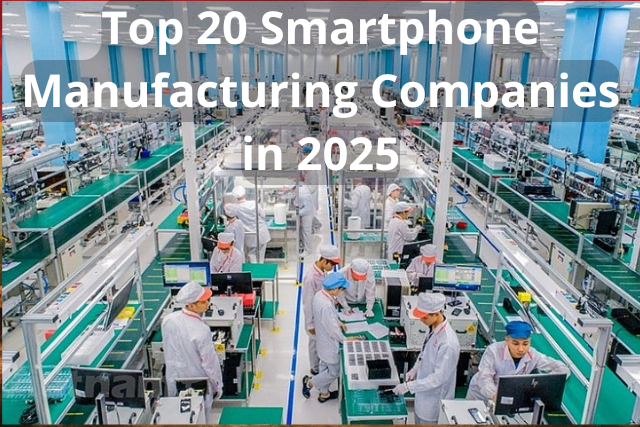
Top 20 Smartphone Manufacturing Companies in 2025
The global smartphone industry in 2025 stands at a turning point. Innovation is no longer limited to faster processors or better cameras—today’s leading smartphone manufacturers compete on artificial intelligence, sustainability, advanced chip integration, foldable designs, and global manufacturing scale. As consumer demand rebounds after several volatile years, a select group of companies dominates production, research, and worldwide distribution.
This article explores the top 20 smartphone manufacturing companies in 2025, focusing on their manufacturing strength, innovation strategies, and global influence. Rather than ranking only by sales volume, this list reflects manufacturing capability, brand reach, technological leadership, and long-term market impact.
1. Apple Inc. (United States)
Apple remains one of the most powerful smartphone manufacturers in 2025. While it does not own all of its factories, Apple controls every aspect of design, silicon development, software, and quality standards. Its iPhone production ecosystem spans China, India, and Southeast Asia, making it one of the most sophisticated manufacturing networks in the world.
Apple’s vertical integration, custom A-series chips, and long software support cycles continue to set industry benchmarks. Strong demand for premium devices keeps Apple at the forefront of global smartphone manufacturing.
2. Samsung Electronics (South Korea)
Samsung is the world’s most diversified smartphone manufacturer. It designs and manufactures displays, memory chips, processors, and batteries in-house, giving it unmatched supply-chain control. In 2025, Samsung continues to lead in foldable phones, AMOLED displays, and mass-market Android devices.
With manufacturing facilities across Asia and strong global distribution, Samsung remains a cornerstone of the smartphone industry.
3. Xiaomi Corporation (China)
Xiaomi has evolved from a budget smartphone brand into a global manufacturing powerhouse. Its strength lies in efficient production, aggressive pricing, and rapid adoption of new hardware technologies. Xiaomi’s sub-brands allow it to cover entry-level, mid-range, and premium segments simultaneously.
In 2025, Xiaomi continues expanding manufacturing outside China, reinforcing its international supply resilience.
4. OPPO (China)
OPPO focuses heavily on design innovation, fast-charging technology, and camera systems. Its manufacturing model emphasizes speed and scale, allowing it to release new models frequently without compromising build quality.
The company has invested heavily in research labs and smart factories, positioning itself as a premium Android manufacturer in Asia and Europe.
5. Vivo (China)
Vivo stands out for its emphasis on imaging technology and sleek design. Its vertically integrated manufacturing allows close collaboration between engineers and assembly units, resulting in refined hardware experiences.
In 2025, Vivo continues to expand in emerging markets while strengthening its presence in the premium segment.
6. Huawei Technologies (China)
Despite ongoing geopolitical challenges, Huawei remains a major smartphone manufacturer. The company has rebuilt much of its supply chain and invested heavily in domestic chip development and operating systems.
Huawei’s manufacturing resilience and strong domestic demand keep it among the top global players in 2025.
7. Transsion Holdings (China)
Transsion, the parent company of Tecno, Infinix, and itel, dominates smartphone manufacturing in Africa and several emerging markets. Its factories specialize in cost-efficient mass production tailored to regional needs.
Transsion’s deep understanding of local markets makes it one of the fastest-growing manufacturers globally.
8. Lenovo (Motorola Mobility)
Lenovo’s smartphone manufacturing arm, Motorola, blends classic branding with modern production techniques. The company focuses on reliable hardware, clean software, and competitive pricing.
Motorola’s manufacturing footprint spans multiple continents, supporting steady global expansion.
9. Google (United States)
Google’s Pixel smartphones represent a unique manufacturing model. While assembly is outsourced, Google maintains strict control over design, AI integration, and software optimization.
In 2025, Pixel devices are increasingly recognized for computational photography and long-term software reliability.
10. Sony Corporation (Japan)
Sony’s smartphone manufacturing emphasizes premium components, particularly imaging sensors and display technology. Although its market share is smaller, Sony plays a critical role in supplying components to the wider industry.
Sony’s vertically connected ecosystem gives it strategic influence beyond unit sales.
11. OnePlus (China)
OnePlus focuses on high-performance smartphones built with streamlined manufacturing processes. Its production strategy prioritizes quality control and flagship-level components at competitive prices.
In 2025, OnePlus maintains a loyal global user base.
12. Realme (China)
Realme is known for rapid product cycles and youth-focused designs. Its manufacturing strategy relies on high-volume output and efficient component sourcing.
The brand continues to grow in Asia and Europe through aggressive pricing and fast innovation.
13. Honor (China)
Honor has successfully re-established itself as an independent smartphone manufacturer. Its modern factories focus on premium materials, camera optimization, and AI-driven performance.
Honor’s growth in 2025 reflects renewed global trust and manufacturing confidence.
14. Nokia (HMD Global)
Nokia’s smartphone manufacturing prioritizes durability, security, and sustainability. Devices are built to last longer than industry averages, appealing to enterprise and government users.
In 2025, Nokia remains relevant through ethical manufacturing practices.
15. ASUS (Taiwan)
ASUS specializes in performance-centric smartphones, particularly gaming devices. Its manufacturing emphasizes thermal management, chipset optimization, and advanced cooling systems.
ASUS remains a niche but influential manufacturer in 2025.
16. ZTE (China)
ZTE continues to operate as a large-scale manufacturer with strong telecom integration. Its smartphones are widely used in carrier-driven markets and government sectors.
ZTE’s manufacturing infrastructure remains robust and cost-efficient.
17. TCL (Alcatel)
TCL focuses on affordable smartphones and display innovation. Its strength lies in large-scale panel manufacturing, which supports cost-effective device production.
In 2025, TCL continues supplying budget-friendly smartphones worldwide.
18. Lava International (India)
Lava represents India’s growing smartphone manufacturing ambition. Its factories focus on domestic production and localized supply chains.
Lava plays a key role in India’s smartphone manufacturing expansion.
19. Micromax (India)
Micromax has returned to smartphone manufacturing with a renewed focus on value and domestic assembly. Its production aligns with regional manufacturing incentives.
The brand remains significant in South Asia.
20. Fairphone (Netherlands)
Fairphone stands apart for ethical smartphone manufacturing. Its modular designs allow easy repairs and extended product lifespans.
In 2025, Fairphone represents the future of sustainable smartphone production.
The Future of Smartphone Manufacturing
The top smartphone manufacturing companies in 2025 reflect a diverse and evolving industry. From tech giants with vertically integrated ecosystems to emerging manufacturers focusing on affordability and sustainability, the market is broader than ever.
As artificial intelligence, regional manufacturing, and environmental responsibility gain importance, smartphone manufacturing will continue to transform—driven by innovation, resilience, and global demand.