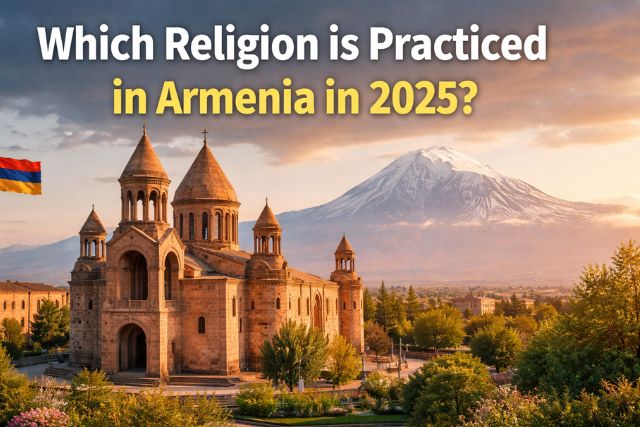
Which Religion Is Practiced in Armenia in 2025?
Religious Demographics, Percentages, and Cultural Significance
Armenia is widely recognized as one of the most religiously distinctive countries in the world. Its faith landscape is deeply intertwined with national identity, history, language, and culture. In 2025, religion in Armenia remains remarkably stable, with Christianity—particularly the Armenian Apostolic Church—continuing to play a dominant role in both spiritual life and collective identity.
Our article provides a clear, up-to-date overview of religions practiced in Armenia in 2025, including estimated percentages, historical context, minority faiths, and the modern role of religion in Armenian society.
Overview of Religion in Armenia (2025)
Armenia is overwhelmingly Christian. The country holds a unique place in world history as the first nation to adopt Christianity as a state religion, a decision made in the early 4th century. This early adoption shaped Armenian civilization in a lasting way.
By 2025, Armenia remains one of the most religiously homogeneous countries in Europe and the Caucasus. While the constitution guarantees freedom of belief, one church—the Armenian Apostolic Church—continues to have a special cultural and spiritual status.
Religious Composition of Armenia in 2025 (Estimated Percentages)
Based on recent census trends, demographic studies, and population stability, the religious breakdown of Armenia in 2025 can be reasonably estimated as follows:
Religion Percentages in Armenia (2025)
-
Christianity (Total): ~96.5%
-
Armenian Apostolic Church: ~95.0%
-
Other Christian denominations: ~1.5%
-
-
Yazidism: ~1.1%
-
Islam: ~0.2%
-
Other religions (Judaism, Paganism, Baháʼí, etc.): ~0.4%
-
No religion / unaffiliated: ~0.6%
-
Unspecified or undeclared: ~1.2%
These figures reflect long-term demographic consistency rather than sudden change, as Armenia experiences limited religious conversion and low immigration compared to many other countries.
Armenian Apostolic Church: The Core Faith of the Nation
Percentage of Population
Approximately 95% of Armenians in 2025 identify with the Armenian Apostolic Church.
Historical Significance
The Armenian Apostolic Church was established in the 1st century and became the official state church in 301 AD, making Armenia the first Christian nation in recorded history. This church belongs to the family of Oriental Orthodox churches and follows its own distinct theological traditions.
Cultural Role
For many Armenians, belonging to the Armenian Apostolic Church is not only a matter of belief but also cultural identity. Even Armenians who are not actively religious often identify with the church due to its historical role in preserving the Armenian language, literature, and national consciousness—especially during periods of foreign rule.
Modern Influence
In 2025, the church continues to:
-
Conduct major life ceremonies (baptisms, weddings, funerals)
-
Influence national holidays and traditions
-
Act as a symbol of Armenian continuity worldwide
Other Christian Denominations in Armenia
Although Christianity is overwhelmingly Apostolic, a small percentage of Armenians follow other Christian traditions.
Roman Catholic and Armenian Catholic Christians (~0.6%)
Catholic communities are mostly concentrated in northern Armenia. These believers follow Catholic theology while preserving Armenian liturgical traditions.
Protestant and Evangelical Christians (~0.5%)
Evangelical and Protestant groups have a modest presence, including:
-
Armenian Evangelical Church
-
Baptist communities
-
Pentecostal congregations
These churches are legally recognized but represent a very small share of the population.
Eastern Orthodox Christians (~0.2%)
Most Orthodox Christians in Armenia are ethnic Russians, Ukrainians, or Greeks rather than ethnic Armenians.
Yazidism: Armenia’s Largest Non-Christian Religion
Percentage of Population
Approximately 1.1% of Armenia’s population practices Yazidism in 2025.
Who Are the Yazidis?
The Yazidis are an ethno-religious group with ancient beliefs distinct from both Christianity and Islam. Armenia hosts one of the largest Yazidi populations in the world outside the Middle East.
Religious Freedom
Yazidism is officially recognized, and Yazidis in Armenia generally enjoy freedom to practice their religion, maintain cultural traditions, and educate their children in their own language.
Islam in Armenia (2025)
Percentage of Population
Muslims make up about 0.2% of Armenia’s population in 2025.
Background
Historically, Muslim populations were larger in Armenia, but geopolitical conflicts and population movements in the late 20th century drastically reduced their numbers. Today, most Muslims in Armenia are:
-
Temporary residents
-
Foreign students
-
Small ethnic minorities
Places of Worship
There are very few active mosques, with the historic Blue Mosque in Yerevan serving primarily cultural and diplomatic purposes.
Other Religions in Armenia
Though numerically small, Armenia is home to several other religious traditions.
Judaism (~0.05%)
Armenia has a tiny Jewish community, mainly concentrated in Yerevan. There is limited religious infrastructure but long-standing historical ties.
Neo-Paganism (~0.1%)
Some Armenians practice modern revivals of ancient Armenian pagan beliefs, often focused on pre-Christian traditions and cultural symbolism.
Baháʼí Faith and Others (~0.2%)
Small communities of Baháʼí believers and followers of other spiritual movements exist, though they have minimal demographic impact.
Non-Religious and Unaffiliated Armenians
Percentage
Around 0.6% of Armenia’s population identifies as non-religious or atheist in 2025.
Social Context
Even among the non-religious, cultural affiliation with Christianity remains common. Many people who do not actively practice religion still participate in religious holidays and ceremonies.
Religion and the Armenian Constitution
Armenia’s constitution guarantees:
-
Freedom of religion
-
Freedom of conscience
-
Separation of church and state
However, the Armenian Apostolic Church is recognized as having a special historical mission, giving it a unique national status without making Armenia a theocracy.
Religion in Daily Life in Armenia (2025)
Religion continues to influence:
-
National holidays
-
Family traditions
-
Architecture and monuments
-
Education and moral values
However, Armenia in 2025 is also increasingly urban, digital, and globally connected. Younger generations often express faith more culturally than doctrinally.
Future Trends: Will Armenia’s Religious Makeup Change?
Significant religious change in Armenia is unlikely in the near future due to:
-
Strong national identity tied to faith
-
Low immigration
-
Limited religious conversion
-
Deep historical continuity
While personal belief styles may evolve, the overall religious percentages are expected to remain stable beyond 2025.
In 2025, Armenia remains one of the most religiously unified nations in the world. Christianity—especially the Armenian Apostolic Church—continues to define the spiritual and cultural framework of society.
Key Takeaways:
-
~96.5% Christian
-
~95% Armenian Apostolic
-
~1.1% Yazidi
-
Very small Muslim, Jewish, and other faith communities
-
Minimal religious change expected in the near future
Religion in Armenia is not merely a belief system—it is a living expression of national history, resilience, and identity.