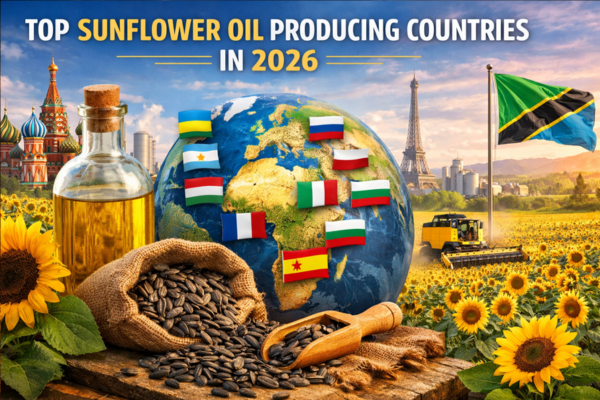
Which are the Top 10 Sunflower Oil Manufacturing Global Leaders in 2026?
Sunflower oil is one of the world’s most consumed edible oils — prized for its light taste, cooking versatility, and heart-healthy profile. It’s a key ingredient in households, restaurants, and food industries around the globe. The manufacture of sunflower oil depends largely on the availability of sunflower seeds — the primary raw material — as well as agricultural infrastructure and processing capacity.
In 2026, the global sunflower oil landscape continues to be dominated by a set of powerhouse producers with deep agricultural legacies, favorable climates, and strong export orientation. In this article, we explore the top 10 sunflower oil manufacturing countries — where they rank, how they contribute to global supply, and what drives their production leadership.
1. Ukraine — The Global Sunflower Oil Champion
Ukraine has long stood at the forefront of sunflower oil production and remains world’s top producer heading into 2026. Blessed with rich, fertile soils and ideal climate conditions across the Black Sea region, Ukrainian agriculture specializes in oilseed crops — particularly sunflower seeds, the essential feedstock for sunflower oil.
Why Ukraine Leads
-
Climate & Geography: Fertile plains, long sunny seasons, and suitable rainfall support large-scale sunflower cultivation.
-
Agricultural Expertise: Farmers have refined techniques for high-yield sunflower seed production over generations.
-
Oilseed Processing Infrastructure: A robust network of crushing and refining facilities turns seeds into high-quality oil for both domestic use and export.
Ukraine’s sunflower oil output dwarfs most other nations. It consistently contributes the largest share of global sunflower oil production, making it a critical supplier in global edible oil markets.
2. Russia — A Close Second and Rising Exporter
Right beside Ukraine in global rankings is Russia, another agricultural titan in sunflower oil manufacturing. It benefits from vast arable land, especially in regions like the Krasnodar Territory, Rostov, and Belgorod, where sunflower cultivation thrives.
Russia’s production volumes have surged due to improvements in farming methods, increased processing capacity, and strategic market positioning. Recent trends show Russia pushing its sunflower oil exports — particularly to major importers like India — signaling its expanding influence in the global edible oils trade.
3. Argentina — South America’s Sunflower Oil Powerhouse
Argentina ranks third globally in sunflower oil manufacturing. Although the country’s output is significantly lower than Ukraine’s and Russia’s, it continues to be a critical supplier — especially to markets in the Americas, Africa, and parts of Asia.
What Makes Argentina Competitive
-
Expanding Sunflower Cultivation: Sunflower acreage has grown as farmers diversify from soy and maize, balancing crop rotation needs with market demand.
-
Refining Capacity: Argentina’s modern oil processing facilities enable it to export both crude and refined sunflower oil.
Argentina’s strategic geographic position allows it to serve Southern Hemisphere markets efficiently, making it a consistent top-three player in sunflower oil production.
4. Hungary — Central Europe’s Leading Producer
Hungary holds a strong position in global sunflower oil rankings, representing Central Europe’s most significant contributor. Its production is supported by:
-
Optimal Growing Conditions: The Hungarian plains are conducive to sunflower cultivation.
-
Longstanding Oilseed Tradition: Sunflower crops are deeply integrated into local agricultural cycles.
While the absolute production volume is smaller than in the top three countries, Hungary remains a key manufacturer and exporter within European markets.
5. France — France’s Growing Oilseed Output
France ranks fifth in the world for sunflower oil manufacturing, with production centered in regions with balanced precipitation and fertile soils conducive to sunflowers.
France’s sunflower oil industry benefits from:
-
Integrated Farming Systems: Many growers integrate sunflowers into rotational cropping systems.
-
Access to EU Markets: As part of the European Union, France easily supplies neighboring countries, aiding in stable demand for its sunflower oil.
This European powerhouse continues to invest in quality production and has seen steady output growth year after year.
🇧🇬 6. Bulgaria — Sunflower Oils from the Balkans
Bulgaria is a notable manufacturer in the sunflower oil arena, consistently ranking among the world’s top producers. Its agricultural sector emphasizes sunflower cultivation both for domestic processing and export.
Key Strengths
-
Stable Sunflower Seed Yields: Bulgarian farms achieve reliable seed production through well-established techniques.
-
Export Potential: Bulgaria exports a significant volume of sunflower oil to neighboring EU and Balkan states.
Though smaller than some larger nations, Bulgaria’s sunflower oil industry continues to expand its footprint in Europe.
7. Romania — Growing Oil Production in Eastern Europe
Romania consistently appears in global sunflower oil rankings and has strengthened its role as a key manufacturer. Favorable agricultural conditions and investments in processing infrastructure have bolstered Romania’s production in recent years.
Romanian sunflower oil often serves European markets, and the country’s proximity to major export hubs contributes to its competitiveness.
8. Spain — A Mediterranean Sunflower Oil Maker
Spain might be more traditionally associated with olive oil, but it also ranks among the top sunflower oil manufacturing countries. Its Mediterranean climate supports extensive sunflower cultivation, particularly in regions like Andalusia and Extremadura.
Spain’s sunflower oil production plays a vital role in Southern Europe, supplying both domestic consumption and export demand.
9. Tanzania — Africa’s Rising Star
While not traditionally counted among top global producers, Tanzania has emerged as a noteworthy player in recent sunflower oil statistics — particularly across East Africa. Its inclusion among the top ten reflects both improved farming practices and expanding local capacity.
Tanzania’s Sunflower Oil Growth Factors
-
Domestic Demand: Rising consumption of edible oils drives local production.
-
Agricultural Expansion: Farmers increasingly embrace sunflower crops for both oil production and seed export.
Tanzania’s presence among the top 10 underscores how sunflower oil manufacturing is diversifying geographically.
10. Kazakhstan — Newcomer in the Top Tier
Rounding out the 2026 list is Kazakhstan, a Central Asian country that has rapidly increased its sunflower oil production and export volume over recent years. Its agricultural sector has expanded acreage under sunflower cultivation, propelling it into the global top ten.
Kazakhstan’s enrollment among the world’s leading sunflower oil manufacturers reflects not just production growth but improved export connectivity with markets across Asia and Europe.
2026 Ranking of Top Sunflower Oil Manufacturing Countries
| Rank | Country | Key Advantage |
|---|---|---|
| 1 | Ukraine | #1 Global producer |
| 2 | Russia | Large scale & expanding exports |
| 3 | Argentina | South American leader |
| 4 | Hungary | Central European stronghold |
| 5 | France | EU production hub |
| 6 | Bulgaria | Balkan exporter |
| 7 | Romania | Eastern European growth |
| 8 | Spain | Mediterranean producer |
| 9 | Tanzania | Rising African manufacturer |
| 10 | Kazakhstan | Fast-growing Central Asian player |
Factors Driving Sunflower Oil Manufacturing in 2026
1. Agricultural Innovation
Technologies such as improved seed varieties, precision farming, and optimized harvesting techniques are increasing yield per hectare, helping producers expand output.
2. Global Trade Dynamics
Countries like Ukraine and Russia actively export sunflower oil worldwide. Trade relationships with importers such as India drive production decisions and influence crop area planning.
3. Climate & Geography
Regions with ideal sunlight, temperature, and rainfall — like Eastern Europe and parts of South America — naturally outperform others in sunflower seed cultivation, the backbone of oil manufacturing.
4. Processing Capacity
Crushing facilities and refineries determine how much sunflower seed can be turned into oil — and countries investing in infrastructure tend to rise in the rankings.
5. Market Demand Trends
Health conscious consumers continue to favor sunflower oil for cooking and food preparation. Growing middle classes in Asia and Africa are boosting demand for edible oils, spurring production growth.
The sunflower oil manufacturing landscape in 2026 is dynamic yet stable.
Established producers like Ukraine, Russia, and Argentina continue to dominate production, while emerging players including Tanzania and Kazakhstan are reshaping the global output map. These trends reflect shifts in agricultural priorities, global trade realignments, and rising demand for healthier edible oils.
Understanding these manufacturing leaders — and the factors that propel them — equips businesses, traders, and consumers with crucial insight into the global sunflower oil market.