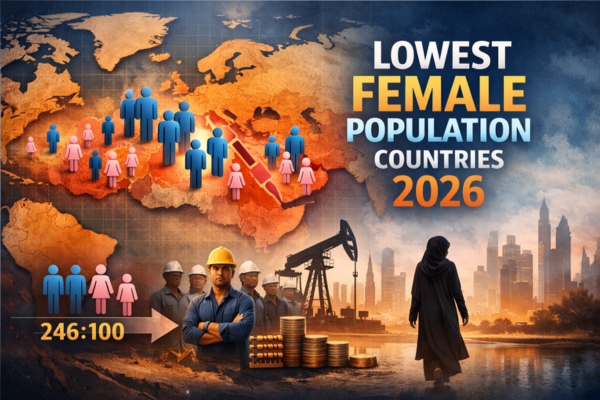
Top 20 Countries with the Lowest Female Population in the World in 2026
Understanding global population dynamics is crucial for economists, policymakers, researchers, and digital content creators alike. One important demographic indicator is the female population share — specifically where women make up a smaller proportion of the total population compared to men. In 2026, data on sex ratios (the number of males for every 100 females) reveals that several countries around the world have more men than women, often due to labor migration, cultural factors, economic opportunities, or historical trends.
This comprehensive SEO‑optimized guide explores the top 20 countries with the lowest female population (or highest male‑to‑female ratios) in 2026, what drives these imbalances, and the social and economic implications behind them.
What Does “Lowest Female Population” Mean?
When we talk about a country having a “low female population,” we mean that the sex ratio is skewed toward males — that is, there are significantly more males than females in the population. A higher male‑to‑female ratio implies fewer women relative to men. For example, a ratio of 246 males per 100 females means that for every 100 women, there are 246 men.
Sex ratios can be influenced by:
-
Migration patterns: Many male migrant workers in certain countries.
-
Economic labor demand: Countries with large construction and oil sectors attract male workers.
-
Cultural and social factors: Preferences at birth or gendered mortality patterns.
-
Life expectancy differences: Varying longevity between men and women.
Top 20 Countries Skewed Toward Male Populations (Lowest Female Share)
Here’s a detailed list of countries where men significantly outnumber women in 2026, ranked roughly by how skewed their sex ratio is:
1. Qatar
-
Sex ratio: ~246 males per 100 females
-
Qatar tops the global list of male‑skewed populations, largely due to massive numbers of male migrant workers in construction and energy sectors.
2. United Arab Emirates (UAE)
-
Sex ratio: ~176 males per 100 females
-
The UAE’s workforce has many foreign male laborers, which significantly reduces the proportion of women.
3. Oman
-
Sex ratio: ~166 males per 100 females
-
Like Qatar and the UAE, Oman attracts large numbers of male workers from abroad.
4. Bahrain
-
Sex ratio: ~163 males per 100 females
-
Bahrain’s gender imbalance also stems from labor migration and expatriate communities.
5. Maldives
-
Sex ratio: ~162 males per 100 females
-
Small island nations may see higher male ratios due to tourism and male migrant workers.
6. Kuwait
-
Sex ratio: ~157 males per 100 females
-
Kuwait shows a similar imbalance due to its expatriate labor force.
7. Saudi Arabia
-
Sex ratio: ~153 males per 100 females
-
Migrant labor and industry sectors account for its male‑heavy population.
8. Seychelles
-
Sex ratio: ~123 males per 100 females
-
Although smaller in scale, some island nations show male‑skewed demographics.
9. Western Sahara
-
Sex ratio: ~123 males per 100 females
-
Regional tensions and migration patterns may influence this imbalance.
10. Palau
-
Sex ratio: ~117 males per 100 females
-
Microstates and territories can show demographic quirks due to population size effects.
Countries Where Women Are Slightly More Numbers But Still Imbalanced
While the list above shows countries where men heavily outnumber women, the next set of countries have balanced but still notable imbalances — often caused by longevity and male migration factors:
11. Equatorial Guinea
-
Slight male‑dominant figures influenced by economic labor migration.
12. Bhutan
-
Historical data shows male‑skewed ratios in some age groups.
13. Mongolia
-
Some demographic data point to slight male predominance.
14. Iran
-
Higher male proportions exist in younger populations due to birth sex ratios.
15. Pakistan
-
With a high young population, there are slightly more males than females.
Close Balances (More Balanced Populations but Still Few Women Relative to Men)
These countries have relatively balanced populations, but data suggests men still slightly outnumber women:
16. Nigeria
-
Slight male predominance due to youth demographics and birth ratios.
17. India
-
Due to cultural and social practices affecting birth ratios, India has more males.
18. China
-
Cultural factors and historical policies have led to more males than females.
19. Malaysia
-
Some demographic reports indicate a mild male majority.
20. Indonesia
-
Slight male skew is observed in several demographic breakdowns.
Why Do Some Countries Have Low Female Populations?
1. Labor Migration & Economic Workforces
Many countries with low female populations rely heavily on expatriate labor, especially male workers in sectors like construction, oil, and industrial work. This is particularly evident in Gulf Cooperation Council (GCC) states such as Qatar, UAE, Saudi Arabia, and Oman.
2. Cultural & Birth Practices
Some countries have historically higher male birth ratios or cultural preferences that influence the sex ratio at birth. Policies and societal norms can subtly influence these ratios as well.
3. Life Expectancy Differences
Women tend to live longer than men, but this advantage may be offset by male‑dominant migration and youth‑heavy populations in some countries. Over time, high male immigration can outweigh female longevity.
Impacts of Skewed Gender Ratios
Social Effects
-
Marriage markets: A large imbalance can affect partner availability.
-
Family structures: Skewed sex ratios influence household dynamics and fertility patterns.
-
Community life: Gender imbalances shape education, employment, and civic engagement.
Economic Effects
-
Labor force composition: Male‑dominated labor pools shape economic policy and workforce planning.
-
Migration policy: Countries may adjust immigration laws to balance population needs.
Healthcare & Aging
In countries with more men, healthcare systems might face different burdens, especially when life expectancy varies by gender.
In 2026, the global landscape of gender demographics reveals that several countries have significantly more men than women, especially nations with large male migrant workforces or historical gender imbalances. From Qatar’s dramatically male‑skewed population to more balanced but still male‑dominant countries like India and Pakistan, these demographic trends shape social structures, economic policies, and community life around the world.
Understanding where the female population is relatively low provides valuable insights for global planning — whether for education, healthcare, migration, or media content strategies.