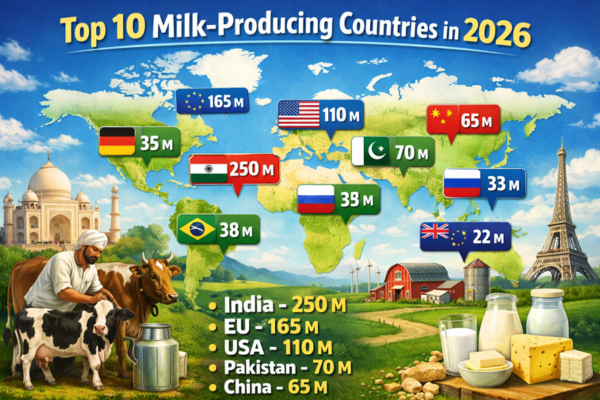
Who are the Top 10 Milk-Producing Countries in the World in 2026?
Milk is one of the most widely consumed animal-sourced foods in the world — rich in essential nutrients like calcium, protein, and vitamins. The global dairy industry supports millions of farmers and feeds billions of people. Each year, leading milk-producing countries release updated production statistics. Based on recent trends, production data and industry forecasts, here’s a comprehensive breakdown of the Top 10 milk-producing countries in 2026, how much milk they produce annually, and what drives their dairy sectors.
1. India — ~250 Million Tonnes (Largest Global Producer)
India continues to dominate global milk production and remains the world’s largest producer. In 2024–25, India produced nearly 248 million tonnes of milk, and industry reports show growth trends continuing into 2026.
Why India Produces So Much Milk
-
Agriculture Foundation: Dairy farming is deeply rooted in rural India, with millions of smallholder farmers raising cows and buffaloes.
-
Diverse Animal Mix: Indian dairy systems rely heavily on buffalo milk — especially Murrah, Surti, and Jaffarabadi breeds — which typically have higher fat content than cow milk.
-
Co-operative Models: Organizations like Amul (one of the largest dairy cooperatives globally) support farmer income and milk collection.
Production Highlights
-
Estimated annual milk output (2026): ~250 million tonnes
-
Accounts for about one-quarter of the entire global milk production, making it one of the largest contributors to the world’s dairy supply.
-
Strong domestic demand fuels continuous increases in milk production and processing facilities.
2. European Union (EU-27) — ~165 Million Tonnes
Although the European Union isn’t a single country, it’s often treated as one entity for statistical comparison due to its collective output. In 2025, the EU produced about 161–162 million tonnes of milk, making it the second-largest global producer.
What Makes the EU a Dairy Powerhouse
-
Large Agricultural Sector: Countries like Germany, France, and the Netherlands contribute heavily.
-
Advanced Technology: EU dairy farms benefit from modern milking systems and efficient logistics.
-
Product Diversification: Milk in the EU goes into cheese, butter, yogurt, and milk powders — many of which are exported worldwide.
Production Highlights
-
Estimated annual milk output (2026): ~165 million tonnes
-
Supports a high level of dairy exports.
-
Maintains strict quality and sustainability standards.
3. United States — ~110 Million Tonnes
The United States has one of the most technologically advanced and productive dairy sectors in the world. In 2025, the U.S. produced around 104–112 million tonnes of milk.
Strengths of U.S. Dairy
-
High-yield Cows: The Holstein breed dominates American dairy farms, producing large volumes of milk.
-
Industrial Scale: U.S. dairy farms are typically larger and highly automated.
-
Product Innovation: The U.S. dairy industry leads in cheese, butter, and whey production.
Production Highlights
-
Estimated annual milk output (2026): ~110 million tonnes
-
Strong export markets for whey and cheese.
-
Significant capacity for value-added dairy products.
4. Pakistan — ~70 Million Tonnes
Pakistan consistently ranks among the top milk producers due to its large livestock population and strong dairy culture. In 2025 estimates, Pakistan’s annual production was around 65–70 million tonnes.
Why Pakistan Is a Top Producer
-
Buffalo and Cow Mix: Like India, Pakistan relies on buffalo milk, which contributes significantly to total output.
-
Domestic Consumption: A high demand for fresh milk and traditional dairy products like lassi and khoa supports production.
-
Growing Dairy Markets: Urbanization and rising incomes are increasing per-capita consumption.
Production Highlights
-
Estimated annual milk output (2026): ~70 million tonnes
-
Production continues rising due to increased investment in dairy infrastructure.
5. China — ~65 Million Tonnes
China’s milk production has grown steadily as its population and urban dairy consumption expand. The country’s output was estimated at about 65 million tonnes in recent years.
Drivers of China’s Growth
-
Large Dairy Herds: China has intensified dairy farming — including imports of high-yielding breeds.
-
Growing Demand: Rising middle-class incomes fuel consumption of milk, yogurt, and cheese.
-
Modernization: Foreign investment in processing technology is improving efficiency.
Production Highlights
-
Estimated annual milk output (2026): ~65 million tonnes
-
Significant domestic market offsets reliance on imports.
6. Brazil — ~38 Million Tonnes
Brazil is the largest milk producer in South America, and its dairy industry continues to develop. In recent years, Brazil produced about 35–38 million tonnes per year.
What Boosts Brazil’s Dairy Sector
-
Favorable Climate: Many regions are suitable for year-round grazing.
-
Growing Domestic Consumption: Milk, yogurt, and cheese are staples in Brazilian diets.
-
Diversification: Brazil also exports dairy products, though most output serves the local market.
Production Highlights
-
Estimated annual milk output (2026): ~38 million tonnes
-
Production is supported by both smallholders and commercial farms.
7. Germany — ~35 Million Tonnes
Germany is the leading milk producer within the EU and one of the top individual countries globally. Recent figures show German milk production at around 34–35 million tonnes annually.
Why Germany Leads in the EU
-
Strong Cooperatives: Many dairy farmers operate within cooperative marketing systems.
-
Cheese and Butter Production: Germany produces large dairy volumes for both domestic use and export.
-
High Quality Standards: Rigorous quality controls ensure Germany’s dairy products meet global benchmarks.
Production Highlights
-
Estimated annual milk output (2026): ~35 million tonnes
-
Integral part of EU’s overall dairy production.
8. Russia — ~33 Million Tonnes
Russia’s dairy industry has rebounded in recent years as the country focuses on food security and import substitution. Its milk output is approximately 32–33 million tonnes per year.
Characteristics of Russia’s Dairy Sector
-
Local Consumption Focus: Most milk is produced for domestic markets.
-
State Support: Policies aim to reduce reliance on imports and build local capacity.
-
Regional Hubs: Large dairy regions include Central and Southern Russia.
Production Highlights
-
Estimated annual milk output (2026): ~33 million tonnes
-
Continued investment in dairy farms expected to sustain production.
9. France — ~27 Million Tonnes
France is widely known for its cheese heritage and strong dairy traditions. Weekly production data place France at around 25–27 million tonnes annually.
France’s Dairy Strengths
-
Cheese Varieties: France produces world-famous cheeses such as Camembert, Brie, and Roquefort.
-
Dairy Exports: Cheese and butter exports are significant.
-
Quality Reputation: French dairy products are associated with strict quality standards.
Production Highlights
-
Estimated annual milk output (2026): ~27 million tonnes
-
Dairy sector remains central to French agriculture.
10. New Zealand — ~22 Million Tonnes
New Zealand closes out the top ten with its highly export-oriented dairy industry. Production averages around 21–22 million tonnes annually.
Why New Zealand Is a Dairy Export Leader
-
Pasture-Based Systems: Cows graze on natural grasslands for much of the year, reducing feed costs.
-
High Export Orientation: A vast share of New Zealand’s milk goes into powdered milk, butter, and cheese for global markets.
Production Highlights
-
Estimated annual milk output (2026): ~22 million tonnes
-
One of the world’s most efficient dairy exporters.
Global Milk Production Trends in 2026
Rising Demand for Dairy
Worldwide milk production has been steadily increasing as populations grow and per-capita consumption rises — especially in Asia and Africa. In many developing countries, milk plays a vital role in nutrition, particularly for children and pregnant people.
Innovation and Efficiency
-
Genetics and Feeding: Advances in animal genetics and nutrition improve herd productivity.
-
Automation: Robotic milking and digital herd management systems boost efficiency.
-
Sustainability: Many countries are investing in reduced-emission dairy systems to address climate challenges.
Challenges Ahead
Despite growth, the global dairy sector faces several challenges:
-
Feed Costs: Rising feed prices can squeeze farmer margins.
-
Climate Impact: Greenhouse gas emissions from dairy require targeted mitigation efforts.
-
Competition: Plant-based milk alternatives are gaining market share in some regions.
Summary: Top 10 Milk Producers (Estimated 2026)
| Rank | Country / Region | Estimated Annual Production (Million Tonnes) |
|---|---|---|
| 1 | India | ~250 |
| 2 | European Union | ~165 |
| 3 | United States | ~110 |
| 4 | Pakistan | ~70 |
| 5 | China | ~65 |
| 6 | Brazil | ~38 |
| 7 | Germany | ~35 |
| 8 | Russia | ~33 |
| 9 | France | ~27 |
| 10 | New Zealand | ~22 |
In 2026, the global milk production landscape continues to be led by long-standing dairy giants. India stands well above all others with an estimated 250 million tonnes of milk annually, driven by extensive smallholder farming and expanding dairy consumption. The European Union and United States hold strong positions, bolstered by advanced technology and large-scale production. Countries like Pakistan, China, and Brazil show rapid growth as domestic demand rises and dairy infrastructure improves.
This data reflects a dynamic and essential industry — one that supports livelihoods, fulfills nutritional needs, and evolves with technological and environmental trends.