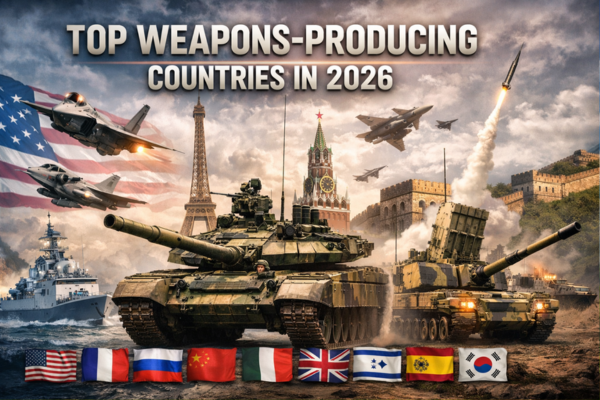
Who are the Top 10 Weapons-Producing Countries in the World in 2026?
Comprehensive Guide to Global Defense Manufacturing and Arms Production
In 2026, the global weapons and defense industry remains one of the most strategic and closely watched sectors in the world. Military capability, geopolitical alliances, and national security priorities drive countries to build powerful defense manufacturing bases. While some nations focus on exported arms, others prioritize domestic production for their own armed forces. This article explores the top 10 weapons-producing countries in the world in 2026, considering each nation’s production scale, global influence, and export footprint.
What Defines a Weapons-Producing Country?
A weapons-producing country is one that:
-
Manufactures military equipment at scale
-
Produces heavy weapons systems, aircraft, naval vessels, missiles, and advanced defense tech
-
Supplies weapons domestically and often internationally
-
Has a structured defense industry including state, private, or mixed enterprises
In this context, production strength goes beyond exports alone; it reflects manufacturing volume, defense budget allocation, technological innovation, and the global role of the country’s defense industry.
Ranking the Top 10 Weapons Producers in 2026
Below is the ranking of the world’s top 10 weapons-producing countries based on their current defense industrial capacity, weapons exports, and global influence in military manufacturing.
1. United States — The World’s Leading Defense Manufacturer
The United States continues to dominate global weapons production in 2026. Its defense industry is unparalleled in scale, technology, and revenue. The U.S. defense sector produces a wide range of advanced military equipment, including fighter jets, missiles, armored vehicles, warships, drones, and communication systems.
Why the U.S. tops the list:
-
Largest defense budget in the world
-
Home to major defense contractors and R&D facilities
-
Strong export market across NATO, Middle East, Asia, and Africa
In 2026, the U.S. remains the clear leader in arms exports, contributing a significant share (over 40%) of global weapons exports.
Production strengths include:
-
F-35 Lightning II and advanced combat aircraft fleets
-
Cruise missiles, smart bombs, and advanced artillery
-
Unmanned systems and cyber defense technologies
2. France — Europe’s Advanced Arms Manufacturer
France holds a solid position as one of the strongest weapons producers in the world. Its defense industry combines heavy manufacturing with cutting-edge technologies.
Key strengths:
-
Advanced fighter jets (e.g., Rafale series)
-
Submarines, helicopters, and missile systems
-
Strategic defense exports to multiple continents
France consistently ranks high in global arms exports and remains Europe’s second-largest exporter after the U.S. in 2026.
3. Russia — Major Arms Manufacturer Despite Challenges
Russia’s defense industry has long been one of the most significant globally. Despite facing economic sanctions and geopolitical pressures, Russia remains a top weapons producer.
Production highlights:
-
Heavy tanks, artillery, and air defense systems
-
Fighter aircraft and missile platforms
-
Submarines and naval vessels
Russia’s weapons industry is geared strongly toward both domestic needs and longstanding partners in Asia, Africa, and the Middle East. In 2026, it still ranks as a top producer even though export figures have fluctuated.
4. China — Rapidly Growing Defense Production Powerhouse
China has been steadily expanding its military production capabilities, focusing on advanced technologies and self-reliant defense manufacturing.
What makes China notable:
-
Large quantities of missiles, aircraft, and naval vessels
-
Increasing sophistication in drones, AI, and naval tech
-
A strategic goal to become self-sufficient in defense exports
China, although slightly behind Russia and France in total weapons exports, remains a top global producer in 2026, and its defense technology continues to improve.
5. Germany — Europe’s Industrial Engine for Defense Tech
Germany combines robust industrial capacity with advanced engineering, making it a key weapons producer.
German defense strengths:
-
Main battle tanks (e.g., Leopard series)
-
Submarines and naval systems
-
High-precision weapons
In 2026, Germany remains a trusted supplier in Europe and beyond, known for producing high-quality defense equipment. Its export figures place it among the top producers globally.
6. Italy — Strategic European Arms Manufacturer
Italy plays a strong role in global weapons manufacturing through both domestic companies and international partnerships.
Italian defense production includes:
-
Military aircraft and helicopters
-
Naval systems and armored vehicles
-
Electronics and defense technology
Italy’s weapons exports and production levels keep it firmly in the top 10 worldwide in 2026.
7. United Kingdom — Advanced Weapons and Technology Maker
The United Kingdom has a long-standing reputation for advanced military innovation, combining established industrial expertise with cutting-edge research and development.
UK production highlights:
-
Advanced combat aircraft and naval vessels
-
Missile systems and electronic warfare tech
-
Defense support services and aerospace innovation
The UK continues to be a major weapons producer on the global stage.
8. Israel — Cutting-Edge Defense Manufacturing
Israel’s defense industry is smaller in scale compared to the largest exporters but punches above its weight due to technological innovation.
Strength areas:
-
Drones and unmanned systems
-
Missile defense systems
-
Cyber and electronic warfare equipment
Israel remains a key player in advanced military tech production, with strong demand from allies around the world.
9. Spain — Emerging Weapons Producer
Spain ranks ninth in global arms production and export capability. While not as large as some European neighbors, Spain brings solid manufacturing and strategic partnerships.
Spanish defense strengths:
-
Aircraft manufacturing
-
Naval vessels and systems
-
Support and logistics platforms
As of 2026, Spain continues to grow its defense footprint internationally.
10. South Korea — Rapidly Advancing Defense Industry
South Korea completes the top 10 list with a defense industry growing both in domestic capacity and export markets.
What makes South Korea noteworthy:
-
Modern artillery, armored vehicles, and missile systems
-
Increasing integration of AI and robotics
-
Export deals with Europe and Southeast Asia
South Korea aims to become one of the world’s top defense producers by 2030 and is already among the leading nations in weapons production in 2026.
Global Arms Exports vs. Production
It’s important to clarify that weapons production and weapons exports are related but distinct:
-
Production refers to the total output of military equipment manufactured within a country.
-
Exports measure the volume of weapons sold or shipped to other nations.
Some countries may produce large amounts of equipment but keep it primarily for domestic use. Others become major exporters of finished weapons systems. In 2026, most of the top producers are also significant exporters — but the ranking can differ slightly if we consider domestic consumption vs. export volumes.
For example, while China’s production capacity is huge, its export share is a bit smaller compared to the United States and France. Similarly, some advanced systems in the UK and Italy are more focused on NATO and European use than on large export markets.
Key Trends Shaping Global Weapons Production in 2026
1. Rising Defense Budgets Worldwide
Many countries are increasing defense spending due to geopolitical tensions. This leads to expanded weapons manufacturing and modernization programs.
2. Focus on Technology and Innovation
Artificial intelligence, autonomous systems, cyber warfare capability, and next-generation aircraft are reshaping the defense industry.
3. More Regional Manufacturing
Countries in Asia and the Middle East are building domestic defense industries to reduce reliance on imports.
4. Export Growth in New Markets
Producers like South Korea and Italy are expanding their presence in emerging markets in Africa, Latin America, and Asia.
Why This Matters
Understanding which countries lead in weapons production in 2026 can help:
-
Analysts interpret global security and geopolitical trends
-
Businesses explore defense industrial partnerships
-
Students and enthusiasts learn about global defense economics
This sector influences not only military capabilities but also international alliances, economic growth in tech sectors, and diplomatic strategy.