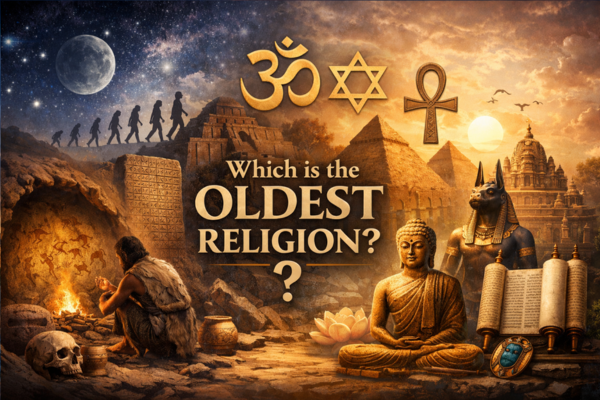
The Oldest Religion in the World
“This curiosity isn’t simple at all—it reflects a profound and layered inquiry into humanity’s earliest spiritual origins.” The answer isn’t as simple as naming a single religion, because religious beliefs and spiritual practices developed gradually over thousands of years. In this article, we’ll explore ancient belief systems, how scholars define “religion,” and what evidence exists about humanity’s earliest spiritual traditions.
What Does “Oldest Religion” Actually Mean?
Before we try to answer the question, we first need to understand what it means.
Some people assume the oldest religion is simply the oldest named religion still practiced today. Others define it as the earliest known spiritual tradition in human history, whether or not it still exists.
There are several ways to approach this question:
-
Archaeological evidence — physical signs of rituals or worship
-
Written records — ancient texts or inscriptions
-
Tradition continuity — religions still practiced today
-
Oral traditions — beliefs passed down without written texts
Because of these different approaches, several candidates can be considered “the oldest religion.”
1. Prehistoric Spirituality: The Earliest Human Beliefs
Long before organized religion with temples and scriptures existed, early humans showed signs of spiritual thinking.
What We Know from Archaeology
Archaeologists have found:
-
Burials with grave goods (suggesting belief in life after death)
-
Cave paintings with symbolic meaning
-
Ritual objects made from carved bone or stone
These show that early humans as far back as 100,000 years ago had spiritual ideas. However, because these beliefs weren’t written down, we don’t know exactly what they believed — only that they had a sense of the sacred.
Prehistoric spirituality isn’t a “religion” in the organized sense, but it represents the earliest forms of human spiritual expression.
2. Hinduism — Often Called the Oldest Organized Religion
When it comes to a named religion still practiced today, Hinduism commonly ranks as the oldest.
Why Hinduism?
-
Hindu practices date back over 4,000 years
-
Early Hindu writings, like the Vedas, are some of the oldest religious texts
-
Many key Hindu traditions developed in ancient India long before most other major religions
Hinduism is unique because it doesn’t have:
-
One single founder
-
One single unified text
Instead, it evolved over millennia, absorbing many beliefs, rituals, and philosophies. Because of this long and continuous history, many scholars consider Hinduism the oldest major living religion in the world.
3. Ancient Mesopotamian Religion
Another strong claim for the “oldest religion” goes to the religions of ancient Mesopotamia.
Who Practiced It?
The Mesopotamians lived in what is now Iraq and parts of neighboring countries, beginning around 3500–3000 BCE.
They worshipped many gods and goddesses connected with nature and society — such as:
-
The sky
-
The sun
-
Fertility
-
War
-
The earth
This religion was highly developed, with temples (called ziggurats), priests, festivals, and a written script (cuneiform).
However, Mesopotamian religion faded after invasions and cultural shifts, so it didn’t continue in the same way into modern times.
4. The Ancient Egyptian Religion
Ancient Egypt also had one of the most advanced early religions in history.
Key Features
-
Worship of many gods, such as Ra, Isis, Osiris, and Anubis
-
Elaborate burial rituals and belief in the afterlife
-
Massive temple complexes and priest classes
-
A belief system strongly linked to kingship
Egyptian religious ideas were central to daily life for thousands of years, starting around 3000 BCE, making it one of the earliest organized religious systems.
Like Mesopotamian religion, it faded over time as new religions took hold.
5. Judaism — Ancient and Foundational
Judaism is another ancient religion that still exists today.
Why It Matters
-
It developed around 2000 BCE or earlier
-
It introduced the idea of monotheism — belief in one God
-
Many modern religions, such as Christianity and Islam, trace roots back to Judaism
While older than Christianity and Islam, Judaism is generally younger than Hindu traditions and ancient Egyptian and Mesopotamian religions.
Still, it is one of the world’s oldest continuous religions based on written scriptures and ongoing practice.
Other Ancient Spiritual Traditions
Besides the major candidates, many indigenous and tribal spiritual traditions have existed for tens of thousands of years. Although they often lack written records, they remain rich and meaningful belief systems, including:
-
Aboriginal Australian dreamtime beliefs
-
Ancient Native American spiritual traditions
-
Early African and Asian tribal beliefs
These traditions offer important insight into early human spirituality, even if they do not fit the modern idea of a “organized religion.”
Comparing the Major Candidates
| Religion/Tradition | Approximate Beginning | Written Texts? | Still Practiced? | Notes |
|---|---|---|---|---|
| Prehistoric Spirituality | 100,000+ years ago | No | No | Earliest human spiritual behavior |
| Ancient Mesopotamian Religion | ~3500–3000 BCE | Yes (cuneiform) | No | Early organized belief system |
| Ancient Egyptian Religion | ~3000 BCE | Yes (hieroglyphs) | No | Highly developed ancient religion |
| Hinduism | ~2000–1500 BCE | Yes (Vedas) | Yes | Oldest major living religion |
| Judaism | ~2000 BCE or earlier | Yes (Torah) | Yes | Early monotheistic religion |
| Indigenous Traditions | Ancient and ongoing | Oral | Yes | Long-standing belief systems |
So, Which Religion Is the Oldest?
If We Mean “Earliest Spiritual Beliefs”
Then prehistoric spirituality — before written records — is the oldest.
If We Mean “Oldest Organized Religion Ever”
Ancient Mesopotamian and Egyptian religions were among the earliest structured systems.
If We Mean “Oldest Religion Still Practiced Today”
Then Hinduism is generally considered the oldest.
If We Mean “Oldest Monotheistic Religion”
That title goes to Judaism.
In summary:
There isn’t just one answer — it depends on how you define “religion.”
But based on historical evidence and ongoing practice, Hinduism is often recognized as the oldest religion still alive today.
Why This Topic Matters
Understanding the history of religion is important because:
It reveals how humans make meaning.
Religion emerged as humans asked big questions:
Who are we? Why are we here? What happens after death?
It shows cultural development.
Early religions helped shape art, law, community, and social systems.
It connects past and present.
Many modern beliefs have roots in these ancient traditions.
Common Myths About the Oldest Religion
Let’s clear up a few misunderstandings:
Myth: “Religion started with one person.”
In reality, religion evolved over time through many people and cultures.
Myth: “The oldest religion must be the best or most correct.”
Age doesn’t determine truth or value — different religions address different spiritual needs.
Myth: “If a religion doesn’t exist now, it wasn’t important.”
Ancient religions influenced later ones and deepened human understanding of the spiritual world.
Frequently Asked Questions
Q: Is Hinduism older than Buddhism?
A: Yes. Hinduism developed long before Buddhism. Buddhism began around the 6th century BCE, while Hindu traditions existed many centuries earlier.
Q: Were the ancient Egyptians religious?
A: Yes. Ancient Egyptians had a highly developed religion with thousands of years of myth, ritual, and worship.
Q: What religion came before Hinduism?
A: There isn’t a single religion before Hinduism, but thousands of years of prehistoric spiritual beliefs that influenced early religions.
Q: Is animism the oldest religion?
A: Animism — the belief that objects, animals, and nature have spiritual essence — may be one of the earliest forms of spiritual thought, but it isn’t an organized religion in the modern sense.
A Journey Through Human Belief
Humans have always searched for meaning beyond what they can see and touch. From the earliest cave rituals to the great religions of today, spirituality has shaped cultures and civilizations.
If we measure by continuity and influence, Hinduism is widely recognized as the oldest religion still practiced today.
But if we measure by the first sparks of spiritual awareness, then human spirituality began long before any organized religion — with our earliest ancestors pondering life’s mysteries.
Whatever definition you choose, the history of religion is one of humanity’s richest stories — a journey from prehistoric ritual to the diverse spiritual world we see today.