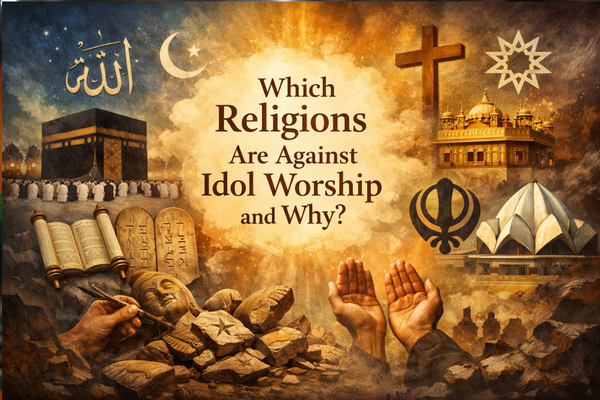
Which faith traditions reject the use of physical images or statues?
The question of which religions are against idol worship and why has been discussed for centuries. Across different cultures and civilizations, human beings have expressed devotion in many ways. Some traditions use images, statues, and symbolic representations in their rituals. Others strongly reject physical representations of the divine and consider them inappropriate or even forbidden.
Understanding why certain religions oppose idol worship requires exploring their theological foundations, historical development, and spiritual philosophy. In this comprehensive guide, we will examine the major religions that discourage or prohibit idol worship and the deeper reasoning behind their beliefs.
What Is Idol Worship?
Before exploring specific religions, it is important to clarify what “idol worship” means.
Idol worship generally refers to the practice of revering or praying to physical objects—such as statues, carved images, or symbolic figures—believed to represent a deity or spiritual power. In some traditions, these objects are considered sacred tools that help focus devotion. In others, such practices are viewed as misdirected worship because they attribute divine qualities to created objects.
Religions that oppose idol worship usually emphasize:
-
The absolute unity of God
-
The invisibility and transcendence of the divine
-
The belief that God cannot be confined to material form
Let’s explore the major religions that reject idol worship and understand why.
1. Islam
Why Islam Rejects Idol Worship
Islam strictly prohibits idol worship. The foundation of Islamic belief is Tawhid, which means the absolute oneness and uniqueness of God (Allah). According to Islamic theology:
-
God has no physical form.
-
God cannot be represented visually.
-
Associating partners or images with God is considered a major sin (shirk).
The Prophet Muhammad taught that worship should be directed to God alone, without intermediaries in the form of statues or images. This is why mosques do not contain statues of God or the Prophet. Instead, Islamic art often features calligraphy and geometric patterns to express devotion without depicting divine figures.
The core reason Islam rejects idol worship is to protect the purity of monotheism and prevent humans from confusing created objects with the Creator.
2. Judaism
Why Judaism Opposes Idol Worship
Judaism is one of the oldest monotheistic religions and strongly prohibits idol worship. The prohibition is clearly stated in the Ten Commandments, which forbid making carved images for worship.
Jewish belief centers on:
-
One invisible, indivisible God
-
The rejection of physical representations of the divine
-
A covenant relationship between God and the Jewish people
The concern in Judaism is that creating images for worship can lead people to treat the object itself as divine. This shifts devotion away from God and toward material forms.
Historically, ancient Israelite society lived among cultures that worshipped idols. The strong prohibition in Judaism was partly a reaction against these surrounding practices.
3. Christianity (Certain Branches)
A Complex Perspective on Idol Worship
Christianity’s view on idol worship varies by denomination.
-
Some branches, especially many Protestant groups, reject the use of statues or icons in worship.
-
Other branches, such as Catholicism and Eastern Orthodoxy, use images but do not consider them idols.
Protestant reformers argued that worship should focus entirely on God without visual representations. They believed that statues or icons could distract believers or lead to misplaced devotion.
The reason for rejecting idol worship in these Christian traditions is similar to Judaism and Islam: maintaining the spiritual purity of worship and preventing confusion between symbol and divine reality.
4. Sikhism
Why Sikhism Rejects Idol Worship
Sikhism, founded in the 15th century in the Punjab region, teaches belief in one formless God. Sikh philosophy strongly discourages idol worship.
Key teachings include:
-
God is shapeless and beyond human form.
-
Devotion should be expressed through meditation, service, and righteous living.
-
The holy scripture (Guru Granth Sahib) is revered, but not worshipped as a physical idol.
Sikh Gurus taught that true spirituality comes from remembering God’s name and living ethically—not from rituals involving statues or images.
5. Baháʼí Faith
The Baháʼí View on Idol Worship
The Baháʼí Faith teaches belief in one transcendent God and emphasizes unity among religions. It does not support idol worship.
Baháʼí houses of worship are simple and free of statues or images representing God. The focus is on prayer, scripture reading, and meditation.
The theological reasoning is similar: God is beyond physical representation, and spiritual connection does not require images.
Core Reasons Religions Oppose Idol Worship
Although these religions differ in culture and history, their reasons for rejecting idol worship share common themes:
1. Protection of Monotheism
In strictly monotheistic religions, there is concern that physical representations may lead people to associate divine power with material objects. This is seen as a threat to the belief in one supreme God.
2. God Is Beyond Human Imagination
Many traditions teach that God is infinite and cannot be captured in human-made forms. Creating images might limit understanding of the divine nature.
3. Avoidance of Misplaced Devotion
There is fear that worshippers may begin focusing on the statue itself rather than what it represents.
4. Historical Context
In many cases, opposition to idol worship developed in response to surrounding cultures that practiced polytheism or image-based worship.
Religions That Allow or Use Images
For balance, it is important to mention that not all religions reject images.
For example:
-
Hinduism commonly uses statues and images (murti) as symbolic representations of deities.
-
Buddhism uses statues of the Buddha, although these are often seen as symbols rather than objects of worship.
-
Some Christian traditions use icons and statues to inspire devotion.
In these traditions, images are viewed as aids to concentration rather than literal embodiments of God.
Philosophical Debate: Symbol vs. Idol
A major debate in religious studies revolves around whether an image is truly an “idol” or simply a symbolic tool.
-
Critics argue that any image risks becoming an object of worship.
-
Supporters argue that humans naturally use visual symbols to connect with spiritual ideas.
The difference often lies in intention and interpretation.
Cultural and Psychological Dimensions
Human beings are visual by nature. Symbols, art, and imagery play powerful roles in shaping identity and belief. Religions that reject idol worship often develop alternative artistic expressions, such as:
-
Sacred calligraphy
-
Geometric patterns
-
Music and recitation
-
Architectural symbolism
For example, Islamic art is famous for its intricate geometric designs, while Jewish tradition emphasizes sacred text study.
Modern Relevance of the Debate
In today’s global society, discussions about idol worship often arise in interfaith dialogue. Understanding these differences helps promote respect and tolerance.
It is important to recognize:
-
Each religion has its own theological framework.
-
Practices that seem unusual to outsiders may have deep spiritual meaning.
-
Respectful dialogue reduces misunderstanding.
So, which religions are against idol worship and why?
Major monotheistic religions such as Islam, Judaism, certain branches of Christianity, Sikhism, and the Baháʼí Faith strongly discourage or prohibit idol worship. Their reasoning centers on:
-
Belief in one, formless God
-
The desire to preserve pure monotheism
-
Concern about misdirected devotion
-
Historical responses to polytheistic cultures
At the heart of this issue is a profound theological question: How should humans relate to the divine? Some traditions use images as tools of devotion. Others reject them to safeguard the idea that God is beyond all material representation.
Understanding these perspectives encourages greater respect for religious diversity and deepens our awareness of how different faiths express their spirituality.
If you are exploring comparative religion, theology, or interfaith studies, examining the question of idol worship offers valuable insight into how humanity understands the sacred.