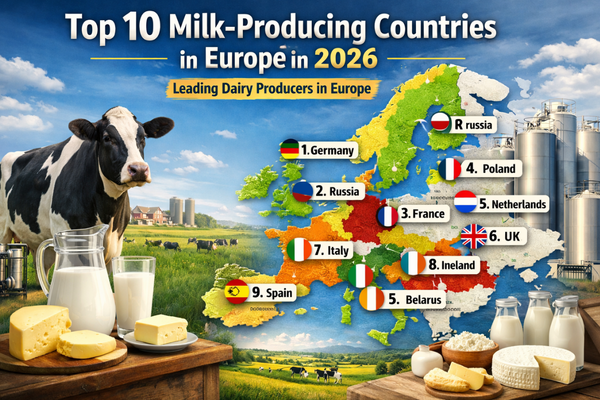
Who are the Top 10 Milk-Producing Countries in Europe in 2026?
Milk is one of the most important agricultural products globally and in Europe. It feeds millions of people, supports farmers’ livelihoods, and fuels a massive dairy industry that turns raw milk into cheese, butter, yogurt, and more. In 2026, Europe remains one of the world’s leading regions for milk production — with several countries ranking among the top producers globally.
Here’s a detailed, ranked list of the Top 10 Milk-Producing Countries in Europe in 2026, including insights into what’s driving each country’s dairy sector.
1. Germany – The Dairy Powerhouse of Europe
Germany consistently ranks as Europe’s largest milk producer. In the EU alone, it accounts for nearly one-fifth of all milk production.
Why Germany Leads
-
Large Dairy Herds: Germany has extensive dairy operations with modern milking systems.
-
Advanced Technology: Automation and precision feeding have improved yields per cow.
-
Diverse Dairy Industry: German dairies produce drinking milk, butter, cheese, and specialty products.
2026 Snapshot
In 2026, Germany is again expected to top the European rankings in raw milk output, leading not just the EU but the entire continent. Its dairy sector balances traditional farm systems with innovation, ensuring stable production even in challenging market conditions.
2. Russia – A Significant Eurasian Producer
Russia, while spanning both Europe and Asia, has large milk production volumes primarily serviced by its European territory.
Key Strengths
-
Expanding Dairy Sector: Russian dairy farms have increased capacity in recent years.
-
Market Focus: There’s strong internal demand for fresh milk and dairy products.
-
Volume Growth: Latest figures suggest top-tier output, keeping Russia in Europe’s top two producers by 2026.
Russia’s positioning is notable for its emphasis on both quantity and self-sufficiency in combined domestic consumption and processing.
3. France – Tradition Meets Production Scale
France is world-renowned for its dairy heritage, famous cheeses, and large raw milk volumes.
Why It’s a Top Producer
-
Cheese Culture: With hundreds of regional cheese types, France must process large amounts of milk.
-
Balanced Dairy Economy: France invests in both fluid milk and value-added products.
-
Rural Farming Strength: Dairy farming remains economically important across French regions.
France’s dairy sector is a blend of tradition and modern agriculture systems, making it one of Europe’s core milk producers well into 2026.
4. Poland – Rising European Milk Star
Poland’s dairy industry has grown steadily over the past decade, with production increases driven by expanded herds and improved farm efficiency.
Highlights
-
Export Growth: Poland exports dairy ingredients like skimmed milk powder and butter.
-
Rural Workforce: A strong agricultural base supports local production.
-
Stable Growth Trends: Production has been increasing, making Poland a major European contributor.
By 2026, Poland is projected to be securely in the European top five producers.
5. Netherlands – Small Country, Big Output
The Netherlands is a powerhouse in dairy production relative to its size. It’s one of the most efficient producers in Europe.
What Makes it Strong
-
High Yields: Dutch dairy farms lead in milk yield per cow.
-
Export-oriented Dairy: The Netherlands exports large volumes of milk derivatives.
-
Modern Farming: High levels of technology and logistics keep output strong.
Even though the Netherlands is geographically small, its milk volumes per capita are among the highest in Europe.
6. United Kingdom – Resilient Production Post-Brexit
The UK remains a significant European milk producer, even after its departure from the EU.
Production Drivers
-
Well-established Farming: Dairy farms are widespread across England, Scotland, Wales, and Northern Ireland.
-
Strong Domestic Market: A large consumer base supports milk and dairy product demand.
-
Adaptive Industry: The UK dairy sector has adjusted supply chains while maintaining strong output.
In 2026, the UK continues to rank among Europe’s top milk producers thanks to consistent production levels and stable farm structures.
7. Italy – Dairy Diversity and Strong Tradition
Italy is known globally for its cheeses like Parmigiano-Reggiano and Mozzarella — and requires high volumes of raw milk to make them.
Why Italy Ranks Highly
-
Cheese Production Needs: World-famous cheese varieties depend on locally produced milk.
-
Regional Dairy Strength: The Po Valley and other areas are deeply rooted in dairy farming.
-
Export of Specialized Products: Italy exports PDO (Protected Designation of Origin) dairy that requires milk from local farms.
Italy stays in the top ten thanks to both its traditional role in Europe’s dairy landscape and modern production techniques.
8. Ireland – Strong Butter and Dairy Output
Ireland has gained attention for its dairy exports, particularly butter and milk powders.
Factors Behind Ireland’s Growth
-
Grass-based Systems: Ireland benefits from natural pastures, which reduce feeding costs and improve milk quality.
-
Export Focus: Much of Ireland’s milk is processed for international markets.
-
Growth Trends: Recent years have shown strong output increases.
In 2026, Ireland is expected to maintain a top-ten position in Europe’s milk production rankings.
9. Spain – Southern Europe’s Leading Producer
Spain is one of Southern Europe’s largest milk-producing countries. While not as high as Germany or France, its volume is significant.
What Drives Spain’s Dairy
-
Regional Markets: Regions such as Galicia are known for dairy farming.
-
Balanced Production: Spain produces both fluid milk and value-added products like yogurt.
-
Growing Output: Over recent years, Spain has increased milk volumes as technology has improved.
Spain occupies a firm spot within the top ten European milk producers heading into 2026.
10. Belarus – Eastern European Contributor
Belarus is often overlooked in global dairy discussions, but it has meaningful production volumes, especially relative to its population.
Strengths
-
Agrarian Economy: Dairy farming is a significant part of rural Belarusian agriculture.
-
Stable Production: Despite economic challenges, milk output remains strong.
-
Export Potential: Belarus has access to regional markets and maintains dairy trade.
In 2026, Belarus’s consistent dairy output places it among Europe’s top ten milk-producing nations.
Trends Behind Europe’s Milk Production in 2026
Understanding the Top 10 list also means knowing the broader trends shaping the dairy industry:
1. European Union’s Aggregate Output
The EU as a bloc continues to produce over 150 million tonnes of milk per year, with Germany, France, Poland, and the Netherlands being major contributors.
2. Technology and Efficiency
Modern dairy farms increasingly use automation, precision feeding, and herd management systems to boost yield per cow while controlling costs. This helps countries like the Netherlands and Ireland punch above their weight.
3. Dairy Product Demand
European consumers and global markets demand a variety of dairy products — from cheese and butter to yogurt and powdered milk. Processing capacity influences how much raw milk producers need to supply.
4. Sustainability Focus
Many European countries are adopting environmentally sustainable practices to reduce greenhouse gas emissions and improve long-term farm viability.
5. Trade and Export
Countries with large dairy export sectors — such as Ireland, the Netherlands, and France — benefit from both strong internal production and access to foreign markets.
Europe’s Dairy Landscape in 2026
In 2026, Europe boasts some of the world’s most significant milk producers. While the European Union overall is a giant milk region, individual countries like Germany, Russia, and France anchor the continent’s dairy output. Smaller but highly efficient producers such as the Netherlands and Ireland also make the top ten, reflecting both scale and quality.
Whether you’re interested in agricultural economics, dairy trends, or international food markets, Europe’s 2026 milk production landscape is rich with data and insight — and this ranking highlights the countries leading the charge.