UK Shut Down 3G Network 2024–2026
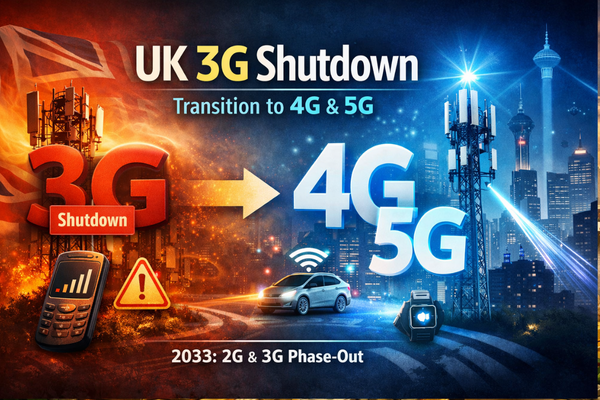
The United Kingdom is undergoing one of the most significant technological transitions in modern telecommunications history: the shutdown of 3G mobile networks. Between 2024 and early 2026, major operators have been systematically turning off 3G services to free up resources for faster and more efficient technologies like 4G and 5G.
This transformation is not random—it is part of a long-term national strategy, supported by both the telecom industry and the UK government, with a final deadline set for 2033 to retire all legacy networks, including both 2G and 3G.
In this article, we’ll explore why the UK is shutting down 3G, when each network made the transition, and how it impacts users, businesses, and the future of connectivity.
What is 3G, and why has it become obsolete?
3G (third-generation mobile technology) was once revolutionary. Introduced in the early 2000s, it allowed mobile users to access the internet, send multimedia messages, and make video calls.
However, technology evolves rapidly. Today, 3G is considered outdated for several key reasons:
- Slow data speeds compared to modern standards
- Limited capacity for growing data demand
- Inefficient use of radio spectrum
- Higher energy consumption compared to newer networks
By 2023, only a small portion of mobile data traffic in the UK relied on 3G—around 3% of total usage . This sharp decline made maintaining the network increasingly unnecessary and costly.
Why the UK Decided to Shut Down 3G
1. To Boost 4G and 5G Capacity
The primary reason for shutting down 3G is to free up valuable radio spectrum. This spectrum can then be reused to improve:
- 4G coverage and speed
- 5G network expansion
- Overall network reliability
Reallocating spectrum significantly enhances mobile performance, especially in crowded urban areas and underserved rural regions.
2. Rising Demand for High-Speed Data
Modern users consume far more data than ever before:
- Streaming HD and 4K videos
- Online gaming
- Remote work and video conferencing
- Cloud-based applications
3G simply cannot handle these demands efficiently. In contrast, 4G and 5G are designed for high-speed, low-latency performance.
3. Energy Efficiency and Environmental Goals
Newer networks are far more energy-efficient. Running older 3G infrastructure consumes more power while delivering less performance.
Switching to 4G and 5G helps operators:
- Reduce carbon emissions
- Lower operational costs
- Support sustainability goals
4. Simplifying Network Infrastructure
Maintaining multiple generations of mobile technology (2G, 3G, 4G, 5G) is complex and expensive.
By removing 3G, operators can:
- Focus investments on advanced networks
- Reduce maintenance costs
- Improve service quality
5. Government and Industry Agreement
The UK government, along with major telecom providers, agreed on a long-term plan to phase out older technologies.
- 3G phase-out target: by end of 2025
- 2G + 3G complete shutdown: by 2033
This coordinated effort ensures a smooth transition for consumers and businesses.
Timeline: When UK Networks Shut Down 3G
Different mobile operators followed slightly different schedules, but all aligned with the national strategy.
2024: Major Switch-Off Year
Three major providers completed their shutdowns in 2024:
- EE – fully switched off 3G in early 2024
- Vodafone – completed shutdown in early 2024
- Three UK – largely completed shutdown during 2024, finalized in late 2025
This marked the beginning of the end for 3G in the UK.
2025: Final Phase Expansion
By 2025:
- Most of the UK had already lost access to 3G
- Remaining areas were gradually phased out
- Focus shifted heavily to expanding 5G coverage
Early 2026: Final Shutdown (O2)
The last major provider:
- Virgin Media O2 scheduled full shutdown in early 2026
This marks the complete end of 3G availability in the UK.
By 2033: Full Legacy Network Retirement
The UK’s long-term goal:
- Complete shutdown of both 2G and 3G by 2033
This will make way for fully modernized networks, including future technologies like 6G.
How the 3G Shutdown Improves Mobile Networks
Faster Speeds
Reallocating spectrum allows:
- Faster downloads
- Better streaming quality
- Reduced buffering
Stronger Coverage
Freed-up spectrum helps extend coverage:
- Rural areas receive better connectivity
- Indoor signal strength improves
Better Call Quality
With technologies like VoLTE (Voice over LTE):
- Calls are clearer
- Connection times are faster
- Fewer dropped calls
Enhanced 5G Expansion
The shutdown accelerates the rollout of 5G:
- Ultra-fast speeds
- Low latency
- Support for smart cities and IoT
Impact on Users and Devices
Who is Affected?
Most users won’t notice any disruption because:
- The majority already use 4G or 5G devices
- Only a small percentage relied on 3G
However, affected groups include:
- People using older phones (3G-only devices)
- Some rural users
- Devices like alarms, trackers, and older IoT systems
What Happens to 3G Phones?
Devices that only support 3G:
- Lose mobile internet access
- May still work for calls/texts via 2G (until 2033)
Users are encouraged to upgrade to:
- 4G-compatible smartphones
- 5G-ready devices
Support Measures
Mobile operators have taken steps to help users:
- Sending notifications to affected customers
- Offering discounted or free upgrades
- Providing guidance for vulnerable users
Impact on Businesses and Industry
1. IoT and Smart Devices
Many devices rely on 3G, such as:
- Payment terminals
- Security systems
- Vehicle trackers
Businesses must upgrade to:
- 4G LTE
- NB-IoT or LTE-M technologies
2. Healthcare and Safety Systems
Critical systems like:
- Emergency alarms
- Telehealth devices
Need to be updated to ensure uninterrupted service.
3. Transport and Logistics
Fleet tracking and communication systems must transition to newer networks to maintain efficiency.
Challenges of the 3G Shutdown
Digital Exclusion
Some vulnerable groups may struggle:
- Elderly users unfamiliar with new technology
- Low-income users unable to upgrade devices
Rural Coverage Concerns
While improvements are expected, some areas initially experienced:
- Reduced fallback coverage
- Temporary connectivity gaps
Device Compatibility Issues
Many hidden devices rely on 3G:
- Smart meters
- Industrial equipment
These require upgrades, which can be costly.
Global Context: UK Is Not Alone
The UK is part of a global trend:
- The United States shut down 3G earlier
- Europe is following similar timelines
- Asia is rapidly transitioning to 5G
This global shift highlights the inevitability of moving away from legacy networks.
Future of Mobile Networks in the UK
Expansion of 5G
The UK aims to:
- Provide widespread 5G coverage
- Support smart infrastructure
- Enable advanced technologies like AI and IoT
Preparation for 6G
Although still in development, 6G is expected to:
- Deliver ultra-fast speeds
- Support futuristic applications like holographic communication
Smarter and Greener Networks
Future networks will focus on:
- Lower energy consumption
- Higher efficiency
- Sustainability
Key Takeaways
- The UK is shutting down 3G to improve 4G and 5G performance
- Major operators like EE, Vodafone, and Three completed shutdowns by 2024–2025
- O2 will complete its shutdown in early 2026
- Only a small percentage of users are affected
- The final deadline to phase out both 2G and 3G is 2033
- The transition enables faster, more reliable, and energy-efficient mobile networks
The shutdown of 3G networks in the UK marks the end of an important era in telecommunications. While 3G once transformed how people connected and accessed the internet, it can no longer meet the demands of modern digital life.
By reallocating resources to 4G and 5G, the UK is building a stronger, faster, and more future-ready mobile infrastructure. Although the transition presents challenges—especially for users with older devices—it ultimately paves the way for innovation, economic growth, and improved connectivity nationwide.
As the UK moves toward the 2033 deadline for fully retiring legacy networks, one thing is clear: the future of mobile communication is faster, smarter, and more connected than ever before.