Which Country Had the Slowest Internet Speed in 2024?
In 2024, internet speed continued to be one of the most important indicators of a country’s digital progress. While some nations enjoyed blazing-fast fiber connections and expanding 5G coverage, others still struggled with slow and unreliable connectivity. The digital divide remained a major challenge, particularly in developing regions where infrastructure, geography, and economic factors limited access to high-speed networks.
This article explores which country had the slowest internet speed in 2024, the reasons behind it, how it affected its citizens and economy, and what efforts were made to improve digital connectivity around the world.
The Global Overview of Internet Speeds in 2024
By 2024, the world’s average internet speed had improved significantly due to the expansion of fiber-optic technology, the spread of 5G networks, and the growing adoption of satellite internet services. According to various speed monitoring platforms, the global average fixed broadband speed reached around 85–90 Mbps, while mobile internet speeds averaged 45–50 Mbps.
However, while some countries like Singapore, South Korea, and the United Arab Emirates led with speeds above 250 Mbps, others lagged far behind. A handful of countries recorded average speeds below 5 Mbps, showing just how uneven global internet access still was.
The Country with the Slowest Internet Speed in 2024
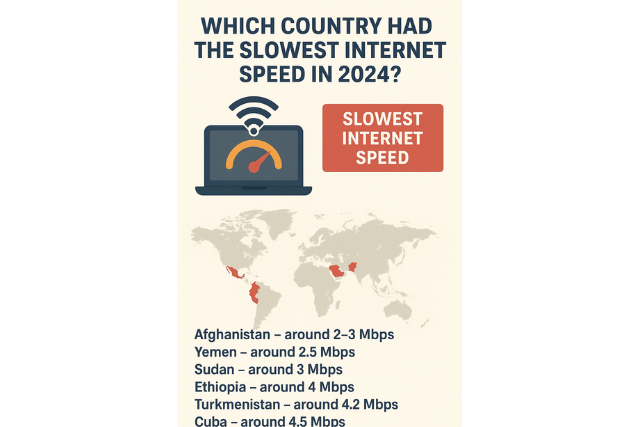
In 2024, Afghanistan was widely recognized as having one of the slowest average internet speeds in the world, with an estimated average download speed of around 2–3 Mbps and upload speeds often below 1 Mbps.
Other countries that also appeared on the list of the slowest included:
-
Yemen – around 2.5 Mbps
-
Sudan – around 3 Mbps
-
Ethiopia – around 4 Mbps
-
Turkmenistan – around 4.2 Mbps
-
Cuba – around 4.5 Mbps
Among these, Afghanistan and Yemen consistently ranked at the bottom because of limited infrastructure, ongoing conflicts, and economic instability.
Why Was Afghanistan’s Internet So Slow in 2024?
Several key reasons contributed to Afghanistan’s position as the country with the slowest internet speed in 2024:
1. Weak Infrastructure
Afghanistan’s telecommunications infrastructure was severely underdeveloped. Many areas lacked fiber-optic cables and relied on outdated copper wire systems or limited satellite connections. Frequent power outages also disrupted network services, further slowing speeds.
2. Geographic Challenges
Afghanistan’s mountainous terrain made it extremely difficult to install underground cables and build cell towers in remote regions. Many rural areas remained completely offline, depending on expensive and unreliable mobile data connections.
3. Political and Security Instability
Years of conflict and political instability discouraged foreign investment in the country’s telecom sector. Many international companies withdrew, halting progress in network modernization and infrastructure upgrades.
4. High Cost of Internet Access
Due to a lack of competition and reliance on satellite networks, the cost of internet access in Afghanistan remained high. Many citizens could not afford regular internet usage, and those who could often faced slow speeds with frequent disconnections.
5. Limited Government Support
While some efforts were made by the Afghan Telecom Regulatory Authority to improve access, lack of funding, skilled manpower, and technological resources limited the success of these initiatives.
Comparison with Other Countries with Slow Internet in 2024
Although Afghanistan topped the list for slowest internet, other countries also faced similar challenges.
1. Yemen
Yemen’s ongoing civil conflict destroyed much of its telecommunications infrastructure. Internet access was limited primarily to major cities like Sana’a and Aden, with rural areas receiving little to no coverage. The country’s average internet speed hovered around 2.5 Mbps, placing it among the slowest globally.
2. Sudan
Sudan struggled with outdated telecom systems, low investment, and frequent political unrest. Although some urban areas had 4G coverage, the majority of users depended on 3G or even 2G connections, resulting in speeds around 3 Mbps on average.
3. Ethiopia
Ethiopia’s state-controlled telecom monopoly hindered competition and innovation. Despite the launch of fiber networks in Addis Ababa, most rural regions had limited access. The average internet speed was estimated at 4 Mbps in 2024.
4. Turkmenistan
Turkmenistan’s government maintained strict control over internet access, filtering and restricting content. The lack of open competition and limited investment resulted in average speeds of around 4.2 Mbps.
5. Cuba
Although Cuba made progress in expanding mobile internet since 2018, speeds remained modest due to limited bandwidth and government control. In 2024, average internet speeds were 4.5 Mbps, which, while an improvement from previous years, still ranked low globally.
Economic and Social Impact of Slow Internet
Slow internet speeds have far-reaching effects on both the economy and daily life of citizens. In countries like Afghanistan, Yemen, and Sudan, the impact was especially severe.
1. Reduced Business Productivity
Businesses that rely on online communication, cloud computing, and digital transactions faced significant delays and inefficiencies. Many startups and small enterprises found it nearly impossible to compete in the global market due to slow connectivity.
2. Limited Educational Opportunities
With e-learning becoming more common, slow internet speeds prevented students from accessing online courses, digital libraries, and global educational resources. This widened the educational gap between developing and developed countries.
3. Restricted Access to Information
Citizens in countries with slow internet often had limited access to global news, social media, and digital services. This isolation hindered freedom of expression and access to knowledge.
4. Health and Telemedicine Challenges
During and after the COVID-19 pandemic, telemedicine became essential in many regions. However, slow internet made it difficult for patients in developing countries to consult doctors remotely or access online health services.
5. Negative Effect on Government Efficiency
Digital governance and e-services depend heavily on reliable internet connections. Slow networks meant that government operations, online registrations, and public service systems were often delayed or inaccessible.
How the Global Digital Divide Looked in 2024
The difference between the fastest and slowest internet speeds in 2024 was staggering.
-
Singapore, South Korea, and Hong Kong averaged speeds above 250 Mbps, enabling 4K streaming, cloud gaming, and ultra-fast downloads.
-
Developing nations in Asia, Africa, and parts of South America often struggled to reach even 10 Mbps.
-
Rural vs. Urban Divide: Even within countries, urban centers had far better connectivity than remote regions.
This digital divide highlighted the importance of international cooperation, investment, and technological transfer to ensure fair global connectivity.
Efforts Made to Improve Internet Speeds in Developing Countries
Despite the challenges, 2024 also saw promising initiatives aimed at improving global internet speeds.
1. Satellite Internet Expansion
Companies like Starlink, OneWeb, and Amazon’s Project Kuiper continued to expand satellite broadband services across underserved areas in Africa, Asia, and Latin America. In Afghanistan and Yemen, small pilot projects began offering limited satellite coverage, showing hope for the future.
2. International Aid and Investment
Several global organizations, including the World Bank and International Telecommunication Union (ITU), funded projects to help developing countries expand broadband infrastructure and build digital literacy programs.
3. Regional Telecom Reforms
Countries like Ethiopia began to open their telecom sectors to private and foreign investors. This move aimed to introduce competition, reduce prices, and encourage network upgrades.
4. Mobile Internet Growth
While fixed broadband remained limited in some countries, mobile internet coverage expanded rapidly. The introduction of 4G networks in parts of Africa and Asia provided affordable alternatives to wired connections.
Predictions for 2025 and Beyond
Looking ahead, the global push for digital equality is expected to continue. Here are some predictions:
-
5G Expansion: More countries are expected to adopt 5G technology, which will drastically improve mobile internet speeds, even in developing regions.
-
Satellite Internet Accessibility: As satellite networks expand, remote and mountainous areas could finally receive reliable internet.
-
Public-Private Partnerships: Governments may partner with private tech companies to build national fiber networks.
-
Focus on Affordability: Internet prices are expected to decline as competition grows, making connectivity more accessible to low-income users.
-
Digital Literacy Programs: Training citizens to use digital tools effectively will be as important as improving infrastructure.
The Slowest Internet in 2024 Was a Wake-Up Call
The year 2024 showed both the progress and inequality of the digital age. While countries like Singapore, South Korea, and Switzerland raced ahead with ultra-fast connections, nations such as Afghanistan, Yemen, and Sudan lagged far behind, struggling with speeds below 5 Mbps.
Afghanistan, in particular, stood out as the country with the slowest internet speed in 2024, primarily due to weak infrastructure, political instability, and limited access to modern technology. Yet, hope remains. Global connectivity projects, satellite internet initiatives, and increasing awareness about digital inclusion may soon bridge this gap.
As the world moves toward 2025 and beyond, internet access will no longer be a luxury but a fundamental necessity — one that determines education, business, communication, and even national progress. Ensuring that every person, regardless of where they live, has access to fast and affordable internet will be key to achieving a truly connected world.