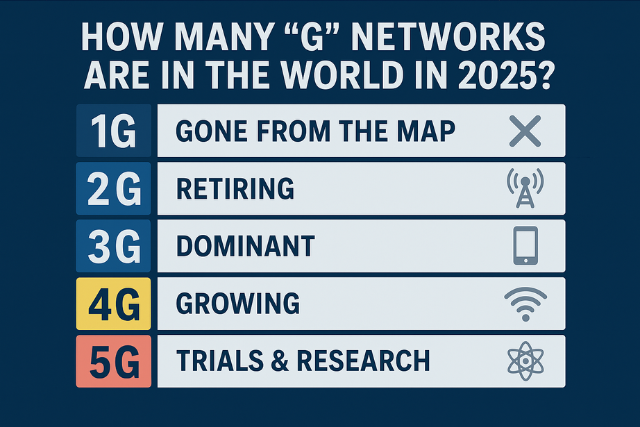
“G” networks in the world in 2025
Curious how many mobile generations (1G → 6G) exist or are active in 2025? This in-depth, easy-to-read guide explains which “G”s are live, which are being retired, where 5G stands today, and what to expect from 6G — with up-to-date 2025 data and clear sources.
Answer
As of 2025:
-
1G: effectively extinct in commercial service.
-
2G & 3G: largely being retired — many countries have completed or planned switch-offs, though some legacy services still run in places and for IoT.
-
4G (LTE): still the global backbone of mobile broadband and present in nearly every country.
-
5G: commercial in many countries; dozens of countries have live 5G and hundreds of operators are active — with many operators now deploying 5G Standalone (SA) networks in 2025.
-
6G: no commercial 6G networks in 2025 — only trials, research programs and early standardization activity.
Below is a full, SEO-optimized breakdown you can use as article content, blog post, or reference text.
What do we mean by “G” — a short primer
Each “G” stands for a generation of cellular technology. Roughly:
-
1G — analog voice (late 1970s–1980s era)
-
2G — digital voice, SMS (1990s)
-
3G — mobile data beginnings (early 2000s)
-
4G (LTE) — modern mobile broadband (2010s)
-
5G — low latency, higher speeds, new architectures (late 2010s → present)
-
6G — research name for the next wave (still pre-commercial in 2025)
Generations are shorthand for sets of standards and capabilities rather than strict product names — and operators commonly run multiple generations in parallel during transitions.
1G in 2025 — gone from the map
Plain fact: There are effectively no commercial 1G networks operating in 2025. 1G was analog cellular and phased out decades ago as digital systems (2G and later) replaced it. Any historic 1G gear or experimental setups are not part of public mobile service.
2G & 3G in 2025 — the era of sunsets and planned switch-offs
Many countries are actively switching off 2G and 3G to reallocate spectrum to 4G and 5G. By mid-2025, industry trackers reported hundreds of completed, planned or in-progress 2G/3G switch-offs across dozens of countries — the trend accelerating as operators push subscribers and IoT devices to modern networks.
Why it matters
-
Spectrum reuse: freeing frequencies for faster, more efficient 4G/5G.
-
Legacy users & IoT: some machine-to-machine devices and very old phones still rely on 2G/3G — switch-offs require migration strategies.
-
Regional variety: high-income markets lead switch-offs, while some developing markets retain 2G/3G longer for coverage and low-cost devices.
4G in 2025 — still dominant and ubiquitous
4G (LTE) continues to be the global backbone of mobile internet in 2025. It offers wide coverage, mature device ecosystems, and remains the primary fallback for 5G-capable devices in most regions. GSMA and related industry metrics show 4G penetration remains high, especially in countries where 5G rollout is still evolving.
5G in 2025 — growth, SA rollouts, and real-world expansion
5G is no longer experimental — it is widely deployed and rapidly maturing in 2025:
-
Industry trackers reported dozens of countries with commercial 5G and many operators ramping 5G Standalone (SA) networks (an architecture that unlocks the full capabilities of 5G). For example, GSA’s August 2025 snapshot listed around 173 operators in 70 countries investing in 5G SA and 77 operators in 43 countries that had launched or soft-launched 5G SA services.
-
5G adoption continues to vary: some markets (urban centers, advanced economies) have broad coverage and many use cases; others see spotty or emerging 5G footprints.
What “how many G networks” means for 5G
-
Counting “how many 5G networks” can mean either:
-
How many operators have commercial 5G? (many hundreds globally when counting non-standalone and standalone rollouts combined)
-
How many countries have commercial 5G? (over 100 countries have live 5G networks in some form by 2025)
-
-
Key metrics to watch: 5G subscriptions, 5G standalone launches, and regional deployment density.
6G in 2025 — research, trials, and early national programs
Important: no country has a commercial 6G network in 2025. What we see in 2025 are research programs, government-funded roadmaps, standardization studies, and technology trials — e.g., terahertz experiments, lab demos, and national initiatives in places like China, South Korea, Japan, the EU, the USA and others. These projects aim to define what “6G” will be (AI-native networks, extreme bandwidths, new spectrum like THz), but mass commercial service is still several years away.
A short global snapshot (numbers and context)
-
Countries with some form of 5G: more than 100 by 2025 (commercial availability varies by city and operator).
-
Operators investing in 5G SA (Aug 2025): ~173 operators in 70 countries; launched/soft-launched SA: 77 operators in 43 countries (GSA tracker).
-
2G/3G switch-offs (mid-2025): GSA identified 278 completed, planned or in-progress switch-offs in 83 countries and territories by the end of June 2025 — this shows how quickly legacy networks are being retired.
-
6G: only trials and R&D in 2025, no commercial networks yet.
(Note: different trackers use different definitions — “launched”, “soft-launched”, “nationwide”, “standalone”, etc. — so exact counts vary slightly by source and cutoff date.)
Why the generation mix matters for users and businesses
-
Consumers get faster speeds and new features as 5G spreads, but coverage and device compatibility still matter.
-
Businesses and industry (manufacturing, autonomous systems, remote surgery demos) benefit from low-latency and private 5G networks as they appear.
-
IoT deployments must plan migrations as 2G/3G sunsets accelerate.
-
Policy & regulators must balance spectrum auctions, license renewals, and support for rural coverage.
Where to get the most up-to-date numbers
Because deployments change fast, the best sources for live counts and launch trackers are:
-
GSA (Global mobile Suppliers Association) — tracks 5G SA launches and operator activity.
-
GSMA Intelligence / Mobile Economy — broad market metrics, subscriptions and coverage trends.
-
Industry associations and operator disclosures (Ericsson, Huawei reports, national regulators) for country-level license and coverage details.
The short story for 2025
In 2025 the world runs multiple “G”s simultaneously, but the practical picture is simple: 1G is a relic, 2G/3G are in active retirement, 4G remains ubiquitous, 5G is commercially active and scaling (with SA deployments accelerating), and 6G remains research and trial-focused. If your interest is “how many G networks,” think less about a single divisor and more about which generations your devices, services, and business partners support — and plan migration accordingly.
FAQs
Q — How many G networks are there total in 2025?
A — The count depends on definition. Technically there are six named generations (1G–6G) as labels, but commercially active generations in 2025 are 2G→5G (with 1G essentially gone and 6G still in R&D).
Q — Is 5G available worldwide?
A — 5G is available in many countries (over 100 with some service), but coverage and maturity vary — urban areas and developed markets lead.
Q — Is 6G a thing now?
A — Not commercially. 2025 sees trials and national programs, but no public commercial 6G networks.
Q — Should I worry about 2G/3G shutdown for my devices?
A — If you or your business relies on very old phones or legacy IoT modules, plan to migrate — many carriers are scheduling closures. Check your operator’s timeline.