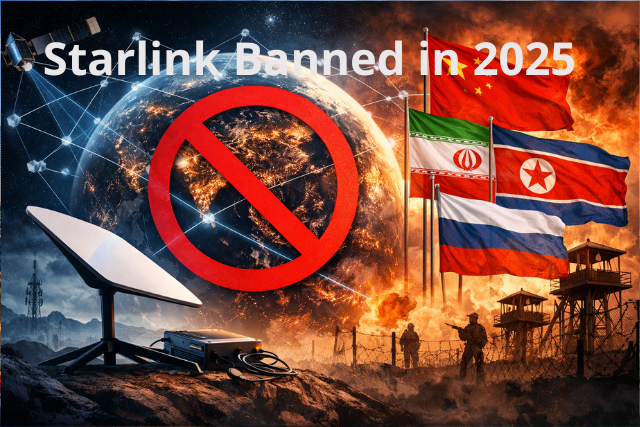
Starlink is banned in which countries? Full updated list and explanation (2025)
Starlink, the satellite internet service developed by SpaceX, has rapidly transformed global connectivity by providing high-speed broadband through low-Earth-orbit satellites. Designed to serve remote, rural, and underserved regions, Starlink is often promoted as a solution to the digital divide.
However, despite its technological promise, Starlink is not welcome everywhere. Several governments around the world have banned, restricted, or refused to license Starlink, citing concerns ranging from national security to regulatory control and political stability.
This article provides a clear, up-to-date list of countries where Starlink is banned or restricted, along with detailed explanations of why these bans exist, how they differ from temporary restrictions, and what this means for users in 2025.
What Does “Starlink Is Banned” Actually Mean?
Before reviewing the list, it is important to understand that a “ban” can take several forms:
-
Full prohibition – Starlink equipment and service are illegal.
-
Licensing refusal – Starlink is not approved to operate.
-
Import restrictions – Terminals cannot legally enter the country.
-
Operational suspension – Service is blocked or disabled.
-
Political or security hold – Approval delayed indefinitely.
In many cases, Starlink may function unofficially through roaming plans or black-market equipment, but that does not mean it is legal.
Countries Where Starlink Is Banned or Effectively Prohibited
1. China
China maintains one of the world’s most controlled internet ecosystems. All telecommunications infrastructure must comply with strict state monitoring and censorship rules.
Starlink is completely banned because:
-
It bypasses the Great Firewall
-
It enables uncensored access to global internet
-
It operates outside Chinese state control
Unauthorized satellite communication is illegal in China, making Starlink usage unlawful nationwide.
2. North Korea
North Korea enforces total state control over information and communication. There is no legal consumer internet access, let alone foreign satellite services.
Starlink is entirely prohibited, and possession of satellite communication equipment is considered a serious crime.
3. Iran
Iran officially bans Starlink, despite the service being activated without government approval during periods of internet shutdowns.
Reasons include:
-
Lack of regulatory authorization
-
National security concerns
-
Circumvention of state internet controls
Although Starlink terminals are used clandestinely, the Iranian government has confirmed the service is illegal and has filed international complaints against SpaceX.
4. Russia
Russia prohibits Starlink due to:
-
National security risks
-
Military concerns
-
Uncontrolled foreign infrastructure
The Russian government has classified unauthorized satellite internet as illegal, especially following geopolitical tensions and conflicts.
5. Syria
Syria strictly controls telecommunications and bans independent satellite services.
Starlink is not licensed and considered illegal due to:
-
Security risks
-
Government surveillance policies
-
Ongoing conflict and sanctions
6. Cuba
Cuba maintains a centralized state-run telecom system.
Starlink is banned because:
-
Foreign satellite internet bypasses state infrastructure
-
Internet access is politically sensitive
-
Independent connectivity is tightly restricted
Private ownership of satellite internet equipment is illegal.
7. Myanmar (Burma)
Myanmar’s military government has blocked Starlink after discovering its use in illegal scam operations and unauthorized communications.
Authorities ordered:
-
Confiscation of terminals
-
Service shutdowns
-
Criminal penalties for possession
Countries With Heavy Restrictions or Suspensions (Not Full Bans)
These countries do not fully ban Starlink but restrict, suspend, or delay its legal operation.
8. India
India has not approved Starlink for commercial use.
Key reasons:
-
Licensing violations
-
National telecom regulations
-
Spectrum management concerns
Authorities have seized Starlink devices and warned users against unauthorized use.
9. Uganda
Uganda recently imposed import restrictions on Starlink equipment.
The government requires special military clearance before terminals can enter the country, raising concerns about election-period internet control.
10. South Africa (Previously Restricted)
South Africa previously blocked Starlink due to local ownership laws requiring equity participation by historically disadvantaged groups.
While regulations were eased in late 2025, service had been suspended, making it effectively restricted for years.
11. Sri Lanka (Temporarily Halted)
Sri Lanka approved Starlink but paused deployment over concerns about lawful interception and national security oversight.
Service is pending final operational clearance.
12. Bolivia (Ban Lifted in 2025)
Bolivia previously banned Starlink but officially lifted restrictions in December 2025 as part of digital infrastructure reforms.
This shows how bans can change with political leadership.
13. Democratic Republic of Congo (Ban Reversed)
The DRC banned Starlink in 2024 over rebel-group usage fears but reinstated approval in 2025.
Summary Table: Starlink Ban Status (2025)
| Country | Status |
|---|---|
| China | Fully banned |
| North Korea | Fully banned |
| Iran | Illegal / banned |
| Russia | Fully banned |
| Syria | Fully banned |
| Cuba | Fully banned |
| Myanmar | Banned |
| India | Not approved |
| Uganda | Import restricted |
| South Africa | Previously restricted |
| Sri Lanka | Temporarily suspended |
| Bolivia | Ban lifted |
| DR Congo | Ban reversed |
Why Do Countries Ban Starlink?
The most common reasons include:
National Security
Governments fear uncontrolled communication channels.
Regulatory Control
Starlink operates independently of national telecom systems.
Political Stability
Satellite internet can prevent shutdowns during protests or elections.
Economic Protection
Local telecom companies may lose market share.
Sovereignty Issues
Foreign infrastructure challenges state authority.
Can Starlink Work Illegally in Banned Countries?
Yes—but at significant risk.
In many banned countries:
-
Terminals are smuggled
-
Users face fines or imprisonment
-
Service may be disabled remotely
Illegal usage offers no legal protection.
Starlink represents a revolutionary step in global connectivity, but it also challenges traditional ideas of national control over communication. As of 2025, several countries continue to ban or restrict Starlink due to security, political, and regulatory concerns.
These restrictions are not permanent—some nations reverse bans as policies evolve—but users should always verify local laws before purchasing or using Starlink equipment.