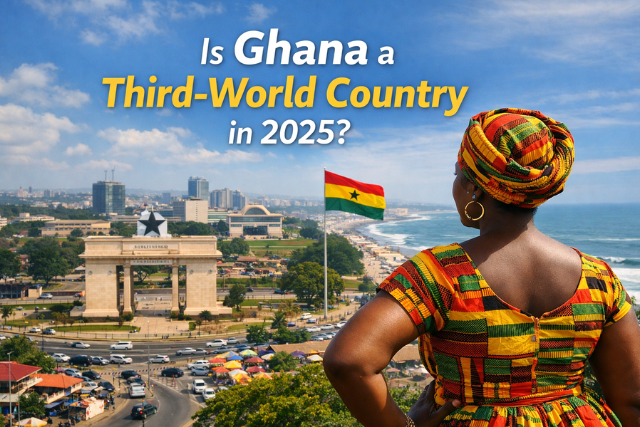
Is Ghana considered a 3rd world country 2025? — A Comprehensive Look
Understanding whether Ghana is a “third-world country” in 2025 requires digging into what the term actually means, how global development is measured today, and where Ghana stands on key economic and social indicators. Rather than repeating stereotypes or outdated Cold War terminology, this article explores Ghana’s real situation in 2025 — economically, socially, and development-wise.
What Does “Third-World Country” Really Mean?
The phrase “third world country” originated during the Cold War. It was a geopolitical label used to describe nations that were not aligned with either the Western bloc (First World) or the Soviet bloc (Second World). That context no longer exists today. Over time, people began using “third world” incorrectly as a shorthand for poor or underdeveloped countries, but that usage is outdated and often considered inaccurate or even insensitive. Academics, international organizations, and economists now prefer terms such as:
-
Developing country
-
Low-income or middle-income country
-
Global South
-
Emerging economy
These terms are based on measured economic and human development data rather than cold war politics.
So before we label Ghana as “third world,” it’s important to evaluate modern development indicators rather than rely on old geopolitical labels.
Why Ghana Is Usually Called a Developing Country
Ghana is widely classified as a developing country in international statistics and by major institutions such as the World Bank and the United Nations.
Here’s why:
✔ Income Classification
According to the World Bank, Ghana is a lower-middle-income economy. This means that while Ghana’s economy is growing, average incomes are not yet high enough to make it a “high-income” country like the United States, Germany, or Japan.
Lower-middle-income countries usually have:
-
Rising but modest gross national income per capita
-
Increasing education and health access
-
Rapid urbanization with mixed rural development
Ghana’s classification reflects progress — but not full development — and definitely does not imply that it is backward or stagnant.
Key Economic Facts About Ghana in 2025
By 2025, Ghana’s economic picture shows both challenges and achievements:
Growth Remains Strong
Ghana’s economy has been growing steadily:
-
It posted strong growth of around 5.7% in 2024, and continued with solid performance into early 2025.
-
Other forecasts suggest growth near 4 – 4.3% in 2025, supported by services, agriculture, and progress in macroeconomic policy.
This level of growth is above the global average and typical for an expanding developing economy.
Lower-Middle-Income Status
Despite this growth, Ghana’s Gross National Income (GNI) per person remains moderate. It is higher than many low-income countries but still far below high-income nations. That’s why it’s classified lower-middle income — a stage of transition toward more advanced economic development.
Inflation and Macroeconomic Reform
In 2025, Ghana’s central bank has cut interest rates following a significant drop in inflation from extremely high levels in previous years. This reflects policy efforts to stabilize the economy.
Fiscal Discipline and Restructuring
Fiscal improvements — such as narrowing deficit targets — signal growing macroeconomic discipline and investor confidence, another hallmark of economies moving beyond traditional developing status.
Human Development — The Bigger Picture
Economic statistics like GDP growth don’t tell the full story. Human development indicators — such as health, education, and overall quality of life — matter just as much.
UNDP and HDI Status
Ghana’s Human Development Index (HDI) is a global metric that combines income, education, and life expectancy.
-
In 2025, Ghana scored around 0.628 on the HDI.
-
That places Ghana in the “medium human development” category.
Compared to many African countries, this is a respectable position — Ghana ranked roughly 18th in Africa on this measure, ahead of several peers.
But it also shows that challenges remain in healthcare, education access, literacy quality, and life expectancy.
Why HDI Matters More Than “Third World” Labels
Unlike the crude “third world” label, the HDI helps us understand what life is like for ordinary people in Ghana — not just what its political alliances once were. This is the modern way development is assessed.
How Ghana Compares to Other Countries
Not a High-Income Country Yet
By global classification standards:
-
Ghana is not a high-income or fully developed economy yet.
-
It has a smaller GDP per capita than developed nations.
-
It still faces challenges in education, health, infrastructure, and poverty reduction.
This is typical for many lower-middle-income economies.
Progress Compared to Other African Nations
However, Ghana is ahead of many peers:
-
Some African countries have lower HDI scores or slower growth.
-
Ghana is consistently one of the faster-growing economies in West Africa.
-
Human development rankings often place Ghana above low-income countries.
So, while Ghana is not “rich” in the developed world sense, it is not among the least developed either.
Common Misconceptions About “Third World” Usage
It’s Not a Useful Economic Term Today
The idea that Ghana could be labeled “third world” in 2025 comes from outdated thinking. Modern analysts prefer terms tied to measurable indicators like GDP per capita, HDI, access to education and healthcare, or economic diversification.
“Third World Country” Can Be Demeaning
Many scholars and citizens argue that the term carries stigma and doesn’t reflect the potential or progress of nations like Ghana. They prefer terms like “developing” or “emerging market.”
Major Development Challenges Ghana Still Faces
Although Ghana shows growing economic strength, it still confronts ongoing development issues:
Poverty and Inequality
-
A portion of the population still lives below international poverty lines.
-
Economic gains are unevenly distributed across regions.
Healthcare and Education Gaps
Improving healthcare access, school quality, and educational outcomes remain priorities for Ghana’s human development. These structural challenges are common among emerging economies.
Infrastructure & Industrialization
Ghana’s industrial base is growing, but the country still relies heavily on commodities like cocoa, gold, and oil — not yet diversified manufacturing or technology sectors seen in high-income countries.
Positive Trends That Signal Progress
Despite challenges, many positive trends show that Ghana is moving forward:
Resilient Economic Growth
Steady GDP growth demonstrates Ghana’s ability to rebound from economic shocks and sustain expansion.
Macroeconomic Reforms
Improved inflation control and fiscal adjustments point to stronger economic management.
Human Development Movement
Even modest gains in HDI and social indicators show real progress in education, health, and income growth.
Emerging Tech & Digital Opportunities
Like many developing nations, Ghana is exploring digital innovation and technology adoption to boost productivity and jobs — a key factor for future growth.
So, Is Ghana a Third-World Country in 2025?
✖ No — Not in the Modern Sense
Based on global development standards used by the World Bank, UNDP, IMF and other institutions:
-
Ghana is not a “third world country” — because that Cold War term is obsolete.
-
Ghana is a lower-middle-income developing economy, with steady economic growth and moderate human development.
✔ Yes — Still Developing
If someone uses “third world” to mean developing with challenges, then Ghana fits many characteristics of a developing nation — but that’s true of hundreds of countries at different stages of economic and social development. The better description is:
Ghana is a growing, developing nation with strong potential, but not yet fully developed by international standards.
This captures both progress and remaining challenges without outdated geopolitical labels.
Why This Matters for You
Understanding Ghana’s development status correctly is crucial for:
-
Investors evaluating economic potential
-
Students and researchers studying global development
-
Businesses exploring markets
-
Readers seeking accurate global perspectives
Framing matters — and Ghana’s story in 2025 is not one of stagnation, but one of transition and growing promise.
Ghana in 2025 — Not Third World, But Still Developing
| Attribute | Status (2025) |
|---|---|
| Official “Third World” label | Outdated term — no longer used |
| World Bank Income Category | Lower-Middle Income |
| Human Development Index | Medium Human Development |
| GDP Growth | Healthy and resilient |
| Long-Term Outlook | Positive, with structural reforms |
The best way to describe Ghana in 2025 is: a developing country on an upward trajectory, not a “third-world country” in the old Cold War sense.