Why is Iran considered a third-world country?
People often ask whether Iran is a third-world country, especially given the economic and political challenges it has faced in recent years. But that term — third world — isn’t used much in modern economic or development analysis. Instead, experts rely on measures like Human Development Index (HDI), income classification, and economic indicators to assess where a country truly stands. In 2026, Iran’s position in the world’s development landscape is the result of decades of history, policy choices, and recent global shifts.
This article explains what third-world really meant, how Iran is classified today, and what key data from 2025 and early 2026 tell us about whether that label fits.
1. What Does “Third-World Country” Mean?
The phrase “third world” originated during the Cold War as a way to describe countries that were neither aligned with the Western capitalist bloc (First World) nor the Soviet socialist bloc (Second World). Over time, it became widely used to describe poor or under-developed countries, but scholars and policymakers no longer use it because it’s outdated and vague.
Today, terms like:
-
Developed country
-
Developing country
-
Low-, middle-, and high-income countries
are preferred because they reflect actual data on income, education, health, and economic output rather than political alignment.
2. Iran’s Current Development Indicators
Iran is a complex case. On one hand, it has significant natural resources and a large economy. On the other hand, it faces serious economic struggles.
2.1 Human Development Index (HDI)
One of the most important measures of development used by the United Nations is the Human Development Index (HDI). This index combines health (life expectancy), education (years of schooling), and income per person to give a broader picture of how well people can live in a country.
According to the UNDP’s most recent Human Development Report (2025, based on 2023 data):
-
Iran’s HDI score is about 0.779–0.780, placing it in the “High Human Development” category.
-
The country is ranked around 75th out of 193 countries in the world.
Countries in the high HDI category are not considered the poorest or least developed; they are typically countries where people have relatively good access to long life expectancy, education, and decent living standards compared to nations in the medium or low categories.
Because of this, Iran cannot be accurately described as a third-world country in the modern economic sense, if we judge by internationally recognized development metrics.
3. Economic Classification — Middle Income, But Under Strain
Another way countries are classified is by income level — usually using data from the World Bank, which groups nations into low, lower-middle, upper-middle, and high-income based on Gross National Income (GNI) per capita.
Although up-to-date World Bank classifications for 2026 aren’t fully released yet, data from 2023 shows that:
-
Iran is typically classified as an upper-middle-income country.
This classification is far above what would be expected for a low-income or very poor state. Countries in the upper-middle-income group are broadly similar to nations like Brazil, China, and Turkey, even if Iran’s economy faces serious challenges.
4. The Iranian Economy in 2026 — Challenges and Realities
Understanding Iran’s development status requires a balanced look at both strengths and weaknesses.
4.1 Size and Structure of the Economy
Iran has a large and diverse economy:
-
It has the 19th largest economy in the world by PPP (Purchasing Power Parity).
-
The country’s economy includes oil, manufacturing, services, and some private enterprise.
However, recent years have been difficult. The country has faced:
-
International sanctions, especially targeting oil exports and financial transactions, which have constrained economic growth.
-
High inflation and rising prices for basic goods.
-
Economic mismanagement and structural inefficiencies that make it harder for businesses and families to thrive.
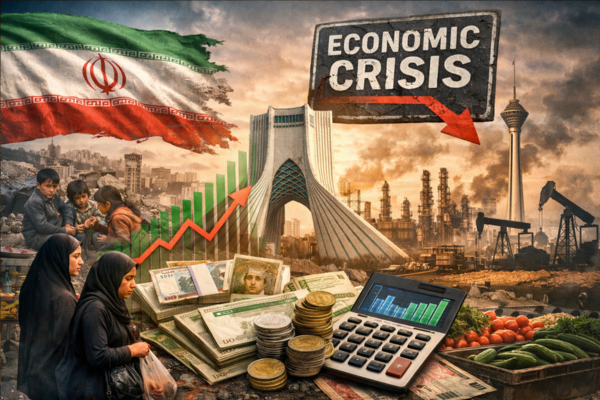
4.2 Recent Economic Crisis
According to recent reports, Iran in early 2026 is experiencing one of the most severe economic downturns in its history:
-
Inflation has soared, putting pressure on household budgets.
-
Poverty rates have increased dramatically.
-
Many basic goods have become less affordable for ordinary citizens.
Despite this crisis, these economic problems do not automatically categorize Iran as a third-world country in the classic sense, because such labels depend more on longer-term development outcomes than temporary downturns.
5. What the HDI Really Shows
The Human Development Index (HDI) helps us see beyond short-term economic chaos. Even at 0.779–0.780, Iran’s HDI positions it as a high-human-development country — which is significantly better than medium or low development categories where truly impoverished nations are placed.
This HDI score reflects:
-
Life expectancy better than many developing nations.
-
Education levels that are relatively strong.
-
GNI per capita that, while not high like in advanced economies, is not extremely low either.
So although Iran faces serious issues — especially economically in 2025–2026 — from a human development perspective the country is not in the lowest development tier globally.
6. Why People Still Use “Third-World Country” for Iran
Despite data showing Iran’s relatively high development status, many people still use the term third world to describe it. There are several reasons for this:
6.1 Economic Hardship and Public Perception
When people see:
-
Rising prices,
-
Shortages of products,
-
Increasing unemployment,
-
Political instability,
they assume the country is deeply “poor” or underdeveloped — similar to nations with low economic output. While these are real struggles, they don’t automatically make Iran a third-world country under modern development definitions.
6.2 Outdated Language
The phrase third world is old and not grounded in current economic or human development metrics. It tends to be used informally in media or conversation, not in professional research.
6.3 Political Narratives
Sometimes geopolitical discussions use terms like third world to frame a country’s place in global power structures. But these narratives don’t always match the actual data on education, health, or income.
7. So, in 2026 — Is Iran a Third-World Country?
No — at least not according to how economists and international institutions define development today.
Here’s why:
7.1 Iran’s HDI Places It in the ‘High Development’ Category
-
HDI scores of approximately 0.779–0.780 place Iran in the high-development rank, which is not characteristic of the poorest nations in the world.
7.2 Iran’s Income is Upper-Middle Level
-
The World Bank and other classification systems list Iran as upper-middle-income, not low-income.
7.3 Economic Challenges Don’t Erase Long-Term Development Gains
Even though Iran is suffering a significant economic crisis, historical investments in education, healthcare, and infrastructure have helped the country maintain higher development indicators than countries often labeled as third world.
Therefore, while Iran faces many major problems in 2026 — especially economic hardship that affects people’s daily lives — by global development standards it is not a third-world country.
8. What This Means for the Future
There’s no doubt that Iran’s economy needs reform and recovery. The challenges of sanctions, inflation, and governance must be addressed for the country to advance further. But the fact that Iran remains in the high human development category indicates:
-
Its people have relatively good access to health care and education.
-
Its average income and living conditions are better than in many lower-income countries.
-
It has economic and human resources that support future growth.
If Iran can overcome its current economic crisis and improve opportunities for its citizens, it could continue to rise in global rankings in coming decades.
So, is Iran a third-world country in 2026? The short answer is no — at least by modern economic and development definitions. While Iran faces serious economic challenges and political tensions, international data show that it is still a high human development country and not part of the lowest development group.
Understanding these terms correctly helps avoid misleading labels and gives a clearer picture of where Iran stands in the world today.