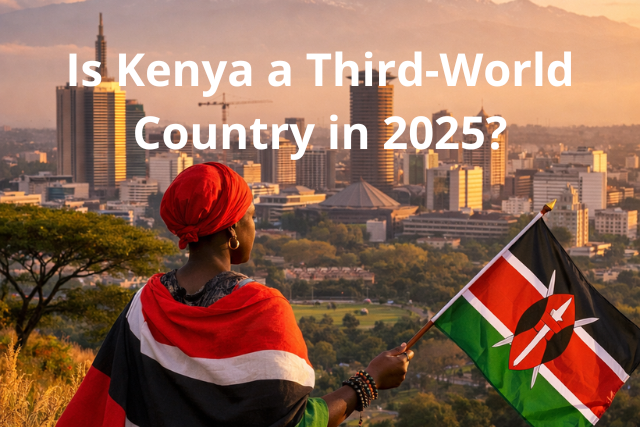
Why is Kenya considered a third-world country in 2025?
Understanding whether Kenya is a third-world country in 2025 requires clarity on what “third-world” means today, how Kenya performs socio-economically, and where it stands compared to global development standards. In this in-depth article, we’ll break down modern definitions, highlight Kenya’s development indicators, and explain why the label “third-world” is outdated and often misleading — while also exploring how Kenya’s progress shapes its global classification in 2025.
Why do people think og Kenya as a Third-World Country? lets know
1. What Does “Third-World Country” Really Mean?
2. Modern Development Labels: Developing, Middle-Income, and Emerging
3. Kenya’s Economic Landscape in 2025
4. Human Development Index (HDI): How Kenya Scores
5. Social Progress: Poverty, Education, and Health
6. Infrastructure, Innovation, and Technology Growth
7. Challenges Facing Kenya’s Development
8. Why “Third-World” Is Not the Right Term for Kenya
9. Looking Ahead: Vision 2030 and Beyond
10. Final Verdict: Is Kenya a Third-World Country in 2025?
1. What Does “Third-World Country” Really Mean?
The term “third-world country” originated during the Cold War, when the world was informally divided into three blocs:
-
First World: Western capitalist countries (e.g., the United States, Western Europe)
-
Second World: Nations organized around communist ideology, historically aligned with or influenced by the Soviet Union.
-
Third World: Countries not aligned with either bloc
Over time, this phrase became synonymous with poor, less developed nations — but this is not its historical meaning, and economists today avoid the term because it lacks precise criteria and can be derogatory.
Instead, researchers and institutions use measured indicators like income level, HDI, and sustainable development goals (SDGs) to classify countries. Let’s explore those modern labels next.
2. Modern Development Labels: Developing, Middle-Income, and Emerging
In current economic discourse, classifications are based on measurable metrics:
a. Developing Country
A developing country typically shows:
-
Lower industrial base compared to developed countries
-
Lower standards of living
-
Middle or low economic indicators such as per-capita income and access to essential services
b. World Bank Income Categories
The World Bank categorizes countries by Gross National Income (GNI) per capita:
-
Low-Income Countries (LICs)
-
Lower-Middle-Income Countries (LMICs)
-
Upper-Middle-Income Countries (UMICs)
-
High-Income Countries
Kenya is currently classified as a lower-middle-income country, reflecting growth from earlier decades but still falling behind wealthier nations.
c. Emerging Market Economy
Emerging markets are nations showing rapid growth and industrialization but not yet fully developed, often attracting foreign investment.
3. Kenya’s Economic Landscape in 2025
Kenya stands as East Africa’s largest economy, with consistent economic activity across multiple sectors including agriculture, services, manufacturing, and technology.
Key Economic Highlights in 2025
✔ Kenya’s economy continues to grow, with GDP expanding year-on-year.
✔ The World Bank revised Kenya’s growth forecast due to global and domestic pressures, estimating about 4.5% growth for 2025.
✔ Public debt remains a concern, with fiscal deficits requiring both external and domestic funding.
Despite challenges, these figures reveal that Kenya is not stagnant economically, but continues to demonstrate positive growth and resilience, especially when compared to many low-income economies.
4. Human Development Index (HDI): How Kenya Scores
The Human Development Index (HDI) is a composite metric that examines:
-
Life expectancy (health and longevity)
-
Education (years of schooling)
-
Standard of living (income)
According to the most recent reports:
Kenya’s HDI score sits in the “medium development” range, above least developed countries but below high-development nations.
This means that while Kenya has advanced compared with many low-income countries, it still has significant room for improvement in education, income distribution, and health outcomes.
5. Social Progress: Poverty, Education, and Health
Poverty
Even with economic growth, a large proportion of Kenyans live near or below the global poverty line. Multidimensional poverty includes access to basic services, nutrition, clean water, and shelter.
Education
Enrollment rates in primary and secondary education have improved, yet quality and access gaps remain between urban and rural areas.
Healthcare
Life expectancy and health infrastructure have improved, but challenges related to affordability and access persist, especially outside major urban centers.
These trends underscore that Kenya is progressing socially but still lags behind higher-income, “developed” countries.
6. Infrastructure, Innovation, and Technology Growth
One of Kenya’s strongest competitive advantages is its:
Mobile and Digital Innovations
Kenya is known globally for pioneering mobile banking technologies and for its thriving tech ecosystem, particularly in Nairobi — often dubbed “Silicon Savannah.”
Infrastructure Projects
Investments in roads, rail, and energy aim to improve connectivity and economic prospects for regions outside the capital.
Such developments show that Kenya is not simply a traditional “developing” nation — it’s actively building competitive sectors that could elevate its global standing.
7. Challenges Facing Kenya’s Development
Although Kenya’s progress is notable, significant structural and social challenges remain:
a. Income Inequality
The gap between wealthy urban populations and poorer rural communities is still wide, affecting equitable access to education and healthcare.
b. Debt and Fiscal Pressure
Borrowing for infrastructure and social programs has increased Kenya’s debt, influencing economic stability and long-term fiscal health.
c. Climate and Agriculture Risks
Droughts and climate change heavily impact agriculture — a sector where many Kenyans depend on for livelihood.
d. Unemployment
Youth unemployment remains a persistent challenge that national strategies seek to address through skill development and job creation initiatives.
8. Why “Third-World” Is Not the Right Term for Kenya
Labeling Kenya as a “third-world country” in 2025 is inaccurate and outdated for several reasons:
Modern vs. Historical Meaning
-
The Cold War context is decades behind us, and the original meaning doesn’t apply to contemporary economic realities.
Data-Driven Classification
Kenya’s classification today comes from measurable indicators — GDP growth, HDI ranking, and income levels — not political affiliations.
Progressive Development Trajectory
Kenya is neither among the least developed countries nor in a perpetual state of stagnation. Its growth trajectory places it in a developing/transitioning economy category, not a simplistic “third-world” tag.
9. Looking Ahead: Vision 2030 and Beyond
Kenya’s long-term plan (Vision 2030) aims to transform the country into a vibrant, middle-income economy by:
-
Elevating human development levels
-
Expanding industrial capacity
-
Improving infrastructure and services
Vision 2030 reflects ambition and strategic planning, underscoring that Kenya aims to move beyond traditional development labels and create wealth, opportunity, and resilience for its people.
10. Final Verdict: Is Kenya a Third-World Country in 2025?
No — in 2025, Kenya does not fit the definition of a “third-world country.”
Here’s why:
✔ The term “third-world” is outdated and not used in modern international classification.
✔ Kenya is classified as a developing, lower-middle-income country — not among the least developed.
✔ The country’s economic growth, innovation, and HDI improvements show real development progress.
✔ Challenges remain, but they are typical of nations in transition — not static, impoverished states.
Today, it’s more accurate to describe Kenya as a growing, developing economy with medium human development, striving toward greater economic complexity and social well-being.
Frequently Asked Questions
Q1: What does “third-world” mean in modern terms?
Historically, “third-world” referred to nations outside the U.S. and Soviet blocs during the Cold War. Today, it’s considered outdated and inaccurate. Modern categorization uses income and development indexes instead.
Q2: Is Kenya a developing country?
Yes, Kenya is widely considered a developing, lower-middle-income country with medium human development based on HDI data.
Q3: What are Kenya’s biggest development challenges?
Key challenges include income inequality, youth unemployment, climate impacts on agriculture, and managing debt while sustaining growth.
Q4: What makes Kenya stand out globally?
Kenya’s leadership in mobile technology, digital finance, and regional economic influence make it a standout among developing nations.
Q5: Will Kenya become a developed country soon?
Kenya has strategic plans (e.g., Vision 2030) aiming for middle-income status and improved global competitiveness — progress toward developed status will depend on sustained growth, investment, and social advancement.
Kenya in 2025 is better understood as a dynamic, developing country with notable economic growth, medium human development, and strong potential for future progress. The term “third-world” doesn’t capture this nuance and is best replaced with data-driven classifications that reflect Kenya’s evolving socioeconomic landscape.