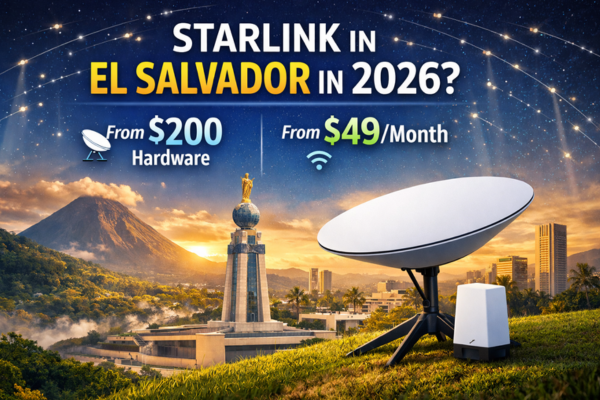
Starlink availability in El Salvador in 2026

Yes, Starlink is available in El Salvador in 2026.
The country officially authorized Starlink to operate after granting the necessary satellite frequency concessions, allowing SpaceX’s subsidiary to legally provide satellite-based internet services nationwide . Since then, coverage has expanded significantly, including both urban and rural areas.

According to Starlink’s official availability tools and regional coverage trackers, most of El Salvador now shows active service availability, with only occasional capacity limitations in densely populated zones . This means new users can sign up, order equipment, and activate service without waiting lists in most parts of the country.

Why Starlink Matters in El Salvador

El Salvador has made progress in expanding fiber and mobile internet, but coverage gaps still exist—especially in rural communities, mountainous regions, and coastal areas. Starlink solves several long-standing challenges:

  • No reliance on ground-based infrastructure

  • Nationwide coverage, including remote villages

  • Consistent speeds compared to older satellite systems

  • Rapid deployment without complex installation

Because of these advantages, Starlink has become attractive to homeowners, small businesses, remote workers, and even emergency response organizations.

Starlink Internet Speeds and Performance

In El Salvador, Starlink users typically experience:

  • Download speeds: 50–150 Mbps

  • Upload speeds: 10–25 Mbps

  • Latency: 20–40 ms

These figures make Starlink suitable for video conferencing, online education, cloud-based work, streaming, and gaming. The performance is especially impressive in areas where traditional ISPs struggle to deliver stable broadband.

While weather and satellite congestion can cause minor fluctuations, uptime is generally above 99%, according to Starlink service descriptions .

Starlink Pricing in El Salvador (2026)

Starlink pricing in El Salvador is notably more affordable than in many developed markets. As of 2026, the costs break down into hardware pricing and monthly service plans.

1. Starlink Hardware Cost in El Salvador

There are currently two main hardware options available in El Salvador:

Standard Starlink Kit

  • One-time cost: approximately USD 200–499

  • Includes satellite dish, Wi-Fi router, mounting base, and cables

Earlier pricing was closer to USD 499, but the introduction of the Starlink Mini significantly reduced entry costs in the region .

Starlink Mini

  • One-time cost: around USD 200

  • Compact, portable, lower power consumption

  • Designed for fixed locations or light mobility

El Salvador was among the first Central American countries to receive the Starlink Mini, making satellite internet more accessible to average households .

2. Monthly Starlink Subscription Prices

As of 2026, Starlink offers several service plans in El Salvador. Prices may vary slightly depending on promotions and capacity, but typical rates are:

Residential Plan

  • Monthly cost: USD 49–65

  • Unlimited data

  • Fixed service address

  • Best option for homes and small offices

Earlier official listings showed residential pricing around USD 49 per month in El Salvador, significantly lower than North American rates .

Roam / Mobile Plan

  • Monthly cost: USD 80–85

  • Allows use in multiple locations

  • Ideal for travelers, RV users, and temporary setups

Some users combine the Starlink Mini with a roaming plan for flexibility, especially digital nomads and field workers .

Is There a Contract or Data Limit?

Starlink in El Salvador does not require long-term contracts. Subscriptions are billed monthly, and users can cancel at any time. There are also:

  • No data caps

  • No throttling for normal usage

  • 30-day trial periods in some cases

This flexibility makes Starlink especially appealing compared to traditional ISPs with long commitments.

Installation and Setup Process

Setting up Starlink in El Salvador is straightforward:

1. Order the Starlink kit online

2. Receive equipment (shipping times vary)

3. Position the antenna in an open area where nothing blocks its line of sight to the sky

4. Plug in the router and power supply

5. Activate service through the Starlink app

No professional installation is required. Most users are online within an hour.

Urban vs Rural Experience in El Salvador

Urban Areas

In cities like San Salvador, Santa Ana, and San Miguel, Starlink competes with fiber and cable providers. While fiber may offer slightly lower latency, Starlink remains a strong alternative when fiber is unavailable or unreliable.

Rural Areas

In rural El Salvador, Starlink is often the best available internet option. Users who previously relied on slow DSL or unstable mobile data see dramatic improvements in speed and reliability.

Starlink for Businesses in El Salvador

Starlink also offers business-grade plans with:

  • Higher priority traffic

  • Better performance during peak hours

  • Higher monthly fees

These plans are suitable for hotels, farms, logistics companies, and remote offices. Pricing is higher than residential plans but still competitive compared to enterprise fiber installations in remote areas.

Legal Status and Government Support

El Salvador officially approved Starlink operations through regulatory concessions, making the service fully legal and compliant with national telecom laws . This regulatory clarity reduces the risk of service interruptions and ensures long-term availability.

Potential Downsides of Starlink in El Salvador

While Starlink is impressive, it is not perfect:

  • Initial hardware cost can be high for some households

  • Performance may dip during heavy rain

  • Requires a clear sky view (trees and buildings can interfere)

However, for many users, these limitations are minor compared to the benefits.

Is Starlink Worth It in El Salvador in 2026?

For most users, yes. Starlink in El Salvador offers:

  • Nationwide availability

  • Affordable pricing compared to global averages

  • Strong speeds and low latency

  • Simple setup and flexible billing

It is especially valuable for rural residents, remote workers, entrepreneurs, and anyone frustrated with inconsistent local internet providers.

Final Answer: Starlink in El Salvador (2026)

Is Starlink available in El Salvador in 2026?
Yes, fully available and legally authorized.

How much does Starlink cost in El Salvador in 2026?

  • Hardware: USD 200–499 (one-time)

  • Monthly plans: USD 49–65 (residential)

  • Mobile plans: USD 80–85

With expanding coverage, competitive pricing, and reliable performance, Starlink continues to play a major role in El Salvador’s digital connectivity in 2026.

Internet Speed, Companies, and Prices in Argentina in 2025

In today’s digital era, reliable internet access has become as essential as electricity or running water. For Argentina, a country known for its vibrant culture, growing tech ecosystem, and diverse geography, internet speed and affordability remain crucial topics in 2025. From bustling cities like Buenos Aires, Córdoba, and Rosario to rural communities in Patagonia, the quality and cost of internet services directly impact business, education, entertainment, and daily communication.

This article explores Argentina’s internet speed in 2025, the top internet service providers (ISPs), their packages, and prices, while also comparing how Argentina’s connectivity stands on the global stage.

Internet Speed in Argentina in 2025

Over the past decade, Argentina has steadily improved its internet infrastructure. In 2025, the country has achieved significant progress thanks to private sector investments and government-backed programs like “Argentina Conectada,” which aim to expand fiber-optic networks and reduce the digital divide.

  • Average Fixed Broadband Speed (2025): Around 95–110 Mbps nationwide, with urban areas often enjoying faster speeds above 150 Mbps.

  • Mobile Internet Speed (4G/5G): Argentina’s 4G is widespread, while 5G networks are expanding in major cities. Average mobile speeds hover around 70–85 Mbps, with peak speeds reaching over 200 Mbps in 5G zones.

  • Latency: Low latency of 20–30 ms is available in fiber-rich areas, making Argentina suitable for online gaming, video conferencing, and cloud-based services.

  • Rural Access: Rural Argentina still faces challenges. While satellite internet solutions like Starlink are available, they remain more expensive than traditional broadband.

Compared to neighboring countries, Argentina ranks mid-to-high in South America for internet speed, behind Chile and Uruguay but ahead of countries like Paraguay and Bolivia.

Top Internet Companies in Argentina (2025)

Argentina’s internet market in 2025 is competitive, with several major ISPs offering broadband, mobile, and bundled services. The leading providers include:

1. Fibertel (Telecom Argentina)

  • One of the largest and most popular ISPs in Argentina.

  • Offers high-speed fiber-optic internet in most major cities.

  • Known for stable service, competitive prices, and TV + internet bundles.

2. Movistar Argentina

  • Operated by Telefónica, Movistar is a major player in both broadband and mobile internet.

  • Provides fiber-to-the-home (FTTH) connections with growing 5G coverage.

  • Popular among urban customers seeking mobile + home internet bundles.

3. Claro Argentina

  • A dominant telecom brand under América Móvil.

  • Offers both 4G/5G mobile and fixed broadband services.

  • Strong coverage across Argentina, especially for mobile users.

4. Personal (Telecom Argentina Mobile Division)

  • Competes strongly in the mobile internet sector with extensive 4G/5G availability.

  • Also offers home internet packages through bundled services.

5. Telecentro

  • A growing ISP that provides fiber internet and cable TV.

  • Known for competitive pricing and good customer service in urban zones.

6. Starlink (Satellite Internet in Argentina)

  • Provides satellite internet services, especially beneficial for rural and remote areas.

  • Offers higher speeds than traditional DSL in underserved regions, though at a higher cost.

Internet Packages and Prices in Argentina (2025)

Internet prices in Argentina vary depending on the provider, speed, and whether the service is bundled with TV or mobile. Inflation and exchange rate fluctuations also influence the costs, but in 2025, providers are offering more affordable deals than before.

Here’s a general overview of broadband and mobile internet packages in Argentina in 2025:

1. Fibertel (Telecom Argentina)

  • 100 Mbps Fiber Plan: Around ARS 14,000 – 16,000/month

  • 300 Mbps Fiber Plan: Around ARS 20,000 – 24,000/month

  • 1000 Mbps Fiber Plan: Premium plan costing ARS 35,000 – 40,000/month

  • Often bundled with cable TV and mobile for discounts.

2. Movistar Argentina

  • 150 Mbps Plan: Around ARS 18,000/month

  • 500 Mbps Fiber Plan: Around ARS 28,000/month

  • 1 Gbps Plan: Around ARS 38,000 – 42,000/month

  • Mobile + fiber bundle deals provide better value.

3. Claro Argentina

  • 120 Mbps Broadband Plan: Around ARS 15,000/month

  • 500 Mbps Fiber Plan: Around ARS 26,000/month

  • 5G Mobile Unlimited Data: Starting at ARS 12,000 – 15,000/month

  • Offers free installation and discounts for family bundles.

4. Telecentro

  • 100 Mbps Plan: Around ARS 13,000/month

  • 300 Mbps Plan: Around ARS 22,000/month

  • 1000 Mbps Fiber Plan: Around ARS 36,000 – 38,000/month

  • Offers special promotions for first-time subscribers.

5. Starlink (Satellite Internet in Argentina)

  • Hardware Kit (Dish + Router): One-time cost around ARS 500,000

  • Monthly Subscription: Around ARS 60,000 – 70,000/month

  • Suitable for rural customers with no fiber coverage.

Mobile Internet in Argentina in 2025

Argentina has a very high mobile penetration rate, and mobile internet remains the most accessible option for many citizens.

  • 4G Coverage: Almost nationwide, reaching over 95% of the population.

  • 5G Expansion: Available in Buenos Aires, Córdoba, Rosario, Mendoza, and other large cities. Telecom Argentina, Movistar, and Claro are leading the rollout.

  • Average Prices (2025):

    • 10 GB 4G Data Package: ARS 4,500 – 6,000

    • Unlimited 5G Data Package: ARS 12,000 – 15,000

    • Prepaid Daily Data: ARS 200 – 300 per GB

The rise of eSIM technology and unlimited mobile plans has made it easier for users to access reliable internet without traditional contracts.

Comparison of Internet Speeds and Prices in South America (2025)

When comparing Argentina’s internet to other countries in South America in 2025:

  • Chile leads with average fixed broadband speeds over 150 Mbps, thanks to heavy fiber investment.

  • Uruguay ranks high with widespread FTTH and average speeds of 120 Mbps.

  • Argentina follows closely, with 95–110 Mbps average speeds, offering competitive pricing compared to Brazil, where inflation drives higher internet costs.

  • Paraguay and Bolivia lag behind with average speeds below 50 Mbps.

This positions Argentina as a strong regional competitor in terms of speed-to-cost ratio.

Challenges Facing Internet in Argentina (2025)

Despite improvements, Argentina still faces challenges in internet development:

  1. Inflation and Economic Instability – Prices of internet packages fluctuate due to exchange rate issues and inflation.

  2. Rural Access Gaps – While urban areas enjoy high-speed fiber, rural Argentina still depends on slower DSL or expensive satellite services.

  3. Infrastructure Expansion Costs – Building fiber-optic networks in remote regions remains costly and time-consuming.

  4. High Demand for Data – With streaming, gaming, and remote work on the rise, ISPs must constantly upgrade infrastructure to keep up.

Future of Internet in Argentina

Looking ahead, Argentina’s internet landscape will likely continue evolving rapidly:

  • Full 5G Rollout by 2027: Most cities expected to have full 5G coverage.

  • Expansion of Fiber-to-the-Home (FTTH): More households will transition from cable to fiber connections.

  • Affordable Satellite Internet: With companies like Starlink facing competition, satellite prices may drop, improving rural connectivity.

  • Smart City Projects: Buenos Aires and other major cities are investing in smart technologies, requiring ultra-fast broadband.

  • AI and Cloud Integration: Argentina’s growing tech startup ecosystem relies heavily on reliable internet speeds for AI, cloud storage, and remote collaboration.

In 2025, Argentina has achieved significant progress in internet speed, accessibility, and affordability. With average fixed broadband speeds reaching 95–110 Mbps and mobile internet steadily improving with 5G expansion, Argentina is bridging its digital divide. Major providers such as Fibertel, Movistar, Claro, Telecentro, and Starlink dominate the market, offering packages tailored for urban and rural needs.

While challenges like inflation and rural connectivity remain, Argentina’s internet sector is on a strong upward trajectory. The coming years promise faster speeds, more competitive prices, and wider access, making the country an attractive hub for digital innovation, remote work, and technology-driven growth.