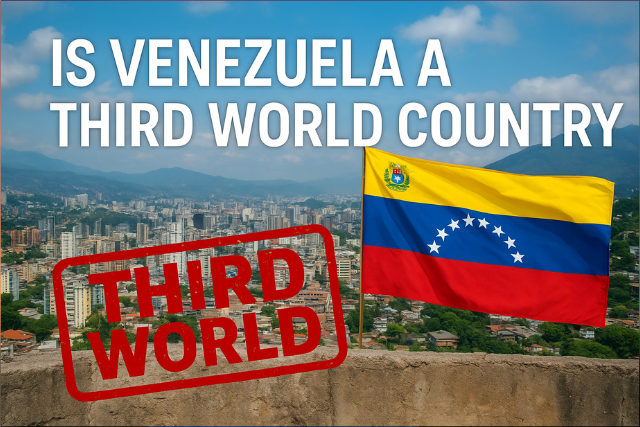
Is Venezuela a “Third World” Country?
The phrase “Third World” is outdated and misleading. This article explains what the term originally meant, how modern organizations classify countries (using World Bank and UN measures), and whether Venezuela fits any modern definition of “third world” today — with clear facts and sources.
Answer
No — the label “Third World” is an outdated Cold War political term and is not used by major international organizations to classify countries today. Using modern measures (income groups, GDP per capita, Human Development Index, and other development indicators), Venezuela is better described as a country that has suffered a severe economic and humanitarian crisis in recent years, rather than being usefully called “Third World.” For clarity, international agencies use terms like low-, lower-middle-, upper-middle-, or high-income country and human development categories.
Where the term “Third World” comes from — and why it’s misleading
The phrase “Third World” was coined in the 1950s during the Cold War to describe countries that were not aligned with either the capitalist bloc (the “First World”) or the communist bloc (the “Second World”). It was a geopolitical label, not a technical economic ranking. Over time, because most non-aligned countries were poorer and less industrialized, the phrase became shorthand for “poor” or “developing” — but that shift in meaning introduced confusion and stigma. Today, scholars and international organizations generally avoid the term and prefer more precise phrases such as developing countries, Global South, or World Bank income groups.
How modern classification works (what experts actually use)
Contemporary institutions classify countries using measurable indicators:
-
World Bank income groups (low, lower-middle, upper-middle, high) based on GNI per capita. These are updated annually and used for lending and policy.
-
Human Development Index (HDI) from UNDP, which combines life expectancy, education, and per capita income to place countries in very high, high, medium, or low human development categories.
-
Country factbooks and analysis (CIA World Factbook, IMF, Reuters and national statistics) that report GDP, inflation, employment, and other macro indicators to capture economic health and stability.
Because these systems are numeric and transparent, they avoid the ambiguity of “Third World.”
Where Venezuela sits in modern terms
Using those modern metrics, here are the key points you need to know about Venezuela:
-
Income classification: Historically Venezuela was classified by the World Bank as an upper-middle-income country (a reflection of past oil revenues), though economic collapse, hyperinflation and data gaps have complicated recent classification and comparisons. For up-to-date numeric GNI figures and the World Bank’s current grouping, consult World Bank country pages.
-
Human Development: Venezuela’s HDI has fallen compared with its mid-20th-century position; UNDP datasets show how components like life expectancy, schooling, and income have changed. The HDI framework is the right way to compare social development rather than using outdated Cold-War labels.
-
Economic turmoil: Since the 2010s Venezuela has experienced severe macroeconomic problems — hyperinflation, sharp GDP contraction, and mass migration. Recent reporting and official data indicate some stabilization signs in very recent years, but the country still faces structural challenges. For example, news reporting and national statistics reported high inflation in recent years and volatile economic growth figures.
Modern measures place Venezuela somewhere between a historically oil-rich upper-middle-income country and a state undergoing severe economic and human development setbacks. That complexity is why the blunt label “Third World” is unhelpful.
Why calling Venezuela “Third World” misses the point
There are three practical reasons to avoid the term:
-
It’s imprecise. “Third World” mixes geopolitics and poverty into a single phrase. Two countries tagged as “Third World” in popular discourse might have very different income levels, governance systems, and social outcomes. Use HDI or World Bank groups instead.
-
It stigmatizes. The phrase has developed negative connotations and can obscure the specific policy problems a country faces (for example, a lack of public services, governance issues, or economic mismanagement).
-
It disguises recent changes. Venezuela’s development story is dynamic: decades of oil wealth were followed by steep decline; very recent signals of economic recovery are mixed. Static Cold War labels cannot capture those trends.
How to discuss Venezuela more accurately
If you’re writing content or doing research, use these phrases and metrics instead of “Third World”:
-
“Upper-middle income (World Bank classification)” — if the World Bank currently lists Venezuela there (check the latest World Bank page).
-
“Human development challenges” or “declining HDI indicators” — if you’re describing education, health, or life expectancy trends.
-
“Economic crisis / hyperinflation / large-scale migration” — to describe the recent humanitarian and macroeconomic realities. Cite up-to-date news and statistical sources.
Short FAQ
Q: Is Venezuela a Third World country?
A: No — “Third World” is an outdated Cold War term. Modern classifications use income groups (World Bank) and the Human Development Index (UNDP) to describe countries’ economic and social status. Venezuela is best described using these modern measures.
Q: What is Venezuela’s World Bank income group?
A: Historically Venezuela has been classified as an upper-middle-income country because of high per capita income in the oil boom years, but economic collapse and data irregularities have complicated the recent picture. Always check the World Bank country page for the latest classification.
Q: How has Venezuela’s development changed recently?
A: Venezuela has faced years of economic contraction, hyperinflation, and a humanitarian crisis that drove large migration flows. Recent years show mixed signals of stabilization, but challenges remain across public services, inflation, and income distribution. Use UNDP and reputable news sources for current trends.
Final takeaways (short and shareable)
-
“Third World” is a Cold War political term and not a useful label today.
-
Venezuela’s situation is complex: not simply “Third World” — it’s a country with a recent economic and humanitarian crisis that must be described using concrete indicators like GNI, HDI, inflation, and migration.
-
For accurate writing and SEO, use World Bank income groups, UNDP HDI, and current news/statistics rather than ambiguous Cold War labels.