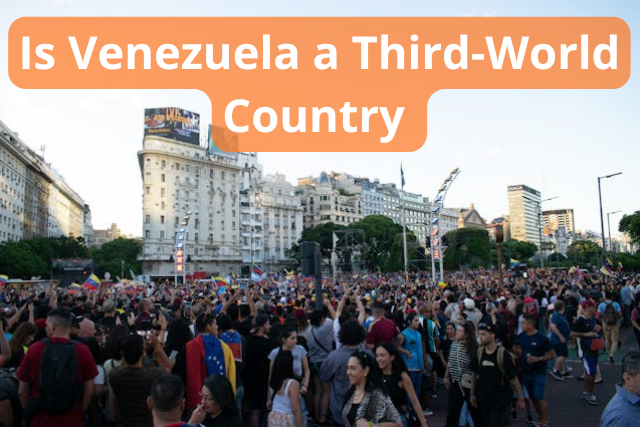
Is Venezuela considered a third world country 2026?
The topic of whether Venezuela should be labeled a third-world country in 2026 often comes up in news outlets, online queries, and political conversations, yet the reality cannot be reduced to a simple yes-or-no response. To understand Venezuela’s position in 2026, we must first clarify what the term third world actually means, why it is considered outdated, and how Venezuela’s economic, social, and political conditions compare to modern development standards.
This article explores the issue in depth, using contemporary indicators such as economic performance, living standards, infrastructure, governance, and human development—rather than relying on Cold War-era labels.
What Does “Third World” Really Mean?
The term “third world” originated during the Cold War, not as an economic ranking, but as a political classification. Countries that were neither aligned with the Western capitalist bloc (First World) nor the Soviet-led communist bloc (Second World) were labeled third world. Venezuela historically fell into this non-aligned category.
Over time, the phrase evolved in popular usage to mean poor, underdeveloped, or unstable countries. Today, many economists and international organizations consider the term outdated and imprecise, preferring classifications such as:
-
Developing country
-
Low- or middle-income country
-
Emerging market
-
Global South
These modern frameworks rely on measurable indicators, not political alliances.
Venezuela’s Historical Position: From Wealth to Decline
Venezuela was not always associated with poverty or underdevelopment. During much of the 20th century, it was one of Latin America’s wealthiest nations, driven by massive oil reserves. Caracas once rivaled major global cities in infrastructure, income levels, and public services.
However, heavy dependence on oil revenue, state mismanagement, corruption, nationalization policies, and declining institutional capacity gradually weakened the economy. When oil prices collapsed and international sanctions intensified, Venezuela entered a prolonged economic crisis that reshaped daily life for millions of citizens.
Venezuela’s Economic Reality in 2026
GDP and Growth
By 2025–2026, Venezuela showed modest economic growth after years of contraction. However, experts agree that this growth is not enough to restore the economy to its former size. The country would require double-digit growth for many consecutive years to recover lost ground.
The country’s nominal GDP remains relatively small, while public debt is extremely high, with debt-to-GDP ratios estimated near or above 180%.
Oil Dependency and Infrastructure Collapse
Oil remains Venezuela’s main economic pillar, but production capacity is severely degraded. Aging facilities, lack of investment, loss of skilled workers, and years of undermaintenance have left large portions of the oil industry nonfunctional. Analysts estimate that tens of billions of dollars in investment would be required to modernize the sector.
In 2026, Venezuela continues exporting oil under tight international oversight and sanctions frameworks, limiting its economic sovereignty and revenue flexibility.
Living Standards and Quality of Life
Poverty Levels
One of the strongest arguments used by those who label Venezuela a “third-world country” is its high poverty rate. By mid-2020s estimates, over 20 million Venezuelans live in multidimensional poverty, lacking reliable access to food, healthcare, and basic services.
Migration Crisis
Since 2014, approximately 8 million Venezuelans have left the country, making it one of the largest displacement crises in modern history. Mass migration is typically associated with severe economic instability and declining living conditions.
Education and Healthcare
Venezuela’s education and healthcare systems still exist nationwide, but they face chronic shortages, underfunding, and staffing gaps. Many schools operate irregularly, and hospitals struggle with medicine availability and infrastructure decay, especially outside major cities.
Infrastructure: Uneven and Fragile
Unlike many low-income nations, Venezuela still possesses significant physical infrastructure, including highways, airports, power grids, and urban housing. However, much of it is aging and poorly maintained.
-
Power outages remain common
-
Water supply is inconsistent in many regions
-
This situation sets Venezuela apart, as it retains the infrastructure typical of a middle-income nation while missing the stable leadership and financial commitment required to keep it functioning
This places Venezuela in a unique category: it has the physical foundations of a middle-income country but lacks the governance and investment needed to sustain them.
Human Development Indicators
From a human development perspective, Venezuela’s situation is mixed:
Strengths
-
High literacy rate
-
Urbanized population
-
Cultural and educational institutions still functioning
Weaknesses
-
Declining life expectancy during crisis years
-
Malnutrition concerns
-
Reduced access to healthcare and employment
In global terms, Venezuela fits neither the category of least developed countries nor that of stable emerging economies.
Is Venezuela “Third World” by Modern Standards?
Technically: No
By strict historical and academic definitions, Venezuela is not a third-world country. The term itself is obsolete and no longer used by major institutions such as the IMF, World Bank, or United Nations.
Practically: Partially
In practical, everyday language, people often use “third world” to describe countries with:
-
Widespread poverty
-
Weak institutions
-
Economic instability
-
Infrastructure problems
By these informal criteria, Venezuela in 2026 exhibits some characteristics commonly associated with that label—but not all.
Venezuela still has:
-
A large urban middle class (though reduced)
-
Industrial capacity
-
Professional workforce
-
Major natural resources
These factors distinguish it from countries traditionally classified as least developed.
More Accurate Classification for Venezuela in 2026
A more precise way to describe Venezuela today would be:
-
Upper-middle-income country in prolonged crisis
-
Resource-rich nation with institutional collapse
-
Developing country experiencing economic recovery from extreme decline
This terminology better reflects reality without relying on outdated or stigmatizing labels.
Future Outlook Beyond 2026
Venezuela’s trajectory depends on several critical factors:
-
Political stability and governance reform
-
Sanctions relief and international cooperation
-
Large-scale infrastructure investment
-
Restoration of institutional trust
If reforms continue and investment returns, Venezuela could gradually re-enter the category of emerging markets. Without these changes, stagnation and uneven recovery may persist.
Is Venezuela a third-world country in 2026?
No—at least not by modern definitions.
However, Venezuela does face conditions that resemble those found in severely struggling developing nations, particularly in terms of poverty, migration, and institutional weakness.
The reality is more complex than a label. Venezuela in 2026 is not a failed state, nor a prosperous one—but a country at a crossroads, balancing limited recovery against deep structural challenges.