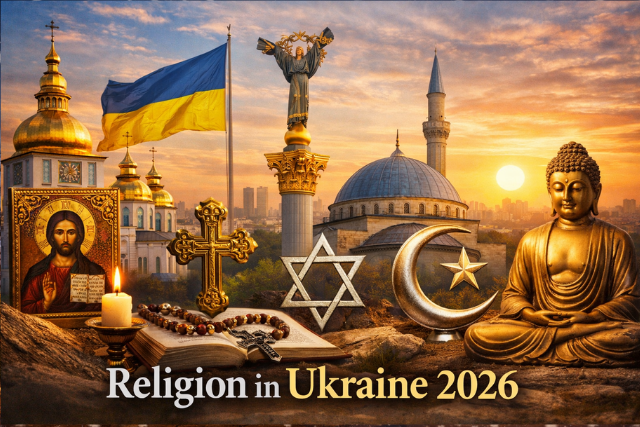
Which Religion Is Practiced in Ukraine in 2026?
Religion continues to play a powerful cultural, historical, and social role in Ukraine. By 2026, the country’s religious landscape reflects not only centuries of tradition but also profound transformations caused by war, national identity, and institutional change. Understanding which religion is practiced in Ukraine in 2026 requires looking beyond labels and into how Ukrainians now define faith, belonging, and spirituality.
This article provides a clear breakdown of religions in Ukraine in 2026, including estimated percentages, historical background, and the reasons behind recent shifts in religious affiliation.
Overview of Religion in Ukraine (2026)
Ukraine remains a predominantly Christian country, with Eastern Christianity shaping its spiritual identity. However, unlike many nations with rigid denominational structures, Ukraine’s religious life is flexible. Many people identify as believers without strict institutional loyalty.
By 2026, surveys indicate that religious self-identification has stabilized after major changes between 2022 and 2024, especially following legislation restricting Russian-linked religious organizations and the continued consolidation of independent Ukrainian churches.
Religion Percentages in Ukraine in 2026 (Estimated)
Based on national surveys, sociological studies, and demographic trends, the religious composition of Ukraine in 2026 is estimated as follows:
Estimated Religious Distribution (2026)
| Religion / Belief System | Percentage |
|---|---|
| Eastern Orthodox Christianity | 55–58% |
| Ukrainian Greek Catholic Church | 11–13% |
| Protestant Christianity | 2–3% |
| Roman Catholic Church | 1% |
| Islam | 1–2% |
| Judaism | 0.5–1% |
| Other religions (Buddhism, Paganism, etc.) | <1% |
| No religion / Spiritual but not religious | 20–23% |
These figures reflect religious identification, not attendance or formal membership.
Eastern Orthodox Christianity in Ukraine
The Largest Religion in Ukraine
Eastern Orthodox Christianity remains the dominant religion in Ukraine in 2026, practiced by more than half of the population. However, Orthodoxy in Ukraine is no longer centralized under a single authority.
Orthodox Church of Ukraine (OCU)
The Orthodox Church of Ukraine (OCU) is now the largest religious institution in the country. Since receiving autocephaly (church independence), it has steadily gained followers.
By 2026:
-
Around 42–45% of Ukrainians identify with the OCU
-
It is widely viewed as a symbol of national sovereignty
-
Many parishes formerly linked to Moscow have transitioned to the OCU
This growth accelerated after 2022, when public trust shifted sharply away from Russia-affiliated institutions.
Ukrainian Orthodox Church (Formerly Moscow-Linked)
The Ukrainian Orthodox Church historically connected to the Moscow Patriarchate has experienced a significant decline.
By 2026:
-
Only 4–6% of Ukrainians identify with this church
-
Many communities have dissolved or changed affiliation
-
Legal restrictions introduced in 2024 reshaped its presence
Public confidence in this institution dropped sharply due to geopolitical associations rather than theological differences.
Unaffiliated Orthodox Believers
A notable segment of Ukrainians describe themselves as Orthodox without church affiliation.
In 2026:
-
About 8–10% identify as Orthodox but avoid institutional labels
-
This reflects a broader European trend of personalized faith
-
Many observe religious holidays but do not attend services regularly.
.
Ukrainian Greek Catholic Church (UGCC)
A Distinct Eastern Catholic Tradition
The Ukrainian Greek Catholic Church follows Eastern Christian rites while remaining in communion with the Vatican. It has deep historical roots, particularly in western Ukraine.
By 2026:
-
11–13% of Ukrainians identify as Greek Catholic
-
The UGCC has expanded beyond its traditional regions
-
It plays an active role in humanitarian aid and civic life
Recent population movement has introduced Greek Catholic communities into central and eastern regions, strengthening national visibility.
Protestant Christianity in Ukraine
Small but Growing
Protestant churches represent a minor yet dynamic religious group in Ukraine.
In 2026:
-
2–3% of the population identifies as Protestant
-
Includes Baptists, Pentecostals, Evangelicals, and Adventists
-
Strong focus on community service and volunteer work
Protestant organizations gained visibility through humanitarian support during wartime displacement.
Roman Catholic Church
Roman Catholics in Ukraine form a small but historic community, primarily associated with ethnic Polish and Hungarian minorities.
By 2026:
-
Approximately 1% of Ukrainians identify as Roman Catholic
-
Concentrated in western regions and major cities
-
Maintains cultural and educational institutions.
Islam in Ukraine
The Muslim Population in 2026
Islam is practiced by 1–2% of Ukraine’s population, making it the largest non-Christian religion in the country.
Key characteristics:
-
Primarily Crimean Tatars, Volga Tatars, and migrants
-
Sunni Islam is the dominant tradition
-
Muslim communities are concentrated in urban centers
Despite displacement caused by occupation, Islamic religious identity remains strong and organized.
Judaism in Ukraine
One of Europe’s Oldest Jewish Communities
Judaism has a deep historical presence in Ukraine, despite demographic changes in the 20th century.
By 2026:
-
0.5–1% of Ukrainians identify as Jewish
-
Active communities exist in Kyiv, Odesa, Dnipro, and Lviv
-
Includes Orthodox, Reform, and secular Jewish identities
Ukraine remains an important center of Jewish cultural and religious life in Eastern Europe.
Other Religions in Ukraine
Smaller religious communities collectively account for less than 1% of the population.
These include:
-
Buddhism
-
Hinduism
-
Neo-pagan movements
-
Baháʼí Faith
-
New religious movements
Most followers live in large cities and practice privately.
Non-Religious and Spiritually Unaffiliated Ukrainians
A Growing Segment
By 2026, 20–23% of Ukrainians identify as:
-
Non-religious
-
Agnostic
-
Spiritual but not affiliated
This does not necessarily mean rejection of faith. Many celebrate religious holidays culturally while avoiding institutional labels.
This trend reflects modernization, urbanization, and generational change rather than secular hostility.
Why Religion in Ukraine Changed After 2022
Several factors reshaped religious affiliation:
1. War and National Identity
Religion became intertwined with sovereignty and cultural independence.
2. Legal Reforms
Laws targeting foreign-controlled religious institutions accelerated change.
3. Internal Migration
Population movement redistributed religious communities.
4. Generational Shifts
Younger Ukrainians favor personal belief over institutional loyalty.
Religious Freedom in Ukraine (2026)
Ukraine continues to guarantee freedom of religion under its constitution.
Key features:
-
No state religion
-
Equal legal status for registered faiths
-
Strong public support for religious pluralism
Despite wartime constraints, Ukraine remains one of the most religiously diverse countries in Eastern Europe.
Religion in Ukraine in 2026
In 2026, Ukraine’s religious identity is deeply rooted yet evolving. Christianity—especially Orthodoxy—remains central, but institutional dominance has given way to national, independent, and personal expressions of faith.
Religion in Ukraine today is not merely belief—it is history, resilience, and cultural self-definition.