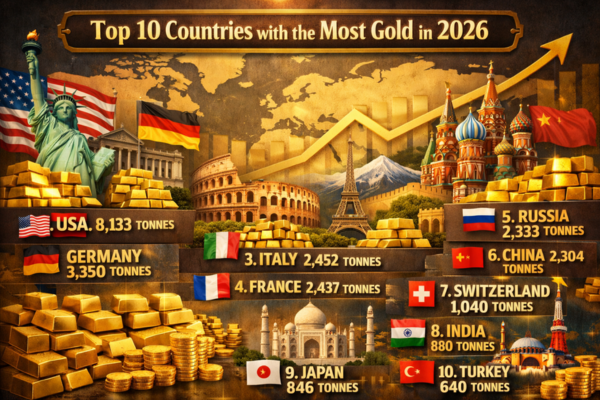
Which are the Top 10 countries with the most gold Reserves in 2026?
Gold has long been one of the most important assets for nations, serving as a hedge against economic uncertainty and a cornerstone of financial stability. In 2026, central banks and governments continue to hold gold as part of their foreign exchange reserves, reflecting both tradition and strategy in global finance. Here are the Top 10 countries with the largest gold reserves in the world in 2026, along with the amount of gold they hold (in metric tonnes).
1. United States – 8,133 tonnes
The United States continues to dominate the global gold ranking, holding approximately 8,133 tonnes of gold — more than double the reserves of any other nation. This massive stockpile is strategically stored in secure facilities such as Fort Knox (Kentucky), the Denver Mint, and the Federal Reserve Bank of New York.
The U.S. gold reserve represents a crucial part of the country’s financial safety net. Its sheer size gives confidence to investors worldwide and acts as a symbol of enduring economic strength. Historically, this stockpile was built during and after World War II and has remained relatively stable over time.
Why this matters: The U.S. gold reserve is the benchmark for global finance. It supports currency stability and helps the United States maintain its position in international markets.
2. Germany – 3,350 tonnes
Germany holds the second-largest gold reserve, with about 3,350 tonnes of gold. Most of Germany’s gold is overseen by the Deutsche Bundesbank and has historically been kept both inside the country and abroad for diversification.
Germany’s approach emphasizes financial reliability and conservative monetary policy. During recent years, the Bundesbank repatriated much of its gold from overseas vaults to increase domestic holdings, reinforcing national confidence.
Why this matters: Germany’s gold stock underlines its commitment to monetary security within the Eurozone and its role as a key economic leader in Europe.
3. Italy – 2,452 tonnes
Italy is ranked third globally with about 2,452 tonnes of gold reserves. These holdings are managed by the Bank of Italy and are seen as an essential part of the country’s foreign reserves.
Italy’s gold reserves play a significant role in its economic policy, offering protection against currency risk and supporting investor confidence. In 2025 and 2026, debates about the political status of gold assets arose in Italy, reflecting public interest in how national wealth is managed.
Why this matters: Italy’s position in the top three highlights how traditional European economies rely on gold as part of a broader reserve diversification strategy.
4. France – 2,437 tonnes
France holds nearly 2,437 tonnes of gold, making it the fourth largest holder in the world. Much like Italy and Germany, gold forms a significant part of France’s strategic reserves.
France’s gold assets are managed primarily by the Banque de France and serve as both a symbol and instrument of financial security. These holdings help stabilize the country’s economic outlook and contribute to maintaining market trust.
Why this matters: Gold supports France’s economic resilience, especially when global markets are volatile or unpredictable.
5. Russia – 2,333 tonnes
Russia holds approximately 2,333 tonnes of gold, ranking it fifth worldwide. Over the past decade, Russia has strategically increased its gold reserves as a way to reduce dependency on foreign currencies — especially the U.S. dollar — and to bolster its economic independence.
Gold plays a key role in Russia’s financial strategy, particularly as global geopolitical dynamics shift and countries look to diversify their assets.
Why this matters: Russia’s sizable gold reserve reflects broader efforts to build sovereign economic resilience in the face of geopolitical changes.
6. China – 2,304 tonnes
China holds around 2,304 tonnes of gold, placing it sixth in the world. While China is also one of the world’s leading gold producers, its official reported gold reserves — managed by the People’s Bank of China — show consistent growth over many years.
China’s gold strategy is closely tied to its long-term economic planning, including diversification away from reliance on U.S. Treasury securities and strengthening the credibility of the Chinese yuan. Some analysts argue that actual holdings could be even higher.
Why this matters: China’s gold holdings are part of a broader strategy to fortify its financial system and global economic influence.
7. Switzerland – 1,040 tonnes
Switzerland holds approximately 1,040 tonnes of gold, ranking seventh among the world’s gold-holding nations. Switzerland’s reputation as a global financial hub and center of banking excellence makes its gold reserve particularly important.
Swiss gold reserves help support the country’s monetary policy and financial stability. They also reinforce the trust of international investors in Switzerland’s banking system.
Why this matters: Switzerland’s gold reserve reflects its long-standing role as a safe and stable financial center.
8. India – 880 tonnes
India holds around 880 tonnes of gold, making it the eighth largest holder globally. The Reserve Bank of India (RBI) has been gradually increasing gold reserves as part of its efforts to diversify foreign exchange assets and protect the economy against currency volatility.
In India, gold also bears deep cultural significance beyond its role in national reserves. Private households and temples own thousands of additional tonnes of gold — far more than what is officially held by the RBI — though this private gold is not counted in official national reserve data.
Why this matters: India’s gold strategy combines economic prudence with cultural tradition, reflecting unique demand dynamics.
9. Japan – 846 tonnes
Japan’s gold reserves total approximately 846 tonnes, placing it ninth in the world. Although Japan’s gold holdings are smaller than those of many European nations, they remain a meaningful part of its foreign exchange reserves.
Japan’s gold strategy has focused on long-term stability. Gold serves as a buffer against currency fluctuations and financial shocks, especially given Japan’s heavy reliance on global trade and investment flows.
Why this matters: Japan’s economic strategy prioritizes stability and balance, and gold plays a role in that mix.
10. Turkey – 640 tonnes
Turkey completes the top ten with around 640 tonnes of gold reserves. Turkey’s gold accumulation has been influenced by currency volatility and inflation concerns, prompting its central bank to hold larger gold reserves as a financial safeguard.
Gold holdings are increasingly seen as a way to reinforce confidence in the country’s financial reserves during uncertain economic conditions.
Why this matters: Turkey’s position highlights how emerging economies can use gold strategically to strengthen financial resilience.
Why Gold Reserves Matter for Countries
Gold continues to be a vital part of national reserve holdings for several reasons:
1. Financial Security and Stability
Gold is a globally recognized store of value. Unlike foreign currency, which can fluctuate with exchange rates, gold retains value across economic cycles. This stability makes gold a key reserve asset during times of inflation or geopolitical risk.
2. Diversification of Reserves
Countries diversify their reserve holdings (which can include foreign currency, bonds, and other assets) to reduce overall risk. Gold acts as a counterbalance — especially when other assets underperform.
3. Hedge Against Currency Depreciation
When a nation’s currency weakens, gold can help protect national wealth. Holding substantial gold reserves can strengthen confidence in a country’s financial stability.
4. Boosting International Credibility
Large official gold reserves often signal economic strength, making foreign investors more confident in a country’s ability to manage financial crises.
Key Trends in Gold Holdings in 2026
Here are important trends shaping gold reserves in 2026:
-
Central banks continue buying gold, especially when geopolitical uncertainties rise. Some countries are increasing holdings to diversify away from currencies like the dollar and euro.
-
Gold prices have surged in early 2026, driven by safe-haven demand amid economic shifts, which increases the value of existing reserves.
-
Developing economies like India and Turkey are steadily adding to their gold stockpiles as part of long-term strategies.
In 2026, the landscape of gold reserves remains dominated by traditional economic powers like the United States, Germany, and Italy, with emerging economies such as India and Turkey rising in relevance. These nations continue to use gold as a strategic asset for economic security, reserve diversification, and financial credibility.
Whether you’re a student, investor, or curious reader, understanding the global distribution of gold reserves offers valuable insight into how countries protect and manage their wealth — especially in times of economic uncertainty.