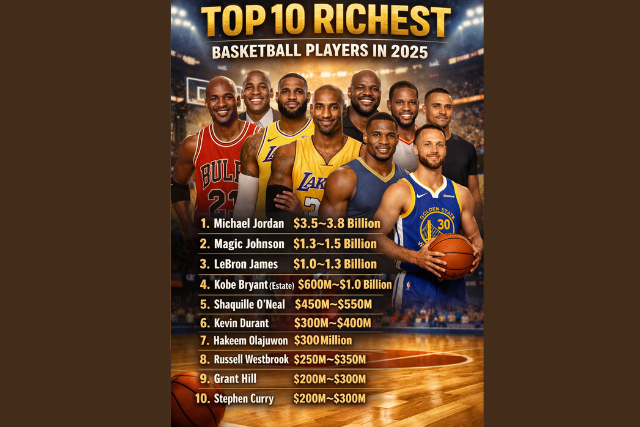
Top 10 Richest Basketball Players in 2025 — Who’s Sitting on the Biggest Hoops Fortune?
Basketball salaries are huge, but the truly massive fortunes usually come from smart deals off the court: shoe royalties, team ownership, media companies, franchises, and smart investments. In 2025 the richest names combine legendary careers with business empires. Below is an up-to-date, sourced list of the Top 10 richest basketball players in 2025, with short notes on how each built their wealth and what makes them stand out.
1. Michael Jordan — ~$3.5–$3.8 billion
Michael Jordan remains the clear leader among basketball fortunes. His wealth is dominated by long-running deals with Nike (Jordan Brand), lucrative endorsement deals, and sports-team ownership stakes and sales. Jordan has also cashed in on non-basketball ventures and selective asset sales that pushed his net worth into the multi-billion dollar range.
Why it matters: Jordan is the template for how an athlete turns fame into an enduring consumer brand.
2. Earvin “Magic” Johnson — ~$1.3–$1.5 billion
Magic Johnson’s post-court career—real estate, franchise ownership, and strategic investments—has steadily increased his fortune. Johnson’s diversified portfolio (restaurants, ownership stakes in sports franchises, and private equity deals) is the backbone of his billionaire status.
Why it matters: Magic’s wealth shows how repeated, well-placed minority stakes and community-focused business models can create long-term growth.
3. LeBron James — ~$1.0–$1.3 billion
LeBron’s combination of on-court earnings, lifetime endorsements, and an expanding media and production business makes him one of the few active players in the billionaire range. LeBron has diversified into media, production, sports equity, and tech, which has been central to his net-worth trajectory.
Why it matters: LeBron’s path illustrates how active athletes can build billionaire-level wealth by owning content and platforms—not just taking paychecks.
4. Kobe Bryant (estate) — ~$600 million–$1.0 billion
Kobe Bryant’s earnings at the time of his death combined with posthumous asset appreciation, royalties, and revenue from investments (notably beverage and brand stakes reported historically) have pushed the estate’s valuation higher. Estimates vary depending on assumptions about private holdings and the after-market value of brand deals.
Why it matters: Athlete estates can appreciate substantially when the brand remains active and new commercial deals continue after an athlete’s playing days.
5. Shaquille O’Neal — ~$450–$550 million
Shaq’s fortune comes from a high NBA salary history combined with decades of endorsements, strategic franchise investments (fast-food, real estate, car washes), and media contracts—including continued broadcast deals. He remains one of the wealthiest retired stars thanks to business scale and monetizing his public persona.
Why it matters: Shaq’s model is volume + visibility—many medium-to-large investments across industries rather than one gigantic company.
6. Kevin Durant — ~$300–$400 million
Kevin Durant’s wealth is a mix of player salary, high-value endorsements, and a growing investment profile (VC, startups, media). Durant’s post-playing plans and his early investments in digital and media companies have added multiple revenue channels to his on-court earnings.
Why it matters: Star players who invest early in tech and media can scale wealth rapidly even before retirement.
7. Hakeem Olajuwon — ~$300 million
Hakeem’s wealth was built through real estate savvy and disciplined investing after his playing days. Compared to modern super-contract salaries, his earnings as a player were smaller—but smart asset allocation produced long-term wealth.
Why it matters: The “real estate play” is a historic route to sustained athlete wealth—especially for players in earlier salary eras.
8. Russell Westbrook — ~$250–$350 million
Westbrook’s net worth reflects strong endorsement deals, merchandise revenue, and multiple business ventures. Known for high earnings during peak seasons, Westbrook has diversified into fashion and brand collaborations.
Why it matters: High annual salaries plus consistent brand deals keep modern high-earning stars near the top of wealth lists.
9. Grant Hill — ~$200–$300 million
Grant Hill turned an excellent playing career into longevity in media and investing. Hill’s business decisions after retirement—careful brand work and portfolio building—have kept his net worth in the upper tier of former players.
Why it matters: Sustained wealth often depends on what players do after retirement: advisory roles, media, and private deals add up.
10. Stephen Curry — ~$200–$300 million
Stephen Curry’s earnings come from elite NBA contracts, major endorsements (notably a large shoe and apparel deal), and equity stakes in food, tech, and sports investments. Curry’s off-court moves are shaping his long-term financial profile.
Why it matters: Modern players with global brand appeal and ownership stakes in consumer brands can accelerate wealth accumulation quickly.
How the rankings are estimated (short methodology)
-
Primary sources: public filings, Forbes profiles, reputable business and sports outlets that track athlete net worth. For older athletes, long-term asset performance (real estate, franchise stakes) is taken into account; for active players, endorsements and equity positions are weighted alongside salary. Because many holdings are private, net worths are estimates and shown in ranges. (Key source examples: Forbes athlete and billionaire lists, major business outlets.)
Why net worth numbers differ between sites
Different outlets use different assumptions for private business valuations, taxes, debt, and the speed at which brand value is monetized. Some lists update frequently (quarterly/monthly) while others use annual snapshots—so ranges are a realistic way to present numbers for 2025. Where available, this article cites recent Forbes profiles and widely-reported estimates from recognized business outlets.
Quick takeaways
-
Long-tail keyword ideas: “richest NBA players 2025 net worth,” “how Michael Jordan became the richest basketball player,” “LeBron James business empire 2025,” “Kobe Bryant estate value 2025.”
-
Content angles that perform well: deep dives into one player’s businesses (e.g., Jordan Brand case study), comparisons between player earnings then vs now, and explainers on how athlete ownership stakes work.
-
Multimedia tips: short charts that show net worth over time, infographic timelines of each player’s major business moves, and short video scripts pulling the top 3 fortunes as shareable clips.
Wealth among basketball greats is less about what they earned on the court and more about what they own and how they turned fame into compact, scalable businesses. In 2025 the leaderboard blends legends who became business tycoons (Michael Jordan, Magic Johnson) with active stars who leveraged media and equity (LeBron James, Stephen Curry). If you’re producing SEO content or a video, angle your piece toward how each player made their money—readers want the story behind the number.
FAQ
Q: Who is the richest basketball player in 2025?
A: Michael Jordan, with an estimated net worth around $3.5–$3.8 billion, remains the richest due to Nike/Jordan Brand, ownership stakes, and diversified investments.
Q: Are any active players billionaires in 2025?
A: In 2025 LeBron James is widely reported around the billionaire threshold or just above (estimates vary by outlet). Magic Johnson and Michael Jordan are established billionaires based mainly on post-play business activities.
Q: How accurate are these net worth numbers?
A: They are estimates. Public company holdings and participation in public transactions are easier to value; private investments and estate valuations are less precise. For authoritative snapshots, Forbes profiles and their billionaire lists are commonly used references.