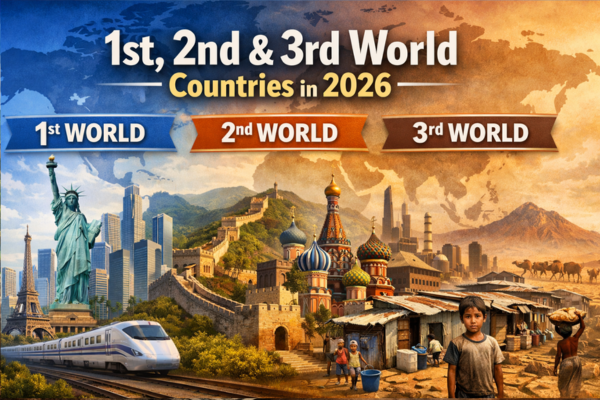
What are the 1st, 2nd, and 3rd World Countries in 2026?
Full Explanation and Country Lists
In 2026, the terms 1st world, 2nd world, and 3rd world countries are still widely used in everyday conversation, media, and online searches. However, their meanings have evolved significantly over time. Originally created during the Cold War, these labels no longer reflect political alliances alone. Instead, they are now commonly used to describe levels of economic development, living standards, technological progress, and social infrastructure.
This article provides a clear, modern explanation of what first, second, and third world countries mean in 2026, how they differ, and a comprehensive country list under each category—written entirely from scratch.
Origin of 1st, 2nd, and 3rd World Countries (Brief History)
The terms first, second, and third world emerged in the mid-20th century:
-
First World: Capitalist, industrialized nations aligned with the United States
-
Second World: Socialist or communist states aligned with the Soviet Union
-
Third World: Non-aligned or developing nations
After the Cold War ended, the political basis became outdated. Today, these terms are informal development categories, not official classifications used by the United Nations or World Bank.
How These Categories Are Interpreted in 2026
In 2026, countries are often grouped based on:
-
Economic strength and income levels
-
Quality of life and human development
-
Industrialization and technological capacity
-
Infrastructure, healthcare, and education
-
Political stability and governance
Let’s explore each category in detail.
Which are the First World countries in 2026?
The first world country in 2026 is a highly developed nation with:
-
Strong and diversified economy
-
High GDP per capita
-
Advanced technology and innovation
-
Excellent healthcare and education systems
-
Stable political institutions
-
High Human Development Index (HDI)
These countries offer high living standards, long life expectancy, and strong social safety nets.
Key Characteristics of First-World Countries
-
Advanced digital infrastructure
-
High employment and wage levels
-
Strong legal systems and civil rights
-
Developed transportation and urban planning
-
Global influence in finance, technology, and culture
List of First World Countries (2026)
North America
-
United States
-
Canada
Europe
-
Germany
-
France
-
United Kingdom
-
Netherlands
-
Switzerland
-
Sweden
-
Norway
-
Denmark
-
Finland
-
Austria
-
Belgium
-
Ireland
-
Iceland
-
Luxembourg
Asia
-
Japan
-
South Korea
-
Singapore
Oceania
-
Australia
-
New Zealand
Others
-
Israel
These nations consistently rank high in economic competitiveness, innovation, and quality of life.
Which are the Second World countries in 2026?
In 2026, second-world countries are generally considered emerging or transitional economies. They are more developed than third-world countries but do not yet meet first-world standards across all sectors.
Many second-world countries show rapid growth, industrial expansion, and rising global influence but still face challenges such as income inequality, infrastructure gaps, or political instability.
Key Characteristics of Second-World Countries
-
Expanding middle class
-
Growing industrial and service sectors
-
Improving education and healthcare
-
Moderate GDP per capita
-
Ongoing structural reforms
List of Second World Countries (2026)
Eastern Europe & Eurasia
-
Russia
-
Ukraine
-
Poland
-
Hungary
-
Romania
-
Bulgaria
-
Serbia
-
Kazakhstan
-
Belarus
Asia
-
China
-
India
-
Vietnam
-
Thailand
-
Malaysia
-
Indonesia
-
Philippines
-
Sri Lanka
Middle East
-
Turkey
-
Iran
-
Saudi Arabia
-
United Arab Emirates
-
Qatar
-
Kuwait
-
Oman
Latin America
-
Mexico
-
Brazil
-
Argentina
-
Chile
-
Colombia
-
Peru
Africa
-
South Africa
-
Egypt
-
Morocco
-
Tunisia
Many of these countries are on a development spectrum, with some cities rivaling first world standards while rural areas lag behind.
Which are the Third World Countries in 2026?
A third-world country in 2026 refers to a developing or least-developed nation facing persistent challenges such as poverty, weak infrastructure, limited industrialization, and lower living standards.
Despite the negative connotation, many third world countries show significant potential, young populations, and natural resource wealth.
Key Characteristics of a Third-World Country
-
Low to lower-middle income levels
-
Limited access to quality healthcare and education
-
Underdeveloped infrastructure
-
Higher unemployment or informal labor
-
Dependence on agriculture or raw material exports
List of Third World Countries (2026)
Africa
-
Nigeria
-
Ethiopia
-
Sudan
-
South Sudan
-
Chad
-
Niger
-
Mali
-
Burkina Faso
-
Somalia
-
Central African Republic
-
Democratic Republic of Congo
-
Mozambique
-
Malawi
-
Sierra Leone
Asia
-
Afghanistan
-
Nepal
-
Bangladesh
-
Myanmar
-
Cambodia
-
Laos
-
Yemen
Latin America & Caribbean
-
Haiti
-
Honduras
-
Nicaragua
-
Guatemala
-
Bolivia
Middle East
-
Syria
-
Iraq
Oceania
-
Papua New Guinea
These countries often rely on international aid, development programs, and foreign investment to improve living conditions.
Important Clarification: These Terms Are Not Official
It’s important to understand that “first,” “second,” and “third world” are not formal or scientific categories. International organizations now prefer terms like:
-
Developed countries
-
Developing countries
-
Least developed countries
-
High-income, middle-income, low-income economies
However, the old terminology remains popular for general understanding and SEO-based discussions.
Can Countries Change Categories?
Yes. Country status is not permanent.
Examples of Progress
-
South Korea moved from third world to first world within decades
-
Singapore transformed from a developing port city into a global financial hub
-
Vietnam is rapidly approaching second-world status
Factors That Drive Change
-
Education and workforce development
-
Foreign investment
-
Political stability
-
Technological adoption
-
Infrastructure development
Why These Classifications Still Matter in 2026
People search these terms to understand:
-
Travel costs and living standards
-
Business and investment opportunities
-
Migration and employment prospects
-
Global inequality and development trends
In 2026, first, second, and third world countries are best understood as levels of development rather than political labels. While first world nations enjoy high prosperity and stability, second world countries are rapidly evolving, and third world nations continue striving for growth amid significant challenges.
The global landscape is constantly changing. With the right policies, innovation, and investment, today’s third world countries can become tomorrow’s success stories.