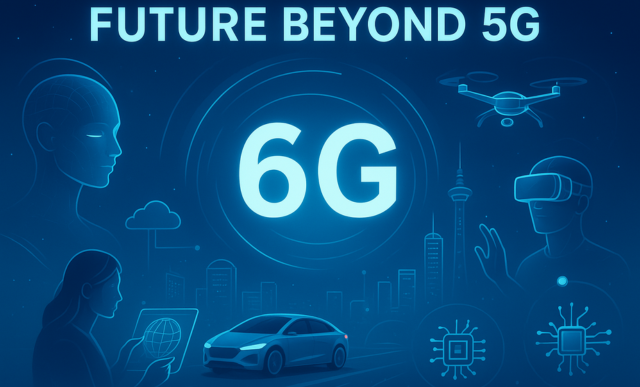
What Comes After 5G Mobile Network? The Future of Connectivity Beyond 5G
The mobile communication world has come a long way—from the first-generation (1G) analog voice systems to the blazing-fast 5G technology we use today. Each new generation has brought revolutionary changes: 2G gave us SMS, 3G introduced mobile internet, 4G made streaming and apps possible, and 5G brought ultra-low latency and massive connectivity.
But as technology continues to evolve, people are already asking: What comes after 5G? What will the **next generation of mobile networks—6G and beyond—**look like, and how will it transform our lives?
This article explores the future beyond 5G, including 6G technology, its expected features, global research efforts, potential applications, and the revolutionary impact it may have on industries and society.
1. Understanding the Journey So Far: From 1G to 5G
Before diving into what’s next, it’s essential to understand how we arrived at 5G and what makes the next step so important.
| Generation | Key Features | Launch Period | Impact |
|---|---|---|---|
| 1G | Analog voice calls | 1980s | Basic mobile telephony |
| 2G | Digital voice, SMS | 1990s | Enabled text messaging |
| 3G | Mobile internet, video calls | 2000s | Brought the web to phones |
| 4G | Broadband, HD video, apps | 2010s | Enabled smartphones, streaming, and social media |
| 5G | Ultra-fast internet, low latency, IoT connectivity | 2020s | Revolutionized smart cities, autonomous vehicles, and AI-driven devices |
Now, as 5G networks mature across the world, researchers and telecom companies are already focusing on the next frontier: 6G.
2. What is 6G Technology?
6G stands for the sixth generation of wireless communication technology, expected to be the successor to 5G. It aims to deliver even higher data speeds, near-zero latency, and intelligent connectivity that integrates AI, quantum computing, and holographic communication.
While 5G focuses on connecting devices faster, 6G will connect humans, machines, and digital worlds seamlessly. Experts believe 6G could become a reality by 2030, with initial research and testing already underway in several countries.
3. How Fast Will 6G Be?
Speed is one of the most talked-about features of any mobile network generation.
-
5G offers peak speeds of around 10 Gbps (gigabits per second).
-
6G is expected to reach 1 Tbps (terabit per second)—that’s 100 times faster than 5G.
At such speeds, downloading a full-length HD movie could take less than a second. Beyond entertainment, this speed will unlock next-level innovations like real-time holograms, brain-computer interfaces, and digital twins.
4. Key Features and Technologies of 6G
6G will not just be faster—it will be smarter, more energy-efficient, and more integrated with artificial intelligence. Below are some of its major expected features:
4.1. Terahertz (THz) Communication
6G will likely use frequencies between 100 GHz and 3 THz, known as terahertz waves. These frequencies can carry vast amounts of data over short distances, enabling ultra-high-speed communication.
4.2. AI-Driven Networks
Unlike 5G, which requires human engineers for optimization, 6G networks will be self-learning and self-healing. Artificial intelligence (AI) and machine learning (ML) will automatically manage traffic, security, and energy use.
4.3. Ultra-Low Latency
5G already reduced latency to 1 millisecond. 6G will bring this down even further—to less than 0.1 milliseconds, enabling instantaneous responses for critical systems like autonomous cars and robotic surgery.
4.4. 3D and Holographic Communication
6G is expected to enable real-time 3D holograms, making remote communication as natural as in-person interaction. Imagine having a holographic meeting with colleagues from across the world!
4.5. Integration of Physical and Digital Worlds
6G will merge the physical, digital, and biological realms through technologies like brain-computer interfaces, extended reality (XR), and Internet of Everything (IoE).
4.6. Advanced Security and Privacy
With more devices and data connected, 6G will use quantum encryption and blockchain-based authentication to secure communications at an unprecedented level.
5. When Will 6G Be Available?
While 5G rollout is still expanding worldwide, 6G is already in its early research phase. The expected timeline looks like this:
-
2025–2027: Large-scale research and lab testing.
-
2028–2029: Pilot projects and standardization by ITU and 3GPP.
-
2030: Commercial launch of 6G networks in advanced countries.
Countries like Japan, South Korea, the USA, China, and Finland are already leading the race to develop 6G technologies. Major companies such as Samsung, Nokia, Huawei, Ericsson, and Qualcomm have announced research programs focused on 6G innovation.
6. Applications of 6G: Transforming the World
The arrival of 6G will not just improve communication—it will reshape entire industries and the way we live. Let’s explore how 6G will impact different sectors:
6.1. Smart Cities
6G will power next-generation smart cities, where infrastructure, traffic, healthcare, and public safety are interconnected through intelligent networks. Sensors and AI systems will optimize energy use, waste management, and urban planning.
6.2. Healthcare and Telemedicine
With ultra-low latency and real-time precision, 6G will enable remote robotic surgeries, AI-assisted diagnostics, and wearable devices that monitor health continuously and transmit data to doctors instantly.
6.3. Education and Virtual Learning
Through immersive virtual classrooms, students from anywhere in the world will be able to participate in lifelike lessons using AR and VR technologies. Imagine studying anatomy using 3D holograms or exploring Mars through virtual simulations!
6.4. Autonomous Vehicles and Drones
6G will allow vehicles and drones to communicate with each other and infrastructure with zero delay, improving safety and enabling fully autonomous transportation systems.
6.5. Industrial Automation
In manufacturing and logistics, 6G will bring hyper-connected factories, where robots, machines, and sensors collaborate efficiently under AI management, boosting productivity and reducing downtime.
6.6. Entertainment and Gaming
6G will revolutionize entertainment through 8K and 16K streaming, metaverse experiences, and interactive gaming with no lag or buffering. It will make truly immersive virtual worlds a daily reality.
6.7. Environmental Monitoring
Advanced sensors powered by 6G networks can track air quality, ocean health, and weather patterns in real-time, helping scientists fight climate change and manage natural resources more effectively.
7. The Role of AI, IoT, and Quantum Computing in 6G
6G will not exist in isolation—it will work in harmony with other emerging technologies:
-
AI (Artificial Intelligence) will manage data, predict network behavior, and ensure seamless communication.
-
IoT (Internet of Things) will expand to IoE (Internet of Everything), connecting billions of devices, humans, and systems worldwide.
-
Quantum Computing will power encryption, data processing, and network optimization at unimaginable speeds.
Together, these technologies will make 6G the backbone of the intelligent digital world.
8. Challenges in Developing 6G
Despite its promise, the road to 6G is not without obstacles. Some major challenges include:
8.1. Technological Barriers
Operating at terahertz frequencies requires new materials, antennas, and energy-efficient chips that don’t yet exist at scale.
8.2. Energy Consumption
The ultra-fast and data-heavy nature of 6G could increase energy use unless sustainable power solutions are developed.
8.3. Security Risks
With billions of devices connected, 6G must have stronger cybersecurity frameworks to protect users from data theft and cyberattacks.
8.4. Global Standardization
Building a unified global 6G standard will require coordination between governments, telecoms, and international organizations.
8.5. Infrastructure Costs
Deploying 6G will demand massive investments in infrastructure, including new satellites, base stations, and fiber networks.
9. Which Countries Are Leading the 6G Race?
The race for 6G leadership is already underway. Here’s a look at the top players:
-
China: Invested billions in 6G research and launched experimental 6G satellites.
-
South Korea: Samsung and LG are testing terahertz communication and AI-driven network systems.
-
Japan: NTT Docomo and NEC are exploring holographic and extended reality (XR) applications.
-
Finland: The University of Oulu is leading Europe’s 6G Flagship research program.
-
United States: Companies like Qualcomm, Intel, and Apple are partnering with the government to develop 6G standards.
10. 7G and Beyond: What’s After 6G?
While 6G is still under development, visionaries are already discussing 7G—a generation that could integrate space-based internet networks, quantum teleportation, and brain-to-brain communication.
7G might rely on satellite constellations orbiting the Earth to provide uninterrupted coverage, ensuring that every corner of the world—from deserts to oceans—has access to high-speed internet.
Though it’s far in the future, 7G could redefine the concept of communication itself, potentially connecting human consciousness directly to digital systems.
11. How Will Life Change After 5G?
Once 6G becomes reality, life as we know it will be deeply transformed:
-
Work will become more remote, interactive, and immersive.
-
Education will be global and holographic.
-
Healthcare will be personalized and AI-driven.
-
Cities will be smarter, safer, and more sustainable.
-
Connectivity will be as natural and essential as breathing.
The digital, physical, and biological worlds will merge into one intelligent ecosystem, powered by the invisible force of 6G.
12. A New Era of Intelligent Connectivity
The evolution of mobile networks from 1G to 5G has reshaped humanity’s relationship with technology. But what comes after 5G—**6G and beyond—**promises to unlock possibilities that border on science fiction.
With ultra-fast terahertz speeds, AI-managed systems, and immersive holographic communication, 6G will build the foundation for the smart society of the future. It will not only enhance how we connect but also redefine how we live, work, and think.
As global research accelerates toward 2030, one thing is certain: the world after 5G will be more connected, more intelligent, and more extraordinary than ever before.