A complete history of Black Ivory Coffee
Black Ivory Coffee is one of the world’s rarest and most expensive specialty coffees. It’s made from Arabica coffee cherries that have been eaten and naturally “refined” by elephants in Thailand. After the elephants consume selected coffee cherries, the beans pass through the animals’ digestive tract; workers then collect, wash, dry and roast the recovered beans. Proponents say the process reduces bitterness and creates a smooth, complex cup — critics raise ethical and ecological questions.
Why people talk about “elephant coffee”
Black Ivory belongs to the same broad family of unusual “animal processed” coffees as kopi luwak (civet coffee): the idea is that digestive enzymes and gut microbes act on the coffee seeds, altering proteins and flavor precursors to create a distinctive sensory profile. What makes Black Ivory stand out is its elephant-based production, its deliberate conservation narrative, and its extremely limited output — which makes it a luxury collector’s item.
History of Black Ivory Coffee
Origins and founder (the idea takes shape)
The Black Ivory story began with a long experiment and a clear commercial and conservation-minded goal. The brand was developed by Canadian entrepreneur Blake Dinkin, who spent years researching and refining a method to produce a consistent luxury coffee using elephants in Thailand. The company first produced the coffee at the Golden Triangle Asian Elephant Foundation and later moved production to Surin province, where village elephants and their mahouts take part in the micro-production process.
Development timeline — from concept to cup
-
Early research: Over roughly a decade Dinkin and collaborators tested feed mixes, recovery systems, and sanitation to reliably recover whole beans after passage through the elephant gut without harming the animals.
-
Public launch (circa 2012): Black Ivory Coffee began attracting international attention around 2012 when media stories highlighted its uniqueness and luxury positioning. Initial press focused on novelty — later coverage emphasized the brand’s claims about elephant welfare and community benefit.
-
Commercial growth and hotel placements: Limited allocations of Black Ivory quickly found their way into luxury hotels and high-end resorts (often sold in single-cup experiences), while small packaged quantities became available for direct sale online. Because production is tiny, the coffee remained a high-price, low-volume product.
How Black Ivory Coffee is made — step-by-step
1. Selecting the cherries
Only ripe Arabica cherries are used. These are often sourced from Thai Arabica crops and selected for ripeness and quality before being fed to participating elephants.
2. Feeding and natural digestion
Elephants are given a carefully prepared diet that includes the coffee cherries. The idea is not to overfeed or harm the animals; instead the cherries are added as part of a broader feeding regime. Elephant digestive enzymes and gut microbes act on the cherry pulp and the outer layers of the seed, which proponents say reduces the proteins that cause bitterness in the final brew.
3. Collecting the beans (post-excretion)
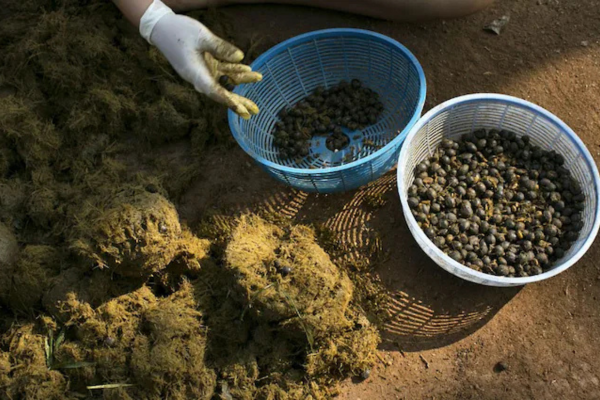
After the beans are passed, mahouts and local teams collect elephant dung and manually recover intact coffee seeds. This is labour-intensive: many cherries are destroyed (chewed or fragmented) or lost, so yield is very low — a key factor in the coffee’s high price.
4. Washing, drying and processing
Recovered seeds are thoroughly washed, sun-dried and processed using standard specialty-coffee techniques (sorting, hulling, additional drying, sometimes resting) before being roasted. Final roasting profiles are tuned to highlight the unique, softened flavor profile claimed by the producers.
Taste profile and sensory notes
Tasters commonly describe Black Ivory as remarkably smooth, with very low bitterness and a delicate, honeyed or floral note that lets subtle chocolaty and fruity flavors come forward. Because the coffee is small-batch and hand-processed, flavor can vary by vintage and roast, but the dominant theme in reviews is a mellow, refined cup rather than aggressive acidity or heavy roast character. Blind tasting and sensory analysis are limited because of the coffee’s scarcity.
Rarity, price and availability
Because so many cherries are required to yield a kilogram of finished coffee (reports often cite figures like 30+ kg of cherries per 1 kg of finished product) and because many beans are destroyed in the process, production volumes remain tiny. Black Ivory has been reported and marketed as selling for upwards of US$2,000 per kilogram (retail pricing varies by packaging and point of sale), and luxury hotels that serve the coffee may charge dozens of dollars for a single cup experience. The company publishes annual allocation numbers that underline the scarcity.
Conservation, community and controversy
The brand’s conservation claims
Black Ivory positions itself as a coffee with a conscience: the project originally linked to an elephant refuge (Golden Triangle Asian Elephant Foundation) and the brand states that a portion of sales supports elephant healthcare, community incomes for mahout families, and rescued elephants. Company materials and some media pieces emphasize the positive socio-economic effects for rural communities.
Ethical and animal welfare concerns
Animal-processed specialty coffees invite scrutiny. Concerns fall into a few categories:
-
Animal welfare: Critics ask whether animals are exploited, how their diets are managed, and whether production compromises normal behavior. Independent reporting and veterinary checks cited by the company assert that the process is non-harmful and that caffeine is not absorbed by the elephants; still, some observers remain skeptical and call for transparency and independent audits.
-
Authenticity and fraud: As with kopi luwak, the rarity of Black Ivory encourages fraudulent or misleading products in the market; sourcing transparency and chain-of-custody are important for buyers who want genuine elephant-processed beans.
Where to try Black Ivory Coffee
Black Ivory is typically sold in very small packages through the brand’s webshop and is sometimes served as a novelty cup in select luxury hotels and resorts (many in Asia and the Maldives have historically offered it as an experience). Because allocations are limited, it’s not available in normal retail channels. Always verify provenance when you buy — ask the seller for batch information and certification of origin.
Is Black Ivory Coffee “worth it”?
-
For curiosity and once-in-a-lifetime experiences: Many buyers treat Black Ivory as a luxury curiosity or a gift item — the experience and story are part of the value.
-
For regular coffee drinkers or ethical purists: The steep price and the ethical questions make it a poor candidate for everyday drinking. Many specialty-coffee lovers prefer traceable single-origin lots with transparent farming and processing practices.
FAQs
Q: Is Black Ivory the same as kopi luwak?
A: Conceptually similar (both involve animal digestion), but kopi luwak uses civets while Black Ivory uses elephants; processing, scale and flavor differ.
Q: Does the elephant absorb caffeine?
A: According to veterinary testing cited by the producer, elephants do not absorb caffeine from the cherries in amounts that affect their health. Independent research on long-term effects is limited.
Q: How much coffee does one elephant produce?
A: Output per elephant is very small; production depends on how many cherries they eat, intact bean recovery rates, and local conditions — which is why total annual allocations are tiny.
Final thoughts — story, taste and responsibility
Black Ivory Coffee is a striking example of how novelty, rarity and storytelling converge in the luxury-food market. Its history — the long development work, the link to an elephant refuge, and the careful small-batch processing — makes for a fascinating origin story. If you’re tempted to try it, do so with curiosity and an eye for provenance: ask questions about animal welfare, how revenue supports local communities, and whether the product you’re buying is authentic. For many, the best part of the Black Ivory experience is its story — and the reminder that extraordinary foods often come with complex ethical choices.

How to Brew Black Ivory Coffee
Learn how to brew Black Ivory Coffee—the ultra-rare Thai coffee with a silky, chocolatey profile. This step-by-step guide covers preparation, grinding, brewing methods (pour-over, French press, espresso), tasting tips, storage, and ethical considerations.
Black Ivory Coffee is one of the world’s rarest and most expensive coffees. Grown in northern Thailand and processed through a unique method involving elephants, it yields a smooth, low-acidity cup with notes of dark chocolate, tamarind, and floral sweetness. Because these beans are so precious, brewing Black Ivory Coffee deserves care and attention. This SEO-friendly guide walks you through everything you need to know to get the most from each precious gram — from preparation and grind to recommended brewing methods and serving tips.
Why Black Ivory Coffee is special
Before brewing, it helps to understand why Black Ivory is different. The beans are carefully selected Arabica cherries that pass through an elephant’s digestive system. Enzymatic fermentation in the gut alters proteins that cause bitterness, producing a cup that is exceptionally smooth and nuanced. Because production yields are tiny, you’ll pay a premium — which makes careful, respectful brewing all the more important.
Primary keywords: Black Ivory Coffee, brew Black Ivory, how to brew rare coffee.
What you’ll need
-
Freshly roasted Black Ivory Coffee beans (buy from reputable seller)
-
Burr grinder (conical or flat burr)
-
Digital scale (accuracy to 0.1 g recommended)
-
Kettle (gooseneck for pour-over preferred)
-
Filter and dripper (V60, Kalita Wave, Chemex) or French press or espresso machine
-
Timer and thermometer (or kettle with temperature control)
-
Clean, filtered water (important — water quality drastically affects taste)
Preparing the beans
-
Buy small, fresh quantities. Because Black Ivory is rare and expensive, buy only the amount you’ll use in a week or two to ensure freshness.
-
Store correctly. Keep beans in an airtight container away from light, heat, and moisture. Avoid the fridge or freezer for daily use; instead, store at cool room temperature in a dark cabinet.
-
Weigh the beans. For precision brewing, use a scale. A good starting ratio for pour-over or drip is 1:15 to 1:17 (coffee:water by weight). For example, 15 g of coffee to 225–255 g of water. For French press, try 1:12 to 1:14.
Grind size recommendations
-
Pour-over (V60, Chemex, Kalita Wave): Medium-fine to medium (slightly coarser than table salt).
-
French press: Coarse, similar to breadcrumbs.
-
Espresso: Fine—use an espresso grinder and dial in the dose and extraction time carefully.
Because Black Ivory’s flavor is delicate, avoid overly fine grinds for immersion methods that can over-extract and introduce bitterness.
Water and temperature
Water quality matters more than almost any other variable. Use filtered water with a neutral pH and mineral content. Aim for 195°F–205°F (90°C–96°C) for most brewing methods. If you don’t have a thermometer, bring water to a boil and let it rest 30 seconds before pouring.
Brewing methods — step-by-step
Pour-over (recommended for clarity and control)
-
Rinse filter with hot water to remove paper taste and preheat the brewer and cup. Discard rinse water.
-
Add ground coffee: Use 15–18 g for 225–260 g water (1:15–1:16 ratio).
-
Bloom: Pour just enough water to saturate the grounds (about twice the coffee weight). Let bloom for 30–45 seconds to release trapped gases.
-
Continue pouring in slow, circular motions until you reach the target water weight. Total brew time should be 2:30–3:30 minutes for a V60; Chemex may be slightly longer.
-
Taste and adjust: If the cup tastes sour, increase brew temperature or grind finer. If it’s bitter, try a coarser grind or shorter brew time.
French press (for a fuller body)
-
Add coarse grounds to the press (example: 30 g coffee to 450 g water for a 1:15 ratio).
-
Pour hot water up to the desired level and stir gently to ensure all grounds are wet.
-
Steep for 3:30–4:30 minutes (experiment within this range).
-
Press and serve immediately to avoid over-extraction. Decant to a server if not drinking right away.
Espresso (for concentrated intensity)
Because of the unique flavor profile, Black Ivory can make an interesting espresso shot, though many aficionados prefer pour-over to experience subtle notes.
-
Dose about 16–18 g for a double shot.
-
Tamp evenly and extract for 25–35 seconds aiming for about 30–40 g of liquid output (adjust to taste).
-
Serve as a straight shot or use in milk-based drinks where the chocolate notes can pair beautifully with steamed milk.
Tasting notes and serving suggestions
Black Ivory’s cup tends toward rich chocolate, ripe fruit, caramel, and floral aromatics with low bitterness and gentle acidity. Serve it black to appreciate these nuances. If you do add milk or sugar, use them sparingly — they can mask the coffee’s delicate qualities.
Pairings: Dark chocolate, shortbread, light citrus pastries, or fruit-forward desserts complement the coffee’s profile.
Adjusting variables for your ideal cup
Because this coffee is so rare, dial in each parameter with small adjustments:
-
If too sour: raise water temp, grind finer, or increase brew time.
-
If too bitter: use slightly coarser grind, reduce brew time or lower water temp.
-
If flat or dull: try fresher beans or adjust ratio to use slightly more coffee.
Ethical considerations and cost
Black Ivory Coffee’s production involves animals, so ethical sourcing and animal welfare are key concerns. Purchase only from reputable suppliers who prioritize elephant welfare and transparency. Be aware of the high cost — savor small, mindful servings rather than everyday consumption.
Common mistakes to avoid
-
Using bad water: Tap water with heavy chlorine or impurities will ruin the cup.
-
Over-grinding for immersion: This produces bitterness. Match grind size to brewing method.
-
Letting brewed coffee sit: It deteriorates quickly; serve immediately.
-
Overheating or boiling water: Scorching water can burn delicate flavors.
Final tips
-
Use a scale and timer — precision matters more than guesswork.
-
Experiment in small steps — change one variable at a time so you can taste the effect.
-
Serve in warmed cups to preserve aroma.
-
Savor mindfully — with a coffee this rare, brewing is part ritual, part science.
Black Ivory Coffee is an indulgence and a curiosity, prized for its silky texture and muted bitterness. Brewing it properly honors the beans, the animals involved in its production, and your palate. Whether you choose pour-over for clarity, French press for body, or espresso for intensity, follow the principles above: use fresh beans, clean water, precise ratios, and method-appropriate grind sizes. Small adjustments will help you discover the cup that feels perfect to you — and because every sip is valuable, you’ll want each one to be exceptional.