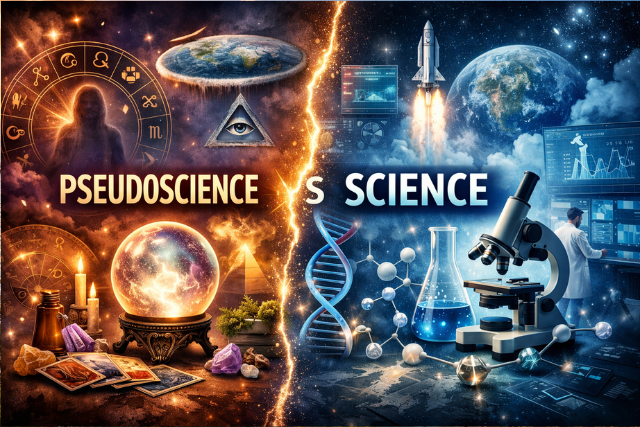
Pseudoscience Meaning, Uses, and Its Impact on Humanity
Introduction
In the modern world, science plays a central role in shaping technology, medicine, education, and public policy. However, alongside real science exists another category of ideas and practices that appear scientific on the surface but lack genuine scientific credibility. This phenomenon is known as pseudoscience. Understanding what pseudoscience is, where it is used, and whether it benefits or harms humanity is essential in an age of rapid information sharing, social media influence, and digital misinformation.
This article explains pseudoscience in simple terms, explores why people believe in it, identifies where it is commonly found, and evaluates its overall impact on society.
What Is Pseudoscience?
Pseudoscience refers to beliefs, theories, methods, or practices that claim to be scientific but do not follow the scientific method. These ideas often rely on personal testimonies, selective evidence, emotional appeal, or outdated concepts rather than systematic experimentation, peer review, and reproducible results.
The word pseudoscience comes from two parts:
-
“Pseudo” meaning false or misleading
-
“Science” involves the careful organization of knowledge that is supported by data and experimental analysis.
In simple terms, pseudoscience imitates science without meeting its standards.
Key Characteristics of Pseudoscience
Pseudoscience usually shares one or more of the following traits:
-
Lack of testable or falsifiable claims
-
No peer-reviewed research support
-
Heavy reliance on anecdotes and personal experiences
-
Resistance to criticism or new evidence
-
Use of scientific-sounding language without real data
-
Claims of secret knowledge rejected by “mainstream science”
Unlike real science, pseudoscience does not change when proven wrong.
How Is Pseudoscience Different from Real Science?
| Real Science | Pseudoscience |
|---|---|
| Uses experiments and data | Uses stories and beliefs |
| Can be tested and disproven | Cannot be reliably tested |
| Open to correction | Rejects criticism |
| Peer-reviewed | Avoids expert review |
| Evolves with evidence | Stays fixed |
Science welcomes doubt; pseudoscience avoids it.
Where Is Pseudoscience Commonly Used?
Pseudoscience can appear in many areas of everyday life. Below is a list of the most common fields where pseudoscientific ideas are found.
1. Medicine and Health
This is one of the most sensitive and dangerous areas.
Examples include:
-
Miracle cures with no clinical trials
-
Detox products claiming to “cleanse toxins”
-
Energy healing without biological evidence
-
Anti-vaccine misinformation
People often turn to pseudoscientific medicine due to fear, chronic illness, or distrust in healthcare systems.
2. Astrology and Horoscopes
Astrology claims that planetary positions influence personality and future events.
Common examples:
-
Daily horoscopes
-
Zodiac compatibility charts
-
Astrology-based life decisions
Despite popularity, astrology lacks scientific evidence and predictive accuracy.
3. Paranormal and Supernatural Beliefs
This category includes claims that cannot be scientifically verified.
Examples:
-
Ghost hunting devices
-
Telepathy and mind reading
-
Psychic predictions
-
Communication with spirits
These ideas often rely on emotional experiences rather than measurable proof.
4. Pseudoscientific Psychology
Some self-help and personality theories claim scientific authority without validation.
Examples:
-
Personality types with no empirical basis
-
Memory recovery techniques without evidence
-
Brain dominance myths (left-brain/right-brain personalities)
Such ideas can mislead people about mental health and behavior.
5. Pseudoscience in Education
In some cases, unproven theories are presented as facts.
Examples:
-
Learning styles myths
-
Intelligence fixed at birth claims
-
Teaching methods unsupported by research
This can harm students by limiting potential and critical thinking.
6. Conspiracy Theories
Many conspiracy theories use pseudoscientific language to appear credible.
Examples:
-
Flat Earth theory
-
Climate change denial
-
Fake moon landing claims
These ideas often reject large bodies of scientific evidence.
7. Alternative Technologies
Some inventions promise revolutionary results without validation.
Examples:
-
Free energy machines
-
Perpetual motion devices
-
Anti-gravity claims
Such technologies violate established physical laws.
Why Is Pseudoscience Used?
Understanding why pseudoscience exists helps explain its persistence.
1. Emotional Comfort
Pseudoscience often provides simple answers to complex problems, offering comfort in uncertain situations such as illness or loss.
2. Fear and Hope
When people feel desperate, they may accept unproven solutions that promise quick results.
3. Lack of Scientific Literacy
Limited understanding of how science works makes it easier to confuse pseudoscience with real research.
4. Mistrust in Institutions
Distrust in governments, pharmaceutical companies, or academic institutions pushes some individuals toward alternative explanations.
5. Financial Gain
Some individuals and companies profit by selling pseudoscientific products, courses, or therapies.
6. Cultural and Traditional Beliefs
Certain pseudoscientific ideas are deeply rooted in traditions and passed down through generations.
Is Pseudoscience Good or Bad for Humanity?
The impact of pseudoscience is complex. It has both minor benefits and serious risks.
Potential Benefits of Pseudoscience
While pseudoscience is not scientifically valid, it can sometimes produce indirect positive effects.
1. Psychological Placebo Effect
Belief alone can improve mood or reduce perceived pain in some cases.
2. Encourages Curiosity
Some people start with pseudoscience and later develop an interest in real science.
3. Cultural Expression
Certain pseudoscientific beliefs serve as cultural or spiritual traditions rather than factual claims.
Dangers and Negative Effects of Pseudoscience
The risks of pseudoscience far outweigh its benefits.
1. Health Risks
Rejecting evidence-based medicine can lead to serious illness or death.
2. Spread of Misinformation
False scientific claims spread quickly online and are difficult to correct.
3. Financial Exploitation
People may lose money on fake treatments, devices, or courses.
4. Damage to Scientific Progress
Pseudoscience can slow innovation by confusing public understanding of real research.
5. Poor Decision-Making
Policies influenced by pseudoscientific beliefs can harm education, health, and the environment.
How to Identify Pseudoscience: A Practical List
Use the checklist below to spot pseudoscientific claims:
-
Claims of “ancient secrets” or “hidden truths”
-
No credible scientific sources cited
-
Overuse of buzzwords like “quantum,” “energy,” or “frequency”
-
Claims that cannot be tested
-
Attacks on scientists instead of addressing evidence
-
Promises of guaranteed results
-
“Too good to be true” solutions
If a claim avoids testing, it is likely pseudoscience.
The Role of Media and Social Networks
Social media platforms have significantly increased the spread of pseudoscience. Algorithms often promote emotionally engaging content rather than accurate information. Influencers without scientific backgrounds may present opinions as facts, further confusing audiences.
Critical thinking and media literacy are essential tools for modern society.
How Humanity Can Reduce the Harm of Pseudoscience
1. Improve Science Education
Teaching how science works is more important than memorizing facts.
2. Promote Critical Thinking
People should be encouraged to question claims respectfully and logically.
3. Support Reliable Sources
Trust information from peer-reviewed journals, universities, and recognized institutions.
4. Encourage Open Dialogue
Dismissing believers aggressively can strengthen pseudoscientific thinking. Calm discussion is more effective.
Pseudoscience is not simply “fake science”—it is a powerful social phenomenon shaped by fear, hope, culture, and misinformation. While it may offer comfort or entertainment, its long-term impact on humanity is largely negative when it replaces evidence-based thinking.
In a world facing global challenges such as climate change, pandemics, and technological transformation, scientific literacy is essential. Distinguishing real science from pseudoscience protects not only individual well-being but also the future of humanity.
By promoting education, skepticism, and curiosity grounded in evidence, society can reduce the influence of pseudoscience and strengthen trust in real scientific progress.
Disclaimer:
This content is intended solely for educational and informational purposes. It does not aim to disrespect, criticize, or harm any religion, religious belief, community, caste, culture, or individual from any part of the world. All topics are discussed in a neutral and respectful manner, focusing on general concepts rather than personal or faith-based beliefs. Any interpretations are unintentional and should not be viewed as offensive or discriminatory.