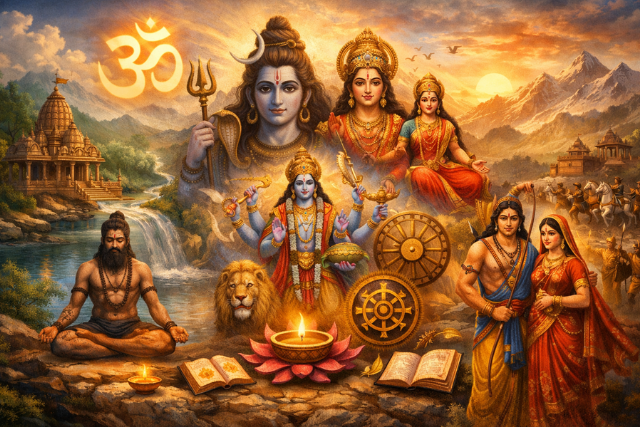
What Is Hinduism? Types, History, and Countries Where Hinduism Is Practiced
Introduction to Hinduism
Hinduism stands as an ancient and deeply layered spiritual tradition, shaped over thousands of years and known for its wide range of beliefs and practices. Rather than being founded by a single individual or originating from one historical event, Hinduism developed gradually over thousands of years. It is a rich spiritual system that includes philosophy, rituals, moral values, meditation practices, festivals, and ways of life. Today, Hinduism influences the daily lives, cultural traditions, and spiritual outlook of more than a billion people across the globe.
Unlike many religions that are based on a fixed set of beliefs, Hinduism is flexible and diverse. It allows followers to choose different spiritual paths based on their understanding, temperament, and personal faith. Because of this diversity, Hinduism is often described as both a religion and a way of living.
What Is Hinduism?
Hinduism is a spiritual and philosophical tradition that focuses on understanding the nature of reality, the self, and the universe. At its core, Hinduism teaches that all living beings are connected through a universal spiritual essence often referred to as Brahman, the ultimate reality. The individual soul, known as Atman, is believed to be part of this universal truth.
Hinduism emphasizes dharma (righteous living), karma (the law of cause and effect), samsara (the cycle of birth, death, and rebirth), and moksha (liberation from the cycle of rebirth). These concepts guide ethical behavior, spiritual growth, and personal responsibility.
There is no single religious authority in Hinduism. Instead, spiritual knowledge is passed down through ancient texts, teachers, and traditions. Worship may involve prayers, meditation, yoga, rituals, temple visits, or quiet self-reflection, depending on the individual.
Key Beliefs of Hinduism
Hinduism includes a wide range of beliefs, but some core ideas are shared by most followers:
-
Belief in Karma: Every action has consequences that shape one’s present and future lives.
-
Reincarnation: The soul is reborn multiple times until it achieves spiritual liberation.
-
Moksha: The ultimate goal is freedom from rebirth and union with the divine.
-
Dharma: Moral duty and ethical living are essential for spiritual progress.
-
Unity of Existence: All life forms are interconnected and sacred.
These principles create a spiritual framework that encourages compassion, self-discipline, and inner awareness.
Sacred Texts of Hinduism
Hinduism has a vast collection of sacred literature written over many centuries. These texts are not all followed in the same way but together form the foundation of Hindu philosophy and practice.
Some of the most important Hindu texts include:
-
The Vedas: Ancient hymns and rituals that form the earliest spiritual records.
-
The Upanishads: Philosophical writings exploring the nature of reality and the soul.
-
The Bhagavad Gita: A spiritual dialogue that teaches devotion, duty, and selfless action.
-
The Ramayana and the Mahabharata: are ancient epic stories that explore ethical values, human duties, and profound spiritual insights through their narratives.
These texts address topics such as devotion, knowledge, meditation, ethics, and the purpose of life.
History of Hinduism
Ancient Origins
The roots of Hinduism can be traced back more than 4,000 years to the Indian subcontinent. Early forms of Hindu thought emerged alongside ancient civilizations that practiced rituals, nature worship, and meditation. Over time, spiritual ideas evolved through oral traditions before being written down in sacred texts.
Vedic Period
During the Vedic period, religious practices focused on rituals, hymns, and offerings. This era laid the foundation for concepts such as karma, cosmic order, and divine forces. Priests played a central role in preserving spiritual knowledge through memorization and recitation.
Philosophical Development
Later periods saw a shift from ritual-centered worship to deeper philosophical inquiry. Thinkers explored questions about existence, consciousness, and liberation. This phase gave rise to diverse schools of thought, including meditation, devotion, and self-knowledge as paths to spiritual freedom.
Medieval and Classical Era
During the medieval era, devotional movements gained popularity. People began worshipping personal deities with love and dedication, making spirituality accessible to all social groups. Temples, festivals, music, and poetry flourished during this time.
Modern Period
In the modern era, Hinduism adapted to social changes, colonial influence, and global interaction. Reformers emphasized ethical living, education, and universal spirituality. Today, Hinduism continues to evolve while preserving its ancient wisdom.
How Many Types of Hinduism Are There?
Hinduism does not have rigid divisions, but it includes several major traditions or paths. These are not separate religions but different ways of understanding and practicing the same spiritual truth.
1. Shaivism
Shaivism centers on the worship of Lord Shiva, who represents transformation and inner awareness. Followers believe Shiva is the supreme reality and focus on meditation, self-discipline, and spiritual knowledge.
2. Vaishnavism
Vaishnavism focuses on Lord Vishnu and his incarnations, especially Rama and Krishna. Devotion, love, and surrender to God are central to this tradition. It is one of the largest Hindu paths worldwide.
3. Shaktism
Shaktism emphasizes the worship of the Divine Mother or feminine energy known as Shakti. This tradition highlights creative power, protection, and compassion as expressions of the divine.
4. Smartism
Smartism promotes the idea that different deities are manifestations of the same ultimate reality. Followers choose one or more forms of God while recognizing unity behind all divine expressions.
Spiritual Paths in Hinduism
Hinduism allows individuals to follow different spiritual approaches based on their nature:
-
Bhakti Yoga: A spiritual way focused on heartfelt devotion, faith, and deep love for the divine.
-
Karma Yoga: A disciplined approach that emphasizes performing one’s duties with sincerity, without expecting personal rewards.
-
Jnana Yoga: The path of knowledge and self-inquiry.
-
Raja Yoga: A meditative path centered on controlling the mind, developing inner awareness, and achieving mental balance.
These paths provide flexibility and inclusivity, making Hinduism adaptable to diverse personalities.
Festivals and Cultural Influence
Hinduism is closely connected with vibrant festivals that celebrate spiritual values, seasonal changes, and historical events. Festivals often involve prayers, fasting, music, dance, and community gatherings. They reinforce cultural identity and spiritual awareness.
Hindu values have influenced art, architecture, literature, music, yoga, Ayurveda, and meditation practices that are now recognized worldwide.
Countries Where Hinduism Is Practiced
Hinduism originated in South Asia but is now practiced across many regions due to migration and cultural exchange. Below is a list of countries where Hinduism has a significant presence:
Major Hindu Population Countries
1. India – The largest Hindu population in the world
2. Nepal – Hinduism is the dominant religion
3. Bangladesh – Significant Hindu minority
4. Sri Lanka – Practiced mainly by Tamil communities
Southeast Asia
5. Indonesia – Notably on the island of Bali
6. Malaysia – Practiced mainly by Indian-origin communities
7. Thailand – Hindu traditions influence culture and rituals
Other Asian Countries
8. Pakistan – Hindu minorities present
9. Bhutan – Hinduism coexists with Buddhism
Western and Global Countries
10. United States
11. Canada
12. United Kingdom
13. Australia
14. South Africa
15. Mauritius
16. Fiji
17. Trinidad and Tobago
In these countries, Hindu communities actively maintain temples, festivals, and cultural traditions.
Hinduism in the Modern World
Today, Hinduism continues to thrive as both a traditional faith and a modern spiritual philosophy. Practices like yoga and meditation have gained global popularity for their physical and mental benefits. Hindu ideas about harmony, tolerance, and respect for all life resonate strongly in a world seeking balance and peace.
Hinduism encourages dialogue rather than division, personal growth rather than rigid belief, and unity rather than exclusion.
Hinduism is a timeless spiritual tradition that offers profound insights into life, consciousness, and the universe. With its ancient roots, diverse practices, and inclusive philosophy, Hinduism remains relevant in the modern age. It is not limited to one belief system or region but represents a living tradition that continues to guide millions toward ethical living and spiritual awareness.
By understanding what Hinduism is, its types, its long history, and the countries where it is practiced, we gain insight into one of humanity’s most influential and enduring spiritual paths.