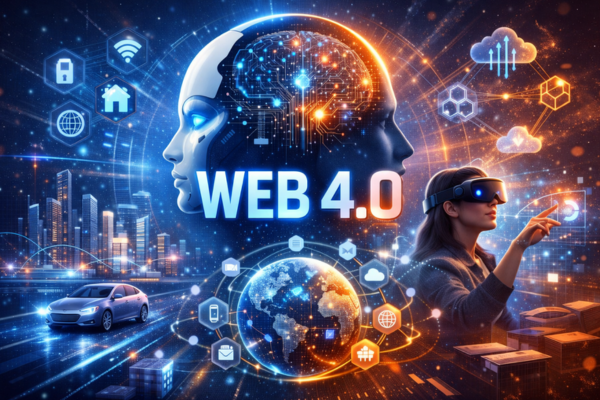
What is Web 4.0? A Complete Guide to the Next Generation of the Internet
The digital world is advancing faster than ever before. From static web pages to intelligent systems and immersive experiences, each phase of the web has transformed how we live, work, connect, and innovate. Now, as we stand on the edge of a new digital era, the term Web 4.0 is gaining momentum among developers, futurists, business leaders, and technologists. But what exactly is Web 4.0? When will it be available? And who is expected to launch it first?
Table of Contents
1. What Is Web 4.0?
2. How Web 4.0 Differs from Web 1.0, 2.0, and 3.0
3. Core Technologies Behind Web 4.0
4. Key Features of Web 4.0
5. Why Web 4.0 Matters for Businesses and Consumers
6. When Will Web 4.0 Be Available?
7. Who Will Launch Web 4.0 First?
8. Challenges and Considerations for Web 4.0
9. The Future of Web 4.0
10. Conclusion
1. What Is Web 4.0?
Web 4.0 is the next evolutionary phase of the internet — a new era where online systems become deeply intelligent, contextually aware, autonomous, and highly integrated with human life.
Instead of merely connecting people and content, Web 4.0 aims to:
-
Understand intent and human perspective,
-
Predict needs before they are stated,
-
Blend physical and digital realities,
-
And enable seamless interactions across devices, platforms, and environments.
In essence, Web 4.0 represents a shift from connected data to connected intelligence.
This means the internet will no longer be just a space for information and social interaction, but an ecosystem that learns, adapts, and collaborates with users — much like a digital partner or assistant.
At its core, Web 4.0 focuses on:
Artificial intelligence (AI) and machine reasoning
Natural language understanding
Ubiquitous computing and immersive interfaces
Human-centric design and context awareness
As a result, users will experience online interactions that feel intuitive, personalized, and predictive.
2. How Web 4.0 Differs from Web 1.0, 2.0, and 3.0
To fully grasp Web 4.0, it helps to review the evolution of the internet:
Web 1.0 — The Static Web (1989–2004)
-
Mostly read-only web pages
-
Limited user interaction
-
Simple HTML sites, basic content delivery
This was the beginning of the internet — useful for information but not interactive.
Web 2.0 — The Social Web (2004–2020)
-
User-generated content
-
Interactive platforms (social media, blogs, forums)
-
Collaboration and sharing
Web 2.0 transformed users from passive consumers to active creators.
Web 3.0 — The Semantic and Decentralized Web (2020–Present)
-
AI-based personalization
-
Decentralized platforms (blockchain, crypto, NFTs)
-
Trustless interactions, digital ownership
Web 3.0 makes online experiences smarter and more autonomous — with a focus on user ownership.
Web 4.0 — The Intelligent and Immersive Web (Future)
Web 4.0 goes beyond decentralization and personalization. It combines:
-
Advanced artificial intelligence
-
Deep semantic reasoning
-
Immersive technologies like AR/VR
-
Ubiquitous connectivity (IoT, edge computing)
-
Human-machine symbiosis
In essence, Web 4.0 moves past being smart to becoming perceptive.
3. Core Technologies Behind Web 4.0
Web 4.0 will be powered by a suite of emerging technologies working together:
Artificial Intelligence (AI) and Machine Learning
AI will not just power recommendations — it will understand context, emotions, and intent. Systems will learn continuously from behavior, environment, and real-time changes.
Semantic Computing
Where Web 3.0 focused on semantics, Web 4.0 will deeply interpret meaning and relationships. This will enable machines to truly understand human language and context.
Internet of Things (IoT)
Web 4.0 will connect billions of smart devices — cars, sensors, wearables, appliances — creating a web that spans physical and digital worlds.
Edge Computing
Instead of central servers, computing will be distributed to the edge — closer to users — for speed, privacy, and responsiveness.
Augmented and Virtual Reality (AR/VR)
AR/VR will bring the web to life. Users may “visit” virtual storefronts, attend hybrid conferences, or collaborate in digital workspaces.
Neuro-Computing and Brain-Computer Interfaces (BCI) (Future Potential)
Some experts predict systems that interpret neural signals — potentially blurring the line between thought and action online.
4. Key Features of Web 4.0
Here’s what Web 4.0 may bring to the internet experience:
1. Predictive Understanding
Web 4.0 systems won’t just respond — they will anticipate. For example:
-
Your digital assistant might schedule your day before you ask.
-
Your health app might detect early warning signs before symptoms appear.
2. Seamless Integration Across Life
From your car to your fridge to your workspace, the web will be embedded in everything.
3. Intelligent Virtual Agents
Bots won’t be simple chat helpers — they will be collaborators capable of reasoning, negotiation, and proactive assistance.
4. Immersive Digital Spaces
Websites will evolve into shared virtual environments — social hubs, stores, classrooms, and offices.
5. Enhanced Privacy and Identity Control
With decentralized identity systems and secure protocols, users will control their digital presence better than ever.
6. Context Awareness
Web 4.0 systems will sense location, preferences, emotional state, and environment to deliver personalized experiences.
5. Why Web 4.0 Matters for Businesses and Consumers
Web 4.0 presents a paradigm shift with massive opportunities:
For Businesses
-
Personalized marketing at scale: Real-time intent prediction means delivering the right message at the right moment.
-
Smarter automation: Operations become adaptive and efficient.
-
New revenue streams: Immersive commerce, virtual services, and intelligent ecosystems.
For Consumers
-
Better user experiences: Frictionless, intuitive, and personalized interactions.
-
Enhanced convenience: Tasks that today require effort could be automated entirely.
-
Greater control of data: With decentralized identity systems, data ownership may shift back to individuals.
6. When Will Web 4.0 Be Available?
Many experts estimate that Web 4.0 will emerge between 2030 and 2040 — but availability is gradual, not instantaneous.
Why?
Because Web 4.0 is not a single product or platform — it’s a convergence of technologies. Full adoption requires:
– Widespread AI advancements
– Edge computing infrastructure
– Immersive hardware (AR/VR, wearables)
– Standardized protocols
– Regulatory frameworks for privacy and safety
Already, elements of Web 4.0 are emerging:
-
AI assistants are becoming more intelligent.
-
Smart home ecosystems are growing.
-
AR/VR experiences are entering mainstream markets.
-
Edge computing is expanding with 5G networks.
However, the complete Web 4.0 ecosystem — where all these systems seamlessly interact — will likely take the next decade to mature.
7. Who Will Launch Web 4.0 First?
There’s no single company or organization that will “launch” Web 4.0 in one moment — it will be an evolutionary rollout across platforms and devices.
That said, certain entities are well positioned to drive early adoption:
Tech Giants
Companies like:
-
Google
-
Microsoft
-
Apple
-
Meta
-
Amazon
…already have vast data, AI infrastructure, and user ecosystems. They are investing heavily in AI, AR/VR, and connected platforms — all key pillars of Web 4.0.
Blockchain / Decentralized Platforms
Decentralized networks will play a role in:
-
Digital identity systems
-
Secure transactions
-
Data ownership
Organizations focused on decentralized protocols may pioneer key Web 4.0 elements.
Telecom and Connectivity Leaders
With the rollout of 5G and future 6G networks, global connectivity becomes faster, more reliable, and capable of real-time intelligence — essential for Web 4.0 experiences.
Hardware Innovators
AR glasses, brain-computer interfaces, wearable sensors, and next-generation devices from innovators will define how users experience Web 4.0.
In short, Web 4.0 won’t be launched by one entity — it will be built collectively by a network of companies, standards bodies, developers, and innovators.
8. Challenges and Considerations for Web 4.0
Web 4.0 promises a revolutionary shift, but it also raises important questions:
Data Privacy and Security
As systems become more intelligent and context-aware, protecting sensitive information becomes critical.
➡ How can users verify that AI predictions are safe and ethical?
➡ Who controls personal data in a deeply interconnected web?
Ethical Use of AI
Advanced AI must be developed responsibly:
-
Avoiding bias
-
Preventing misuse
-
Ensuring transparency
Infrastructure and Access
Not all regions have equal access to high-speed networks, immersive hardware, or edge computing. This could widen the digital divide.
Regulation and Governance
Laws and norms will need to evolve to address:
-
Digital identities
-
Autonomous decision systems
-
Virtual economic ecosystems
Addressing these challenges is not optional — it’s essential for a healthy and equitable Web 4.0 future.
9. The Future of Web 4.0: What to Expect
By the 2030s and 2040s, Web 4.0 could reshape industries and day-to-day life:
Healthcare
Personal health systems that monitor, predict, and assist in real time.
Education
Immersive classrooms where learning becomes interactive and adaptive.
Work
Virtual workspaces that feel physical — breaking geographical barriers.
Commerce
Stores that understand buyer intent and deliver customized experiences instantly.
Entertainment
Virtual worlds that evolve with user decisions, emotions, and interactions.
Every industry will be touched by Web 4.0 — and not just digitally, but in deeply human ways.
10. Conclusion
Web 4.0 represents the next giant leap in internet evolution — from networks that connect information to ecosystems that understand and assist human experiences.
It promises:
Intelligent and predictive systems
Immersive, human-centric interactions
Seamless integration of physical and digital worlds
New opportunities for business and innovation
While there’s no exact launch date, Web 4.0 is expected to grow into reality between 2030 and 2040. Rather than a single event, it will unfold gradually as technologies mature and users embrace new ways of interacting with the web.
No single company will “release” Web 4.0. Instead, global innovators — from AI labs and hardware makers to decentralized platforms and connectivity leaders — will collaboratively shape this future.
As we move toward Web 4.0, one thing is clear:
The internet will become not just a tool — but a partner in human life.
Whether you’re a business owner, developer, marketer, learner, or everyday user, understanding Web 4.0 now will help you thrive in this next digital era.