Which 5G Companies Are Banned in the World? (Updated 2025)
The fifth generation of mobile networks—5G—has transformed the global communications landscape. Offering lightning-fast internet speeds, ultra-low latency, and massive connectivity, 5G is the backbone of future innovations such as autonomous vehicles, smart cities, and advanced robotics.
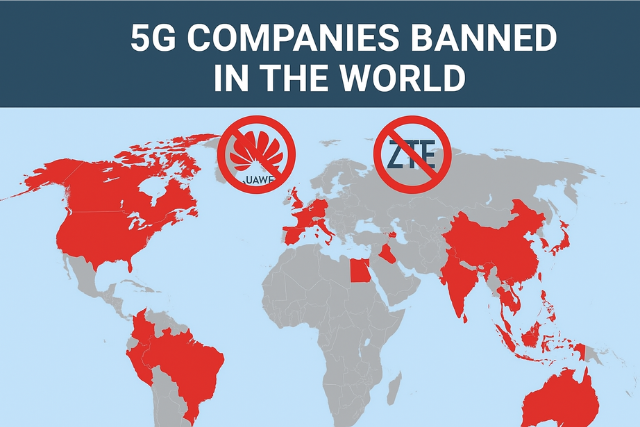
However, the global rollout of 5G has not been smooth. Political tensions, national security concerns, and trade wars have led many governments to ban or restrict certain 5G companies from operating within their borders. These bans have primarily targeted Chinese technology giants, although the reasons and scope vary from country to country.
In this article, we’ll explore which 5G companies are banned around the world, the reasons behind these bans, and how these decisions have shaped the international telecommunications landscape in 2025.
1. Understanding Why Some 5G Companies Are Banned
Before diving into the specific companies, it’s important to understand why these bans exist. The most common reasons governments cite include:
a. National Security Concerns
Many governments worry that 5G equipment supplied by foreign vendors could be used for espionage or cyberattacks. Since 5G connects everything—from homes to critical infrastructure—it’s seen as a potential security risk if controlled by companies linked to rival nations.
b. Data Privacy Issues
5G networks carry huge volumes of data. Concerns have arisen that certain equipment providers might allow unauthorized access to sensitive user data or national information.
c. Political and Trade Conflicts
Some bans are politically motivated, especially during times of economic or technological rivalry. For instance, the U.S.-China trade war heavily influenced 5G vendor restrictions worldwide.
d. Protecting Domestic Industries
A few countries prefer to promote local 5G manufacturers and telecom firms instead of depending on foreign suppliers, using bans as part of their industrial policy.
2. Major 5G Companies That Faced Bans Worldwide
Let’s look at the main companies that have faced bans, restrictions, or severe limitations on their 5G equipment.
1. Huawei Technologies Co., Ltd. (China)
Huawei, one of the world’s largest telecommunications equipment manufacturers, has been at the center of the global 5G controversy.
Why Huawei Was Banned
-
Governments in countries like the United States, the United Kingdom, Canada, and Australia allege that Huawei’s close ties with the Chinese government pose a national security threat.
-
They fear that Huawei could be compelled under Chinese law to assist with intelligence gathering, even though Huawei denies these claims.
Countries That Banned or Restricted Huawei
-
United States: Fully banned Huawei from participating in 5G infrastructure and prohibited U.S. companies from doing business with it.
-
United Kingdom: Ordered telecom operators to remove Huawei equipment from their 5G networks by 2027.
-
Canada: Announced a complete ban on Huawei in 2022.
-
Australia: Banned Huawei from providing 5G equipment as early as 2018.
-
New Zealand, Sweden, Japan, and India: Imposed either partial or full bans on Huawei 5G gear.
-
European Union: While not all EU countries banned Huawei, many—such as Germany, France, and Denmark—have introduced strict security rules that effectively limit its participation.
Impact
Huawei’s exclusion from several major markets slowed its global expansion but also motivated the company to focus on domestic Chinese 5G projects and emerging markets in Africa, Latin America, and the Middle East.
2. ZTE Corporation (China)
ZTE, another major Chinese telecom equipment provider, has faced similar scrutiny.
Why ZTE Was Banned
-
Accusations of violating U.S. sanctions on Iran and North Korea.
-
Alleged cybersecurity and espionage concerns similar to Huawei.
Countries That Restricted or Banned ZTE
-
United States: Banned ZTE from buying American components in 2018 (though the ban was temporarily lifted after fines and leadership changes).
-
Australia and Japan: Also prohibited ZTE from participating in 5G network builds.
-
India and several EU nations: Have limited ZTE’s involvement due to security concerns.
Impact
While ZTE remains active in several developing countries, its global reputation was damaged. It now mainly focuses on Asian, African, and Latin American markets, where regulatory pressure is lower.
3. China Mobile, China Telecom, and China Unicom
These state-owned Chinese telecom operators have also been restricted in some countries, mainly due to their government ownership and potential data security concerns.
Countries That Restricted Them
-
United States: Banned these companies from operating in the U.S. and delisted them from the New York Stock Exchange.
-
Canada and Australia: Imposed similar restrictions on partnerships and infrastructure access.
Impact
While these telecom companies still thrive in China, they have limited international operations in Western markets.
4. Russian 5G Companies
Since the start of the Russia-Ukraine conflict, several Russian technology and telecom companies have faced international sanctions that affect their participation in global 5G projects.
Key Companies Affected
-
Rostelecom and MTS have faced export restrictions from Western countries.
-
Western equipment providers like Nokia and Ericsson have withdrawn from Russia, halting 5G development there.
Reasons for Restrictions
-
Geopolitical tensions and international sanctions following the invasion of Ukraine.
-
Concerns over government surveillance and cyberwarfare capabilities.
5. Other Companies Facing Regional Restrictions
Although Chinese and Russian firms are the most frequently banned, other companies have also encountered partial restrictions depending on the region.
a. Ericsson (Sweden) and Nokia (Finland)
-
While not banned, both companies have faced limited market access in China in retaliation for Western bans on Huawei and ZTE.
-
The Chinese government allegedly reduced their 5G contract opportunities as part of a “reciprocal response.”
b. Smaller Vendors
In certain regions, lesser-known equipment suppliers have been blacklisted for failing to meet cybersecurity standards, though these cases are usually domestic and not political.
3. Countries Leading the 5G Bans
Let’s take a closer look at countries that have imposed the most significant 5G company bans worldwide.
United States
The U.S. government was the first to act against Huawei and ZTE, citing national security risks.
It passed the Secure and Trusted Communications Networks Act, which forbids U.S. telecom carriers from using Chinese-made equipment in 5G networks.
The Federal Communications Commission (FCC) also maintains a blacklist of banned entities, including Huawei, ZTE, Hytera, and Dahua.
United Kingdom
After initial hesitation, the U.K. decided to remove Huawei equipment from its 5G networks completely by 2027.
British authorities cited concerns over long-term dependency on Chinese suppliers and potential security vulnerabilities.
Australia
Australia became the first country to ban Huawei and ZTE from providing 5G technology back in 2018.
The government declared that suppliers “subject to extrajudicial directions from a foreign government” could not be trusted in critical infrastructure.
India
India initially allowed Chinese companies to participate in 5G trials but later excluded them.
The Indian government’s decision followed border tensions with China and fears over cybersecurity.
Now, India promotes homegrown 5G technologies from companies like Reliance Jio and Bharti Airtel using Nokia and Ericsson equipment.
Canada
After years of delay, Canada announced in 2022 that Huawei and ZTE would be banned from participating in 5G networks, aligning its policy with its allies in the Five Eyes intelligence alliance (U.S., U.K., Canada, Australia, and New Zealand).
Japan and South Korea
Japan has banned Huawei and ZTE from government contracts and encourages local and Western 5G suppliers.
South Korea has restricted Huawei’s participation in sensitive infrastructure but allows its use in limited, non-core parts of private networks.
European Union
The European Union has not imposed a collective ban, but several member states have taken independent actions.
Sweden, Denmark, and the Czech Republic have restricted Huawei and ZTE, while Germany introduced new laws requiring security certification for all 5G vendors.
4. Impact of 5G Bans on the Global Market
The bans have reshaped the global 5G ecosystem in several key ways:
a. Rise of Western and Asian Alternatives
Companies like Ericsson, Nokia, and Samsung have gained massive market share due to Huawei’s absence in Western markets.
b. Fragmentation of Global 5G Networks
Instead of one unified system, the world now has divided 5G ecosystems—one led by Western countries and another dominated by Chinese companies.
c. Acceleration of Domestic Innovation
Countries like India, Japan, and South Korea are investing heavily in domestic 5G technologies, aiming to reduce dependence on foreign suppliers.
d. Higher Deployment Costs
Banning major suppliers has increased the cost of 5G rollout in several countries, as alternative equipment tends to be more expensive.
5. The Future of 5G Regulations
As of 2025, global 5G restrictions are evolving.
Some countries are reassessing their bans, while others are tightening them further due to ongoing geopolitical rivalries.
Emerging discussions also include:
-
6G readiness and who will lead the next generation of mobile technology.
-
Supply chain diversification to prevent over-reliance on any single nation.
-
Cybersecurity certification frameworks to ensure transparency and safety regardless of vendor origin.
The rollout of 5G technology has been as much about politics as it has been about progress.
While 5G promises revolutionary connectivity, the bans on companies like Huawei, ZTE, and other state-linked telecom giants reveal the deep intersection between technology, security, and international relations.
As we move toward 6G and beyond, nations will likely continue to balance innovation with caution, ensuring their networks are both advanced and secure.
Whether this results in a more fragmented or cooperative global network remains to be seen—but one thing is clear: 5G has become a battleground for technological supremacy.