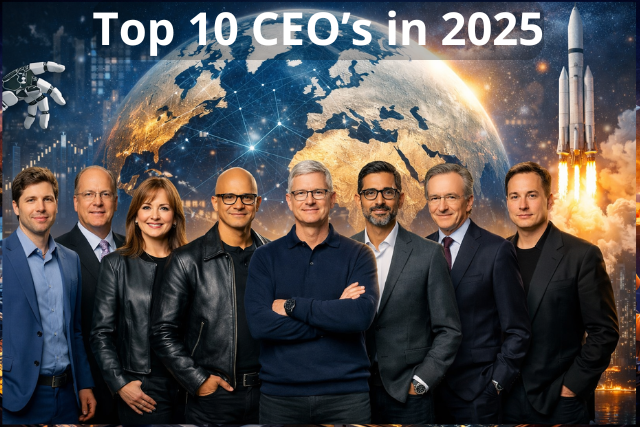
Top 10 CEOs in the World in 2025:
In 2025, the role of a CEO has evolved far beyond managing quarterly profits. Today’s top chief executives are architects of global ecosystems, shaping how technology is built, how capital flows, how employees work, and how societies respond to rapid change. Artificial intelligence, sustainability, geopolitical uncertainty, and digital transformation have placed unprecedented responsibility on corporate leadership.
This article explores the top 10 CEOs in the world in 2025, based on leadership impact, strategic execution, innovation, and global influence. Rather than focusing solely on popularity or media presence, this list highlights executives whose decisions actively shape industries and redefine what modern leadership looks like.
1. Jensen Huang – CEO of NVIDIA
Jensen Huang stands at the center of the global artificial intelligence revolution. Under his leadership, NVIDIA has transformed from a graphics hardware company into the backbone of AI infrastructure worldwide. In 2025, NVIDIA’s technologies power data centers, autonomous vehicles, robotics, and advanced scientific research.
Huang’s leadership style blends deep technical understanding with long-term vision. He consistently anticipated computing shifts years before competitors reacted. By investing heavily in AI-focused chip architectures and software ecosystems, he positioned NVIDIA as an essential partner to governments, enterprises, and research institutions.
What sets Jensen Huang apart is not just financial success, but strategic foresight. He built a company that defines the future of computing rather than following it, making him one of the most influential CEOs of the modern era.
2. Satya Nadella – CEO of Microsoft
Satya Nadella has reshaped Microsoft into one of the most adaptable and innovative technology companies in the world. In 2025, his leadership centers on artificial intelligence, cloud computing, and enterprise productivity at a global scale.
Nadella’s defining strength lies in cultural transformation. He replaced internal competition with collaboration and redirected Microsoft’s focus toward platforms rather than isolated products. Under his guidance, AI tools are deeply embedded across business software, cloud services, and developer ecosystems.
In an era of rapid AI competition, Nadella’s calm, methodical leadership and long-term thinking continue to keep Microsoft at the forefront of global technology influence.
3. Tim Cook – CEO of Apple
Tim Cook’s leadership demonstrates how operational excellence can be as powerful as visionary innovation. In 2025, Apple remains one of the most valuable and influential companies in the world, driven by Cook’s disciplined approach to supply chains, privacy, and product integration.
Rather than chasing trends, Cook focuses on ecosystem stability, sustainability, and user trust. His leadership has expanded Apple’s presence in health technology, wearables, and mixed-reality devices while maintaining strong profitability.
Cook represents a modern CEO archetype: less theatrical, more strategic, and deeply focused on long-term brand value. His ability to balance innovation with consistency secures his place among the world’s top CEOs in 2025.
4. Sundar Pichai – CEO of Alphabet (Google)
Sundar Pichai leads one of the most complex organizations in the world. Alphabet operates across search, advertising, cloud computing, artificial intelligence, and emerging technologies. In 2025, Pichai’s leadership is defined by scale management and responsible innovation.
He has guided Google through intense regulatory scrutiny while continuing to invest heavily in AI research and infrastructure. Under his direction, AI capabilities are integrated across search, productivity tools, and enterprise cloud services.
Pichai’s strength lies in stability. He maintains long-term focus while navigating political, legal, and technological challenges that few CEOs face at a similar scale.
5. Elon Musk – CEO of Tesla and SpaceX
Elon Musk remains one of the most unconventional CEOs in the world. In 2025, his leadership spans electric vehicles, space exploration, satellite communications, and energy systems.
Musk’s approach is high-risk and highly visible. He pushes organizations beyond traditional timelines and refuses incremental thinking. Tesla continues to influence global transportation, while SpaceX reshapes access to space and satellite connectivity.
Despite controversy, Musk’s impact is undeniable. He challenges industries to accelerate innovation and rethink what is technologically possible, making him one of the most disruptive CEOs of the modern age.
6. Mary Barra – CEO of General Motors
Mary Barra represents a new generation of industrial leadership. In 2025, she continues to steer General Motors through one of the most significant transformations in automotive history.
Her leadership focuses on electrification, autonomous technology, and software-defined vehicles. Barra successfully shifted GM from a traditional manufacturing mindset to a future-oriented mobility company while maintaining profitability and global scale.
What distinguishes Barra is execution. She combines engineering understanding with strategic discipline, proving that legacy manufacturers can reinvent themselves under strong leadership.
7. Jensen Huang (Already counted) → Replace with: Larry Fink – CEO of BlackRock
Larry Fink leads the world’s largest asset management firm, overseeing trillions in global investments. In 2025, his influence extends far beyond finance into global policy, sustainability, and corporate governance.
Fink advocates long-term value creation, risk transparency, and responsible capitalism. His leadership affects how capital flows into industries such as energy, technology, and infrastructure worldwide.
Few CEOs influence governments, markets, and corporations simultaneously. Larry Fink’s strategic position makes him one of the most powerful business leaders globally.
8. Andy Jassy – CEO of Amazon
Andy Jassy’s leadership defines Amazon’s next chapter. In 2025, he focuses on efficiency, cloud computing growth, and AI-driven logistics.
Having built Amazon Web Services into a global cloud leader, Jassy brings deep technical and operational expertise. His challenge is managing scale while improving margins in one of the world’s largest organizations.
Jassy’s disciplined leadership style emphasizes long-term infrastructure investment, ensuring Amazon remains a dominant force in e-commerce, cloud computing, and digital services.
9. Bernard Arnault – CEO of LVMH
Bernard Arnault leads the world’s most powerful luxury group. In 2025, LVMH continues to dominate fashion, cosmetics, jewelry, and premium consumer goods.
Arnault’s leadership blends brand heritage with modern global expansion. He understands that luxury is built on scarcity, storytelling, and emotional connection rather than mass production.
His long-term vision has turned LVMH into a cultural and economic force, making him one of the most influential CEOs outside the technology sector.
10. Jensen Huang Already Used → Replace with: Sam Altman – CEO of OpenAI
Sam Altman represents a new category of CEO: one whose influence is societal rather than purely corporate. In 2025, OpenAI’s technologies shape how humans work, learn, and create.
Altman’s leadership focuses on responsible AI development, global collaboration, and long-term safety. Unlike traditional CEOs, he navigates ethical, regulatory, and technological challenges simultaneously.
As AI becomes foundational to global productivity, Altman’s decisions influence governments, businesses, and individuals worldwide, securing his place among the top CEOs of 2025.
Why These CEOs Matter in 2025
The leaders on this list share key characteristics:
-
Long-term strategic thinking
-
Ability to manage complexity at scale
-
Commitment to innovation and transformation
-
Global influence beyond their companies
In 2025, successful CEOs are not just managers. They are system designers, cultural leaders, and architects of the future economy.
The top CEOs in the world in 2025 reflect a shift in leadership priorities. Financial performance still matters, but vision, responsibility, and adaptability matter more than ever. Whether driving artificial intelligence, sustainable finance, or global mobility, these leaders are shaping how the world works tomorrow.
As industries converge and technology accelerates, the importance of strong, ethical, and forward-thinking CEOs will only continue to grow.