Top 10 Cheapest Internet Countries in the World (2025)
Looking for the cheapest internet in the world in 2025? Here’s an up-to-date, research-backed list of the top 10 most affordable countries for internet access in 2025, with clear reasons why each country ranks low-cost and practical tips for travelers and digital nomads.
Access to affordable internet is one of the defining features of the modern digital economy. In 2025, the gap between the most and least expensive countries remains large — but several nations consistently stand out for offering remarkably cheap connectivity, whether measured by cost per gigabyte of mobile data or by average monthly broadband bills. Below you’ll find a practical, SEO-friendly guide to the Top 10 cheapest internet countries in 2025, why they are inexpensive, and what to watch for if you plan to work or travel there.
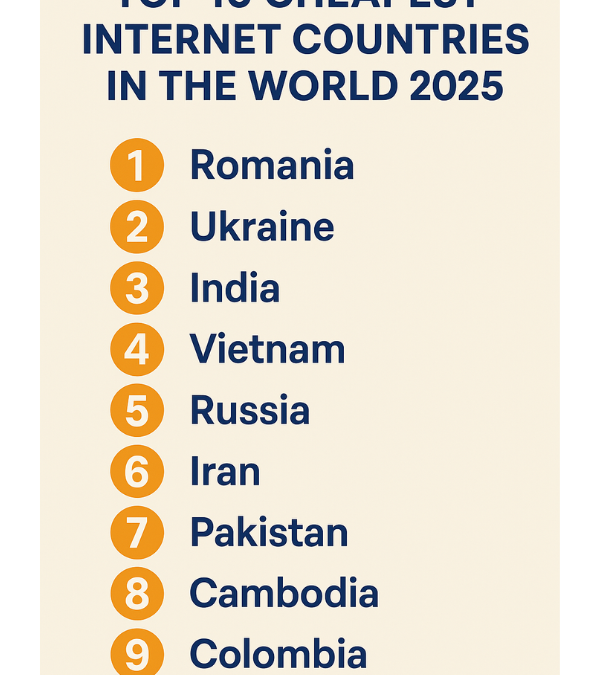
Quick list — Top 10 cheapest internet countries (2025):
1. Romania
2. Ukraine
3. India
4. Vietnam
5. Russia
6. Iran
7. Pakistan
8. Cambodia
9. Colombia
10. Nepal
How this ranking was compiled (methodology and caveats)
Different publications and datasets measure “cheap internet” in different ways: some report cost per megabit (price per Mbps for fixed broadband), others report cost per GB of mobile data, and some look at average monthly household bills. To produce a practical Top-10 for readers in 2025, this article synthesizes multiple reputable 2025 datasets and media summaries to find countries that repeatedly appear near the bottom of cost rankings across metrics (low monthly bills, low $/GB, or low $/Mbps). Because metrics and local packages change frequently, consider this a data-informed snapshot rather than an immutable ranking.
Country snapshots — why these 10 made the list
1. Romania
Romania often appears near the top of affordability lists for fixed broadband and offers very high average speeds for low prices — a combination that drives its ranking as one of the cheapest places to get fast home internet in 2025. Robust fiber deployment and aggressive competition among ISPs keep monthly bills down and value high.
2. Ukraine
Despite economic and geopolitical challenges, Ukraine continued to report very low average internet costs in 2025, driven by intense local competition among mobile carriers and a wide base of lower-cost fixed packages. For many residents, mobile data bundles remain extremely affordable relative to income and compared with global averages. (Travelers should note that service quality and availability can vary by region.)
3. India
India’s position among the cheapest countries is sustained by massive scale — billions of users and fierce competition among national and regional mobile operators push per-GB prices down. High subscriber volumes allow providers to offer very low-cost mobile data plans and attractive prepaid bundles. India’s fixed broadband markets in many urban areas also deliver competitive rates.
4. Vietnam
Vietnam combines expanding fiber infrastructure with cheap mobile data packages. High uptake of mobile internet and aggressive pricing strategies by carriers make Vietnam one of Southeast Asia’s most affordable countries for daily internet users and digital consumers.
5. Russia
Russia shows up on multiple affordability lists for low monthly bills and inexpensive mobile data in 2025. Large domestic carriers and competition in many regions help keep the headline prices for basic packages comparatively low. Note: political and regulatory factors can affect both price and international connectivity.
6. Iran
Several 2025 datasets list Iran among the countries with low per-GB prices for mobile data. Government policies, market structure and a large user base contribute to low nominal prices for many consumers. As always, international visitors should check roaming and payment options before they travel.
7. Pakistan
Pakistan’s mobile data market has become increasingly price-competitive. Multiple operators offer low per-GB rates and inexpensive prepaid bundles, which places Pakistan among the most affordable countries for mobile internet in 2025.
8. Cambodia
Cambodia frequently ranks among the cheapest in Southeast Asia for mobile data per GB. Aggressive pricing aimed at growing mobile usage and tourism, plus regional wholesale arrangements, have kept consumer rates down.
9. Colombia
Colombia’s inclusion reflects improving infrastructure and competitive mobile packages that result in low monthly costs for many consumers. Government initiatives and provider competition have pushed prices into the lower deciles of global rankings.
10. Nepal
Nepal appears on multiple affordability lists for low monthly broadband bills and cheap mobile data packages. Expansion of mobile networks and targeted pricing for large rural populations make Nepal an unexpectedly low-cost country for internet access.
Why prices differ so much between countries
-
Market scale and competition: Countries with many competing providers (or very large subscriber bases) can push prices down. India is the classic example.
-
Infrastructure model: Nations with widespread fiber or efficient mobile towers can deliver more megabits for the same cost. Romania’s fiber investments are a leading case.
-
Regulation and subsidies: Government policies, subsidies or price controls can produce low consumer prices but sometimes at the cost of slower investment or restricted access.
-
Purchasing power parity and local wages: A $5 monthly plan is cheap in nominal terms — but its real affordability depends on local incomes. That’s why some low-price countries can still have access gaps.
Practical tips for travelers and digital nomads
-
Buy local SIMs: In many of the cheap countries above, a local prepaid SIM + data bundle is the most economical way to get online.
-
Check speed vs price: A very cheap plan may be slow during peak hours. Always look for real user speed reports if you need consistent bandwidth for Zoom calls or streaming.
-
Roaming can be expensive: Don’t assume your home provider’s roaming will match local prices — always compare local prepaid SIM options.
-
Use a lightweight VPN when needed: Some countries impose content filtering or throttle certain services; a VPN helps if that’s a concern (respect local laws).
-
Watch for multi-SIM plans and eSIMs: eSIM options have expanded and sometimes let travelers activate small low-cost data packages without a physical SIM.
-
The cheapest internet in 2025 is not confined to one region — it’s a global mix of European, Asian and Latin American countries. Romania, Ukraine, India and Vietnam repeatedly appear in affordability data because of a mix of infrastructure, competition and pricing strategies.
-
Method matters: Rankings change depending on whether you measure cost per Mbps, cost per GB, or average monthly bills — so use the metric that matters most to you (speed, data volume, or monthly price).
-
If you’re a digital nomad or frequent traveler, consider local prepaid plans or eSIMs in these low-cost countries to get the best value.