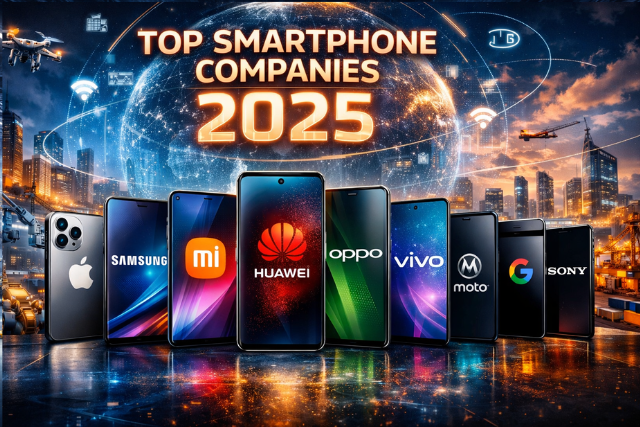
Top 10 Smartphone Manufacturing Companies in the World in 2025
The global smartphone industry in 2025 stands at a fascinating crossroads. After years of rapid innovation, supply-chain disruptions, and shifting consumer behavior, smartphone manufacturing has entered a more mature but highly competitive phase. Today’s leading smartphone companies are no longer defined only by how many devices they sell. Instead, they compete on ecosystems, artificial intelligence integration, sustainability, software longevity, and global manufacturing reach.
In 2025, smartphone manufacturers operate massive production networks across Asia, Europe, and the Americas, delivering billions of devices annually to both developed and emerging markets. Our article explores the top 10 smartphone manufacturing companies in the world in 2025, based on global influence, production scale, innovation leadership, and long-term market strength.
1. Apple Inc. (United States)
Apple remains one of the most powerful smartphone manufacturers in the world in 2025, redefining what premium smartphones mean on a global scale. While Apple produces fewer models than many competitors, its vertically integrated ecosystem gives it a unique advantage. From custom-designed processors to tightly controlled software updates, Apple maintains near-total command over the iPhone experience.
In 2025, Apple’s manufacturing strategy relies heavily on diversified production across multiple countries, reducing dependence on any single region. Its ability to maintain strong demand year after year proves that brand loyalty and long-term software support remain decisive factors in the smartphone market. Apple is also projected to lead global smartphone shipments in 2025, overtaking traditional volume leaders for the first time in over a decade.
2. Samsung Electronics (South Korea)
Samsung Electronics continues to be a cornerstone of global smartphone manufacturing in 2025. The company operates one of the most vertically integrated manufacturing systems in the technology sector, producing displays, memory chips, processors, and batteries in-house.
Samsung’s strength lies in its ability to serve every price segment, from affordable smartphones to ultra-premium foldable devices. Its continued leadership in display technology and foldable innovation keeps it at the forefront of Android manufacturing. Although competition has intensified, Samsung remains one of the top two smartphone manufacturers globally by market share in 2025.
3. Xiaomi Corporation (China)
Xiaomi has firmly established itself as a global manufacturing powerhouse in 2025. Known for delivering high-performance smartphones at competitive prices, Xiaomi operates with razor-thin margins while relying on scale and ecosystem expansion for profitability.
The company’s manufacturing strength lies in its flexible production model, partnerships with regional factories, and aggressive expansion in Europe, South Asia, and Latin America. Xiaomi’s multi-brand strategy allows it to address both entry-level consumers and technology enthusiasts. In 2025, Xiaomi remains among the top three smartphone manufacturers worldwide by unit shipments.
4. Huawei Technologies (China)
Despite years of global trade restrictions, Huawei remains one of the most influential smartphone manufacturers in 2025. While its international footprint has narrowed, Huawei dominates its domestic market and continues to invest heavily in self-reliant semiconductor design and software development.
Huawei’s manufacturing ecosystem emphasizes independence, innovation, and long-term resilience. The company’s ability to adapt under pressure has made it a unique case study in modern manufacturing strategy. In 2025, Huawei holds a leading position within China’s smartphone market, maintaining a strong manufacturing base and loyal customer following.
5. OPPO (China)
OPPO has grown into one of the world’s most recognizable smartphone manufacturing brands in 2025. With a strong focus on industrial design, camera technology, and fast-charging systems, OPPO targets consumers seeking premium features without premium pricing.
The company’s manufacturing operations span multiple countries, allowing it to scale production efficiently while adapting devices to regional preferences. OPPO’s presence across Asia, Europe, and parts of Africa has solidified its position among the world’s top smartphone manufacturers.
6. Vivo (China)
Vivo continues to be a major force in smartphone manufacturing in 2025, particularly in Asia and emerging markets. The company invests heavily in camera innovation, audio performance, and sleek design, making its smartphones appealing to younger demographics.
Vivo’s manufacturing strategy focuses on speed and localization. By adjusting features and pricing to suit regional demands, Vivo maintains strong growth even in highly competitive markets. Its large-scale manufacturing facilities support consistent output across multiple product tiers.
7. Transsion Holdings (China)
Transsion Holdings may be less familiar in Western markets, but in 2025 it stands as one of the largest smartphone manufacturers in the world by volume. Its brands are especially dominant across Africa, South Asia, and parts of the Middle East.
Transsion’s manufacturing success comes from hyper-local customization, such as enhanced battery life, region-specific camera tuning, and support for multiple local languages. By focusing on underserved markets, Transsion has built a manufacturing empire where others struggle to compete.
8. Lenovo (Motorola Mobility)
Lenovo’s smartphone manufacturing operations, primarily under the Motorola brand, continue to strengthen in 2025. Motorola benefits from Lenovo’s global manufacturing infrastructure and supply-chain expertise.
The company focuses on clean software experiences, durable hardware, and competitive pricing, making its smartphones popular in North and South America. Lenovo’s balanced approach to cost control and product differentiation allows it to maintain relevance in a crowded market.
9. Google (United States)
Google has evolved into a serious smartphone manufacturer by 2025. While its production volumes are smaller compared to industry giants, Google’s influence lies in software-first hardware design and deep AI integration.
Google’s smartphones showcase what is possible when hardware is built explicitly around software intelligence. Its manufacturing model prioritizes quality, long-term updates, and ecosystem synergy rather than mass-market domination. This strategic positioning secures Google a place among the world’s leading smartphone manufacturers.
10. Sony (Japan)
Sony remains a specialized but influential smartphone manufacturer in 2025. Unlike mass-market competitors, Sony focuses on premium components, professional-grade cameras, and multimedia performance.
Sony’s smartphones appeal to photographers, content creators, and technology enthusiasts who value precision engineering. Its manufacturing expertise in sensors and imaging technology gives Sony a unique advantage that extends beyond smartphone sales into the broader electronics industry.
Key Trends Shaping Smartphone Manufacturing in 2025
Global Manufacturing Diversification
Smartphone manufacturers increasingly distribute production across multiple countries to reduce geopolitical and logistical risks.
AI-Driven Hardware Design
Artificial intelligence now influences everything from camera systems to power management, reshaping how smartphones are manufactured.
Sustainability and Repairability
Environmental responsibility has become a core manufacturing consideration, with longer software support and recyclable materials gaining importance.
Emerging Market Focus
Manufacturers targeting Africa, South Asia, and Latin America are driving the next wave of smartphone growth.
In 2025, the smartphone manufacturing landscape reflects both technological maturity and strategic transformation. The top 10 smartphone manufacturing companies in the world succeed not only by producing devices at scale, but by aligning innovation, localization, and long-term vision.
As competition intensifies and consumer expectations rise, these companies continue to redefine what smartphones can achieve—making 2025 one of the most dynamic years in the history of mobile manufacturing.