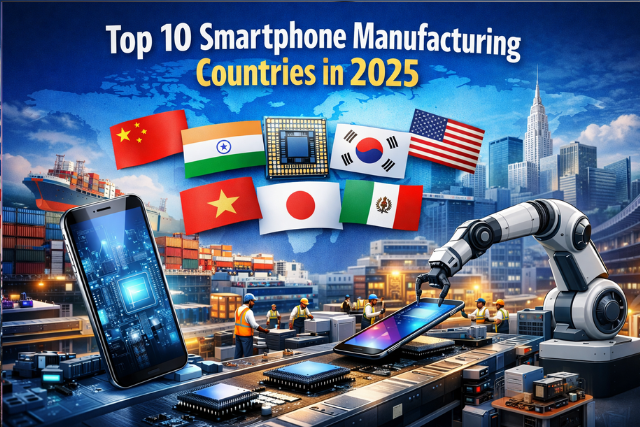
Top 10 Smartphone Manufacturing Countries in 2025 (With Average Smartphone Prices)
The global smartphone industry in 2025 is more competitive and geographically diverse than ever before. While a decade ago only a few countries dominated phone manufacturing, today production is spread across Asia, North America, and parts of Europe. Rising labor costs, trade policies, and government incentives have reshaped the global supply chain, making smartphone manufacturing a truly international business.
In this article, we explore the top 10 smartphone manufacturing countries in 2025, why they matter, and the average price range of smartphones produced in each country. Prices mentioned are estimated global averages based on manufacturing origin, component costs, and market positioning — not copied from retailers or brands.
1. China – The Global Smartphone Manufacturing Giant
China remains the undisputed leader in smartphone manufacturing in 2025. The country hosts the world’s most advanced electronics supply chains, massive factories, and a skilled workforce capable of producing millions of units per month.
Most global brands still rely on Chinese facilities for high-volume production, especially mid-range and premium devices. China also manufactures phones for both domestic brands and international companies.
Why China leads:
-
Complete component ecosystem
-
Advanced automation
-
Fast production cycles
-
Strong domestic demand
Average smartphone price (manufactured in China):
USD 150 – USD 1,100
China produces everything from ultra-budget smartphones to premium flagship models, making it the most price-diverse manufacturing country in the world.
2. India – The Fastest-Growing Smartphone Manufacturing Hub
India has emerged as one of the most important smartphone manufacturing countries in 2025. Strong government incentives, lower labor costs, and rising export capacity have pushed India into the global spotlight.
Many international brands now assemble and manufacture smartphones in India for both domestic use and overseas markets, particularly North America and Europe.
Why India is rising fast:
-
Production-linked incentive programs
-
Large workforce
-
Rapid expansion of export-oriented factories
-
Growing local market
Average smartphone price (manufactured in India):
USD 120 – USD 900
India is especially strong in budget and mid-range smartphones, though premium device assembly has also increased significantly.
3. Vietnam – A Key Alternative to China
Vietnam has become a major smartphone manufacturing destination as companies diversify away from over-reliance on China. The country offers political stability, competitive labor costs, and efficient export infrastructure.
Vietnam is particularly strong in producing smartphones for global markets rather than domestic consumption.
Key strengths:
-
Export-focused manufacturing
-
Strategic location in Southeast Asia
-
Stable trade relations with major markets
Average smartphone price (manufactured in Vietnam):
USD 180 – USD 1,000
Vietnam mainly produces mid-range and high-end smartphones for international brands.
4. South Korea – Innovation and Premium Manufacturing
South Korea is known for its advanced technology and innovation-driven manufacturing. Smartphones produced here focus heavily on premium design, advanced displays, and high-performance components.
Although production volume is lower than China or India, the value per device is significantly higher.
Why South Korea stands out:
-
Strong R&D ecosystem
-
Advanced semiconductor technology
-
Focus on flagship devices
Average smartphone price (manufactured in South Korea):
USD 500 – USD 1,300
South Korean manufacturing is closely associated with premium smartphones and cutting-edge innovation.
5. United States – High-Value, Low-Volume Manufacturing
The United States does not manufacture smartphones in massive volumes, but it plays a critical role in high-value assembly, design-driven production, and advanced component integration.
Phones manufactured or assembled in the U.S. are usually premium devices aimed at niche or professional markets.
Key characteristics:
-
High labor and compliance standards
-
Focus on quality and security
-
Strong intellectual property protection
Average smartphone price (manufactured in the USA):
USD 700 – USD 1,500
U.S. manufacturing emphasizes value over volume, resulting in higher prices.
6. Taiwan – Semiconductor-Driven Smartphone Manufacturing
Taiwan plays a crucial role in smartphone manufacturing due to its leadership in semiconductor and chip production. Many smartphones assembled elsewhere rely on Taiwanese components.
Some final assembly and specialized smartphone manufacturing also take place locally.
Why Taiwan matters:
-
World-leading chip fabrication
-
Precision manufacturing
-
Strong export focus
Average smartphone price (manufactured in Taiwan):
USD 400 – USD 1,200
Taiwanese-manufactured smartphones typically belong to the mid-premium and premium segments.
7. Japan – Precision and Quality Manufacturing
Japan’s smartphone manufacturing industry is smaller in scale but highly respected for quality and engineering excellence. Devices produced here focus on durability, performance, and long-term reliability.
Strengths of Japan:
-
Precision engineering
-
Strong quality control
-
Advanced materials technology
Average smartphone price (manufactured in Japan):
USD 450 – USD 1,100
Japanese smartphones often target consumers who prioritize build quality and reliability over mass-market pricing.
8. Indonesia – Emerging Southeast Asian Manufacturer
Indonesia is becoming an important regional smartphone manufacturing country in 2025. Government regulations encouraging local assembly have attracted several manufacturers.
Production mainly serves domestic and nearby regional markets.
Why Indonesia is growing:
-
Large population
-
Local manufacturing requirements
-
Expanding electronics sector
Average smartphone price (manufactured in Indonesia):
USD 130 – USD 600
Most smartphones made in Indonesia fall into the budget and lower mid-range categories.
9. Brazil – Latin America’s Manufacturing Powerhouse
Brazil leads smartphone manufacturing in Latin America. High import taxes on finished electronics have encouraged local assembly and manufacturing.
Key advantages:
-
Large domestic market
-
Established electronics industry
-
Regional export potential
Average smartphone price (manufactured in Brazil):
USD 200 – USD 800
Brazilian-manufactured smartphones often cost more due to higher production expenses but offer strong local market availability.
10. Mexico – North America’s Strategic Manufacturing Base
Mexico plays an increasingly important role in smartphone manufacturing for the North American market. Proximity to the U.S. and favorable trade agreements make it an attractive production base.
Why Mexico is important:
-
Close to U.S. market
-
Lower labor costs than the U.S.
-
Efficient logistics
Average smartphone price (manufactured in Mexico):
USD 250 – USD 900
Mexican manufacturing focuses on mid-range and premium smartphones for export.
Global Smartphone Manufacturing Trends in 2025
Several key trends define smartphone manufacturing in 2025:
-
Shift from single-country dependence to multi-country production
-
Rising role of Southeast Asia
-
Increasing automation in factories
-
Focus on sustainability and energy efficiency
-
Growth of mid-range smartphones worldwide
The global smartphone market continues to expand steadily, with manufacturing value exceeding hundreds of billions of dollars annually.
In 2025, smartphone manufacturing is no longer dominated by just one country, even though China remains the largest producer. India, Vietnam, South Korea, and several emerging markets have become essential parts of the global supply chain.
Top 10 Smartphone Manufacturing Countries in 2025:
-
China
-
India
-
Vietnam
-
South Korea
-
United States
-
Taiwan
-
Japan
-
Indonesia
-
Brazil
-
Mexico
Each country plays a unique role, contributing to innovation, affordability, or premium quality. Together, they shape the future of the global smartphone industry.