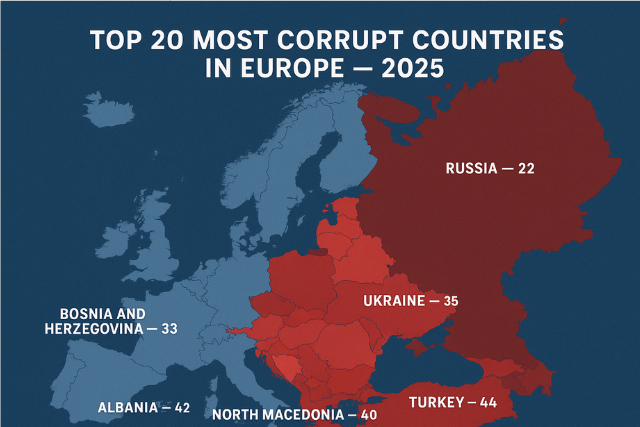
Top 20 Most Corrupt Countries in Europe (2025)
Corruption remains one of the most persistent governance challenges in Europe. To create the list below we use the Corruption Perceptions Index (CPI) 2024 published by Transparency International (released in February 2025) — the standard, widely used measure of perceived public-sector corruption worldwide. The CPI ranks countries on a 0–100 scale where 0 = highly corrupt and 100 = very clean. In this article “most corrupt” means the lowest CPI score — i.e., countries perceived as having the largest public sector corruption problems.
Important note on methodology: the CPI reflects perceptions of public-sector corruption gathered from experts and businesspeople, using multiple data sources. Scores are rounded to whole numbers in Transparency International’s published tables; the list below is based on those published CPI scores and sorted from lowest (most corrupt) upward for European countries
The Top 20 most corrupt countries in Europe — 2025 (CPI 2024 scores)
Below are the 20 European countries with the lowest CPI scores (most perceived corruption) according to Transparency International’s CPI 2024 dataset. Each entry shows the CPI score and a short explanation of factors contributing to its low score.
1. Russia — 22
Russia sits at the bottom among European states included here. Persistent problems include concentrated political power, weak checks on elites, limited judicial independence, and high levels of state capture that affect procurement and public finances.
2. Azerbaijan — 22
Azerbaijan’s score reflects concerns over opaque public procurement, limited media freedoms, restricted civic space, and powerful patronage networks linking business and political elites. (Azerbaijan is often included in European/Caucasus regional discussions.)
3. Bosnia and Herzegovina — 33
Bosnia’s fragmented post-war governance, clientelism, and weak rule of law undermine transparency and allow nepotism and corrupt contracting to persist across public institutions.
4. Belarus — 33
The country’s authoritarian model, limited institutional independence, and lack of transparent public procurement contribute to its low CPI score and entrenched corruption risks.
5. Turkey — 34
Turkey faces problems with political influence over institutions, weak oversight, and concerns about transparency in public contracting and regulatory capture — factors reflected in its CPI score. images.transparencycdn.org
6. Serbia — 35
Serbia struggles with political interference in key institutions, insufficient transparency in public spending, and clientelist networks that undermine meritocratic public appointments. images.transparencycdn.org
7. Ukraine — 35
War and institutional disruption complicate Ukraine’s anti-corruption efforts, even as important reforms and anti-corruption bodies have been established; the war’s pressures, illicit rent-seeking risks, and state capture concerns keep the score low. images.transparencycdn.org
8. North Macedonia — 40
North Macedonia has improved in some governance areas, but persistent patronage, political influence over public administration, and loopholes in procurement continue to limit progress. images.transparencycdn.org
9. Hungary — 41
Hungary’s score is affected by concerns about weakening checks and balances, shrinking media freedom, political influence on public institutions and the judiciary, and opaque allocation of state resources. images.transparencycdn.org
10. Albania — 42
Albania faces entrenched patronage and corruption within public administration and judiciary weaknesses; transparency reforms are ongoing but governance gaps persist. images.transparencycdn.org
11. Moldova — 43
Moldova’s political instability and past high-profile graft scandals leave legacy vulnerabilities: weak oversight, problematic procurement, and elite capture of state institutions. images.transparencycdn.org
12. Bulgaria — 43
Bulgaria continues to confront issues with judicial independence, influence in public procurement, and oligarchic networks that affect policymaking and enforcement — reflected in a below-midpoint CPI score. images.transparencycdn.org
13. Kosovo — 44
Kosovo’s institutions are emerging but face significant corruption risks: weak public financial management, low administrative capacity, and political patronage are commonly cited concerns. images.transparencycdn.org
14. Romania — 46
Romania has mixed performance: anti-corruption courts and investigations have been strong at times, but backsliding in oversight, political challenge to independent institutions, and inconsistent enforcement affect the score. Recent domestic debates and legal changes continue to shape perceptions. images.transparencycdn.org+1
15. Montenegro — 46
Montenegro’s small-state dynamics, concentrated economic interests, and weaknesses in procurement oversight and political transparency contribute to the country’s modest CPI score. images.transparencycdn.org
16. Malta — 46
Malta’s low absolute size contrasts with governance challenges highlighted in recent years relating to regulatory gaps, money laundering concerns, and the influence of private interests on public policy. images.transparencycdn.org
17. Croatia — 47
Croatia’s score reflects problems in public procurement transparency, occasional political influence in institutions, and enforcement gaps despite EU membership and reform pressures. images.transparencycdn.org
18. Armenia — 47
Armenia — while making democratic strides at times — still faces issues of elite influence, weaknesses in regulatory systems and public administration, and vulnerabilities in procurement and public finance. images.transparencycdn.org
19. Greece — 49
Greece has been tackling long-standing governance and corruption challenges, but public sector inefficiencies, occasional clientelism, and enforcement gaps still hurt perceptions. Recent reforms aim to counteract these trends. images.transparencycdn.org
20. Slovakia — 49
Slovakia’s ranking reflects ongoing concerns about political influence, the need for stronger independent oversight and anti-corruption enforcement, and vulnerabilities in public procurement.
What this list does — and what it doesn’t
This ranking is not an index of criminality, poverty, or cultural attitudes — it is a measure of perceptions of public-sector corruption derived from expert and business surveys compiled by Transparency International’s CPI 2024 dataset. Because perception-based measures capture what informed observers see in public institutions, they are useful for cross-country comparison and trend analysis — but they should be read alongside local context, recent news, and national anti-corruption reforms.
Why these countries score poorly (common drivers)
Across the European countries listed above, several recurring drivers explain low CPI scores:
-
Weak independence of courts and prosecutors. Where judicial systems are politicised, corruption investigations stall and impunity rises.
-
Opaque public procurement and major public contracts. Large projects and defense or energy contracts can become channels for kickbacks or clientelist distribution.
-
Political capture and concentrated economic power. Elites who control political decisions can shape laws and appointments to favor private interests.
-
Limited media freedom and civic space. Without investigative media and active civil society, corruption is harder to detect and sanction.
-
Conflict, state fragility or authoritarian rule. War or authoritarian consolidation often weakens oversight and concentrates resources in the hands of a few.
Final notes and up-to-date caution
This article uses Transparency International’s CPI 2024 (published February 2025) as the authoritative source for the rankings and scores cited. Transparency International is the most commonly used reference for cross-country corruption perception comparisons. Political events, reform measures, or new scandals can move perceptions quickly; for the latest single-country changes check the CPI dataset page or national anti-corruption monitoring reports.