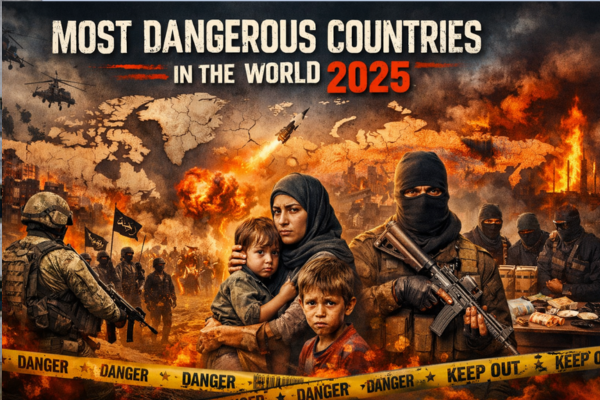
Top 20 Most Dangerous Countries in the World in 2025
Comprehensive Ranking & Insights
In 2025, global security continues to face severe challenges. From prolonged armed conflicts and fragile governments to terrorism, crime waves, and socioeconomic instability, many nations are grappling with conditions that make daily life perilous for their citizens and visitors alike. Understanding the most dangerous countries in the world is vital for travelers, policymakers, international organizations, and global citizens interested in peace and safety.
In this article, we break down the Top 20 Most Dangerous Countries in 2025, exploring why they are ranked as such and what key risk factors contribute to their dangerous environments.
What Makes a Country “Dangerous”?
Before diving into the list, it’s important to define what “dangerous” means in a global context. Experts usually consider multiple factors, including:
✔ Ongoing armed conflict or war
✔ High levels of violent crime (homicides, kidnappings, robberies)
✔ Terrorism and insurgent activity
✔ Government instability or breakdown
✔ Humanitarian crises and displacement
✔ Weak law enforcement and corruption
✔ High levels of political and social unrest
These combined pressures often result in environments where safety risks are significantly higher than the global average. Rankings such as the Global Peace Index (GPI) consider these elements when evaluating countries on peace and security metrics.
Top 20 Most Dangerous Countries in the World (2025)
1. Afghanistan
Afghanistan remains one of the most dangerous countries on Earth in 2025. More than two decades after international intervention ended, the country continues to face violent insurgencies, frequent terrorist attacks, deteriorating governance structures, and widespread insecurity. Armed groups and militant networks pose persistent threats throughout rural and urban areas.
Why It’s Dangerous
-
Ongoing conflict between different armed factions
-
Presence of extremist groups
-
Weak central government and law enforcement
-
Limited access to basic services and security
2. Yemen
In Yemen, a long‑running civil war has devastated the nation’s infrastructure and social systems. The conflict has resulted in mass displacement, famine conditions, and rampant insecurity. Multiple armed factions and external interventions contribute to a chaotic situation with profound human suffering.
Key Risks
-
Active civil war with multiple fronts
-
Severe humanitarian crisis
-
Lawlessness in many regions
3. Syria
More than a decade after its civil war began, Syria remains dangerous due to ongoing violence, shattered governance, and competing armed groups. Large swathes of the country suffer from insecurity, economic collapse, and limited state control.
Security Challenges
-
Militarized zones and clashes
-
Terrorism and extremist remnants
-
Refugee and humanitarian emergencies
4. South Sudan
As one of the youngest nations in the world, South Sudan has struggled with recurring conflict, tribal clashes, and political instability. Inter‑communal violence and weak institutional frameworks have fueled displacement and humanitarian suffering.
Danger Factors
-
Ongoing internal conflicts
-
Ethnic violence
-
Widespread poverty and insecurity
5. Democratic Republic of the Congo (DRC)
The DRC is battling persistent insurgencies, militias, and political instability across many territories. Armed groups such as the M23, CODECO, and others continue to destabilize regions, leading to widespread displacement and civilian casualties.
Top Risks
-
Armed groups active across the east
-
Humanitarian crises
-
Government struggles to maintain control
6. Iraq
Despite a reduction in large‑scale conflict compared with past years, Iraq still experiences militant attacks, sectarian tensions, and sporadic violence. Security forces face challenges in combating extremist groups while political instability continues.
Key Threats
-
Terrorist attacks
-
Sectarian instability
-
Residual insurgent activity
7. Somalia
Somalia remains a hotspot for terrorism and conflict. The extremist group al‑Shabab controls or contests many rural areas, frequently carrying out bombings and attacks on civilians and security forces.
Main Concerns
-
Persistent al‑Shabab insurgency
-
Weak governance structures
-
Clan and militia conflicts
8. Central African Republic (CAR)
The CAR continues to suffer from recurrent coups, militia clashes, and political uncertainty. Large sections of the population face intense insecurity due to fragmented armed groups.
Risk Profile
-
Frequent militia battles
-
Weak central authority
-
Human rights abuses
9. Sudan
Conflict in Sudan escalated into a full‑blown civil war between the Sudanese Armed Forces and the Rapid Support Forces (RSF), creating one of the gravest humanitarian crises in recent memory. Millions have been displaced, and civilians are caught between violent factions.
Current Dangers
-
Active civil war
-
Food insecurity and displacement
-
Mass violence and human rights dangers
10. Ukraine
In 2025, Ukraine remains deeply affected by protracted conflict. The war continues to impact civilian life, infrastructure, and security across multiple fronts. Active combat, missile strikes, and political uncertainty contribute to its inclusion on the dangerous list.
Security Issues
-
Ongoing war with Russia
-
Civilians targeted in frontline areas
-
Infrastructure destruction
11. North Korea
North Korea’s highly militarized regime, limited freedoms, and unpredictable international actions contribute to its dangerous status. Travel advisories strongly discourage visits due to tightly controlled movement and reported human rights abuses.
Top Safety Concerns
-
Authoritarian regime
-
Severe restrictions on freedom
-
Risk of international tensions
12. Libya
Post‑Gaddafi Libya still struggles with competing militias, fragmented governance, and sporadic violence between armed groups. Rival factions control key cities and trade routes, making security unpredictable.
Key Issues
-
Armed militia activity
-
Political instability
-
Weak law enforcement
13. Mali
Mali’s security situation has deteriorated owing to insurgencies and extremist violence in the Sahel region. Groups such as ISIS‑Sahel and other jihadist factions conduct deadly attacks, targeting civilians and security forces alike.
Danger Factors
-
Terrorism and insurgencies
-
Regional instability
-
Lack of strong governance
14. Ethiopia
Civil tensions and fighting in regions like Tigray and Oromia have created dangerous conditions in Ethiopia. Inter‑communal clashes and ongoing hostilities disrupt security and basic services.
Security Challenges
-
Multiple conflict zones
-
Ethnic tension
-
Displacement of civilians
15. Venezuela
Once a middle‑income economy, Venezuela now faces severe political unrest, economic collapse, and skyrocketing crime rates. Violent crime — including kidnappings, armed robberies, and gang activity — contributes significantly to its risk profile.
Hazard Highlights
-
Rising violent crime
-
Political turmoil
-
Law enforcement breakdown
16. Pakistan
Polls and indexes show that political instability, terrorism, and social unrest in certain regions lead to significant safety risks. While conditions vary widely across provinces, some areas remain unpredictable and hazardous.
Threat Elements
-
Terrorist activity in border regions
-
Social and political unrest
-
Law enforcement challenges
17. Burkina Faso
Located in the volatile Sahel, Burkina Faso faces extreme dangers from extremist groups. Frequent terrorist attacks destabilize large swaths of territory, particularly in the north.
Danger Indicators
-
High terrorism activity
-
Government instability
-
Weak security presence
18. Turkey
Though not traditionally labeled a “war zone,” Turkey experiences multiple security challenges in 2025, including attacks by extremist groups and urban violence. Complex geopolitical tensions and internal security operations contribute to risk perceptions.
Main Risks
-
Extremist attacks
-
Terrorist threats
-
Domestic unrest
19. Colombia
Despite significant improvements overall, Colombia still contends with pockets of guerrilla groups, drug‑trafficking violence, and rural insecurity. These localized hot spots make certain regions particularly dangerous.
Security Challenges
-
Drug‑related violence
-
Guerrilla activity
-
Crime in remote areas
20. Nigeria
Nigeria rounds out the top 20 dangerous countries, with significant violence spurred by Boko Haram insurgents, banditry, and inter‑communal conflict. Attacks in the northeast and other regions continue to destabilize communities.
Top Threats
-
Boko Haram and extremist attacks
-
Banditry and kidnapping
-
Regional instability
Patterns Behind the Danger Rankings
While each nation has its own unique challenges, several recurring themes explain why these countries are among the most dangerous:
1. Ongoing Armed Conflicts
Many top‑ranked dangerous countries (such as Sudan, Syria, and Afghanistan) are in the midst of prolonged wars or civil strife, where active combat zones pose life‑threatening risks.
2. Terrorism & Insurgency
Regions in Africa’s Sahel, the Middle East, and southern Asia face persistent terrorism — from al‑Shabab to ISIS‑linked factions and other extremist networks.
3. Economic & Humanitarian Crises
Economic collapse (Venezuela), famine (Sudan), and mass displacement often accompany or worsen violent conflict.
4. Weak Governance
Many of these countries suffer from governance breakdowns, where law enforcement cannot maintain order or protect citizens from abuse.
5. Crime Waves
Even outside traditional war zones, countries like Venezuela and Nigeria endure high levels of violent crime, often linked to socioeconomic inequality and organized crime.
The global security landscape in 2025 remains complex and volatile. While progress has been made in some areas, multiple countries continue to grapple with violence, political instability, and deep‑rooted risk factors that affect millions of lives.
Understanding these risks isn’t just important for travelers — it’s crucial for global efforts toward peacebuilding, humanitarian aid, and diplomatic engagement.
Stay informed, consult official travel advisories, and respect local conditions if you must travel to high‑risk regions. Prioritize safety and awareness wherever you go.