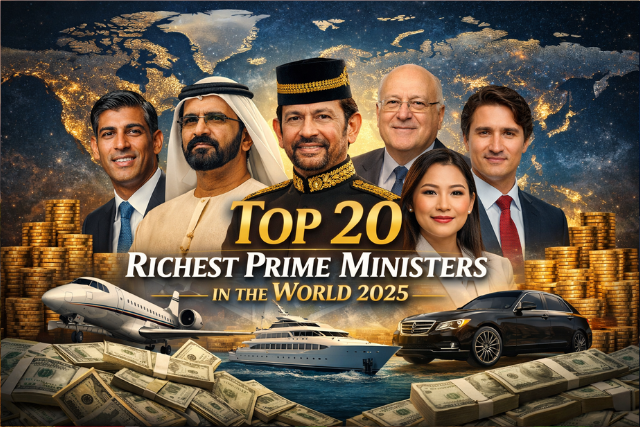
Top 20 Richest Prime Ministers of the World in 2025 – Wealth Rankings and Profiles
In the global political arena, leadership is not just about vision and governance, but sometimes about personal wealth. While prime ministers are expected to serve their nations, many hold substantial personal fortunes accrued through business ventures, investments, inheritance, or family wealth. In 2025, the landscape of wealthy prime ministers reflects a blend of political authority and financial power. This article explores the Top 20 Richest Prime Ministers of the World in 2025, ranking them by their estimated net worth and giving insights into their sources of wealth.
1. Hassanal Bolkiah (Brunei) – Estimated Net Worth: ~$50 Billion
Hassanal Bolkiah is not only one of the longest-reigning monarchs but also the wealthiest prime minister in the world. As Sultan and Prime Minister of Brunei since 1984, his fortune stems largely from the nation’s vast oil and gas wealth and decades of savvy investments. Because he serves as both head of state and government, his personal net worth dwarfs that of typical political leaders and places him at the top of this list.
Despite the opaque nature of royal finances, most estimates place his wealth in the tens of billions, making him an outlier in the political world where public servants are often not among the ultra-rich.
2. Najib Mikati (Lebanon) – Estimated Net Worth: ~$3.2 Billion
Najib Mikati stands out as one of the few billionaire prime ministers in modern global politics. Before entering public office, he co-founded the telecom giant Investcom, which he later sold in a major deal that netted billions. His leadership roles in both business and politics have enabled him to maintain substantial wealth. Mikati’s profile as a trained businessman-politician sets him apart in this ranking.
Unlike many of his counterparts, his wealth is well documented and comes from entirely private enterprise, rather than state resources.
3. Rishi Sunak (United Kingdom) – Estimated Net Worth: ~£640 Million (~$790M)
Former British Prime Minister Rishi Sunak is one of the wealthiest leaders in democratic nations. His significant net worth is largely thanks to his marriage to Akshata Murty, whose stake in Infosys – a major Indian multinational – contributes significantly to their combined wealth. Sunak’s tenure in office ended in 2024, but his financial standing in 2025 remains high compared to most prime ministers worldwide.
Sunak’s wealth is particularly notable because it is rare for leaders of large democracies to hold such substantial private fortunes.
4. Lee Hsien Loong (Singapore) – Estimated Net Worth: ~$80 Million
Singapore’s Prime Minister Lee Hsien Loong combines a long legacy of political leadership with moderate wealth compared to global heavyweights. His fortune reflects Singapore’s prosperous economy and the influential roles his family has held in both business and governance. Lee’s financial profile illustrates how prime ministers in rich, developed economies often accumulate respectable wealth through property and investment portfolios.
5. Sheikh Mohammed bin Rashid Al Maktoum (UAE) – Estimated Net Worth: ~$14 Billion
Sheikh Mohammed bin Rashid Al Maktoum rules as Prime Minister and Vice President of the United Arab Emirates, as well as the Ruler of Dubai. His wealth is intricately tied to Dubai’s strategic growth as a global financial, tourism, and trade hub. His portfolio includes vast real estate holdings, state enterprises, and investments across industries. While precise figures are difficult to verify, his financial stature places him among the richest leaders with executive power.
6. Paetongtarn Shinawatra (Thailand) – Estimated Net Worth: ~$390 Million
Thailand’s prime minister in 2025, Paetongtarn Shinawatra, comes from one of Thailand’s most prominent political families. Her personal assets include valuable properties domestically and internationally, luxury collections, and significant business interests. While much of her family’s wealth is tied to legacy holdings and real estate, her declared wealth is still exceptionally high for a national leader.
Her situation reveals how political lineage often intersects with wealth accumulation in many countries.
7. Anthony Albanese (Australia) – Estimated Net Worth: ~$10 Million
Australia’s prime minister holds considerable personal wealth compared to many other democratic leaders. Albanese’s net worth derives from investments, superannuation, and property. While far smaller than the top financial heavyweights on this list, his wealth places him above many other elected prime ministers from developed nations.
8. Justin Trudeau (Canada) – Estimated Net Worth: ~$12 Million
Justin Trudeau combines a long family legacy in Canadian politics with a respectable personal fortune. His media engagements, speaking tours after prime ministerial leadership, and book deals have boosted his wealth beyond typical political earnings. His financial portfolio also includes property and investments that cumulatively place him near the higher end of elected leaders’ wealth.
9. Olaf Scholz (Germany) – Estimated Net Worth: ~$4 Million
Germany’s Chancellor (equivalent to prime minister in many systems), Olaf Scholz, holds a moderate wealth portfolio comprising property and investments acquired over years in public service. Though not a billionaire or millionaire in the upper echelon, his financial standing is notable for the office he holds in one of the world’s largest economies.
10. Jonas Gahr Støre (Norway) – Estimated Net Worth: ~$4 Million
The Norwegian prime minister’s wealth reflects Norway’s high standards of living and investment principles. His personal assets include diversified stock holdings, real estate, and government pension rights earned over decades in politics. While his wealth is modest relative to global leaders, it still places him among the more financially secure prime ministers.
11. Mark Rutte (Netherlands) – Estimated Net Worth: ~$2 Million
Mark Rutte’s financial profile shows how long political careers in economically stable European nations can accumulate substantial, though not billionaire-level, wealth. His personal investments and property holdings contribute to his place on this list.
12. Élisabeth Borne (France) – Estimated Net Worth: ~$2 Million
France’s prime minister holds wealth typical of senior executives in Europe. Her assets include savings and pensions from government service and private investments, which together create a solid financial base.
13. Alexander De Croo (Belgium) – Estimated Net Worth: ~$2.5 Million
Belgium’s prime minister ranks among the mid-range in financial standing. His wealth reflects property ownership, savings, and a professional career that includes both politics and business experience.
14. Xavier Bettel (Luxembourg) – Estimated Net Worth: ~$3 Million
Luxembourg’s prime minister enjoys wealth boosted by the small nation’s strong economy and banking sector. Bettel’s personal assets include diversified investments and his involvement in various economic forums.
15. Ulf Kristersson (Sweden) – Estimated Net Worth: ~$1.7 Million
Kristersson’s financial profile shows the typical wealth range of Scandinavian political leaders. His property, retirement benefits, and investments place him securely in the top 20 list by virtue of stable economic participation.
16. Sanna Marin (Finland) – Estimated Net Worth: ~$1.2 Million
Finland’s former prime minister remains financially secure through investments and pensions accrued over many years of public service. While not exceptionally wealthy, Marin’s financial standing still surpasses many global leaders without such assets.
17. Fumio Kishida (Japan) – Estimated Net Worth: ~$5 Million
Japan’s prime minister holds accumulated wealth from both family holdings and personal investments, typical of senior political leaders in East Asia. His personal finances include property and diversified financial portfolios.
18. Kyriakos Mitsotakis (Greece) – Estimated Net Worth: ~$3 Million
Mitsotakis comes from a wealthy Greek political family, and his personal financial profile reflects inheritance as well as investments outside of politics. His position on this list illustrates how familial wealth influences the financial standing of prime ministers.
19. Narendra Modi (India) – Estimated Net Worth: ~$450,000
Although India’s prime minister is extremely influential, his personal wealth remains modest compared to other leaders on this list. Modi’s financial portfolio consists mainly of savings and modest investments, reflecting a lifetime in public service rather than private enterprise.
20. Mario Draghi (Italy) – Estimated Net Worth: ~$3 Million
While no longer actively serving as prime minister in 2025, Mario Draghi’s financial reputation remains relevant due to his influential role in European finance and government. His accumulated wealth from international banking and government service keeps him on this extended ranking.
Why Wealth Among Prime Ministers Matters in 2025
The financial standing of world leaders provides insight into the intersection between politics and wealth. While royal prime ministers like Hassanal Bolkiah dominate with enormous fortunes tied to state resources, democratically elected leaders with substantial personal wealth are rarer. Leaders such as Rishi Sunak exemplify how private enterprise and political careers can combine to create significant net worth.
In contrast, many prime ministers serve with modest financial backgrounds, their wealth reflecting public service more than private enterprise. These disparities raise interesting questions about governance, influence, and public trust in leadership.
The Top 20 Richest Prime Ministers in the World in 2025 highlights a varied spectrum of personal wealth—from multi-billionaire royals to public servants with modest assets. Whether inherited, earned, or invested, these financial backgrounds shape perceptions of power and leadership. While wealth does not define a leader’s ability, it certainly adds a compelling layer to how global politics and personal finance intersect in the 21st century.